
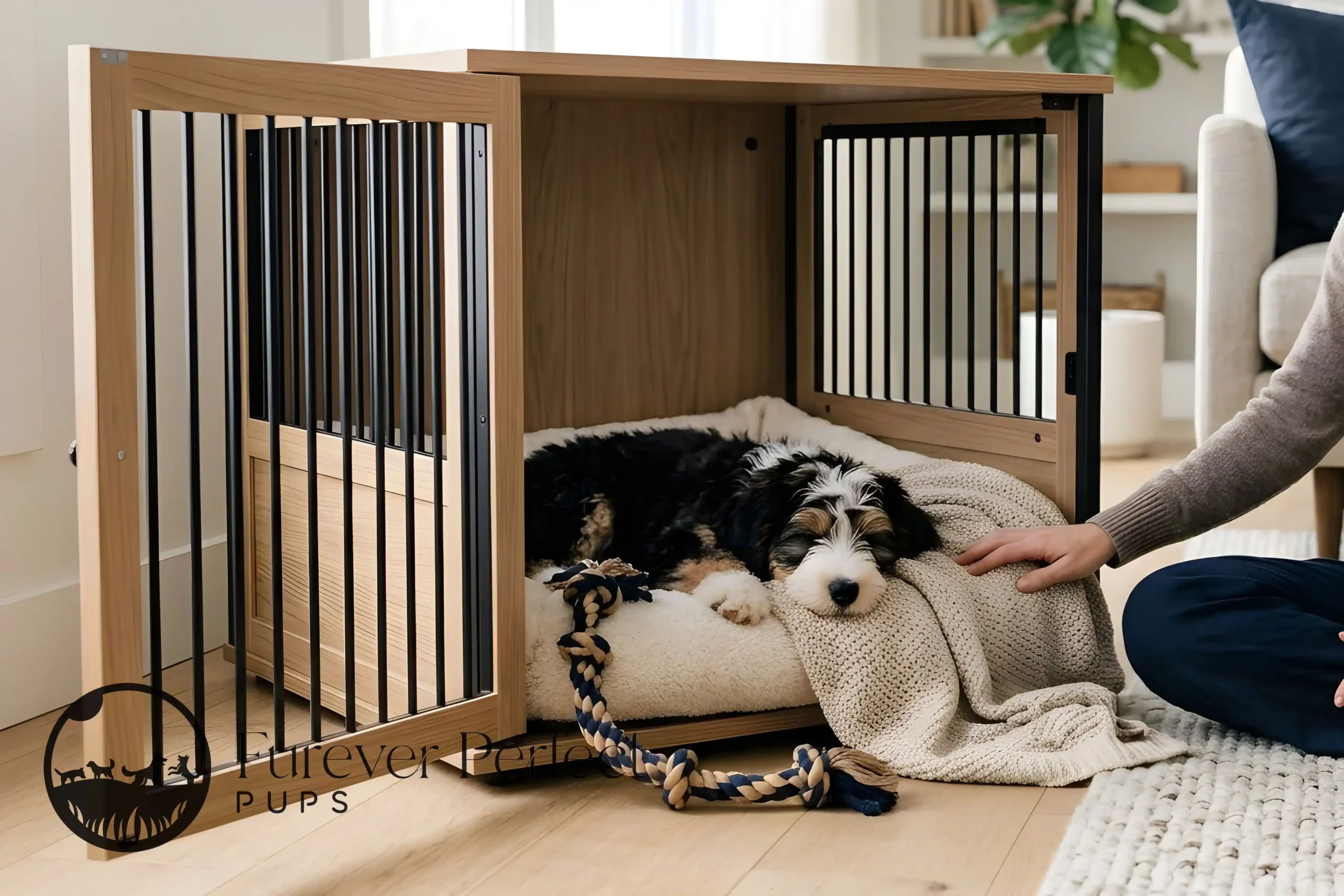
Crate Training a Bernedoodle: A Gentle, Positive Approach
Crate training is one of the most valuable things you can do for a Bernedoodle in its first months of life, and it is also one of the most commonly done wrong. The errors tend to cluster at the same points: moving too fast, using the crate as punishment, leaving the puppy confined beyond its hold time, and misreading normal first-night protest as evidence that crate training is not working. Each of those mistakes is understandable and each one makes the process take longer and be harder on both the dog and the owner than it needs to be.
The approach that produces a Bernedoodle that genuinely rests comfortably in its crate, enters it voluntarily, and uses it as a settling space throughout its life is not complicated. It requires patience, it requires consistency, and it requires understanding what the crate is for and what it is not. The ASPCA describes crates as best used as a relatively short-term management tool rather than a lifetime pattern of housing. That framing matters: the goal of crate training is not to create a dog that lives in a box. It is to give the dog a safe, comfortable den space that supports house training in the early months, provides a predictable home base during the adjustment period, and functions as a settling tool and travel companion throughout the dog’s life.
For Bernedoodles specifically, the Bernese Mountain Dog’s emotional sensitivity makes the positive, gradual approach not simply preferred but genuinely necessary. The Vieira de Castro et al. (2020) study published in PMC documented that dogs trained with aversive methods showed more stress behaviors, both during and outside training sessions, and displayed a pessimistic cognitive bias compared to reward-trained dogs. The AVSAB’s 2021 position statement on humane dog training is unambiguous: based on current scientific evidence, the AVSAB recommends that only reward-based training methods are used for all dog training. A Bernedoodle rushed into the crate, punished for protest, or confined against its will learns that the crate is associated with fear and powerlessness. That association, once formed in a sensitive breed, is difficult to undo. The gentle, positive approach in this guide is not a philosophical preference. It is the approach that works.
The crate serves different functions at different life stages, and understanding all of them helps owners commit to the training process even when the early nights are difficult.
In the puppy and early adult phase, the crate’s primary function is housetraining support. As the ASPCA’s housetraining guidance explains, dogs have a natural instinct to avoid eliminating where they sleep and eat. A correctly sized crate leverages this instinct: a puppy confined to a space just large enough to stand, turn around, and lie down will typically resist eliminating there, buying time for the owner to get the puppy outside before elimination happens. That mechanism breaks down if the crate is too large, which is why crate sizing is one of the most consequential setup decisions in the whole process.
The crate’s second function, which continues throughout the dog’s life, is providing a predictable, reliable den space. SpiritDog Training’s behavioral guidance summarizes this well: as den animals, dogs have an instinct to relax and feel safe when in small, cozy, private spaces like a crate. A Bernedoodle that has been positively crate trained from puppyhood has a portable home base that travels with it to hotel rooms, veterinary stays, and any unfamiliar environment. The crate the puppy learned to rest in at home is the crate it settles in during a road trip, a kennel visit, or a post-surgical recovery. That portability is a genuine practical asset that owners with uncrated dogs discover they are missing at the moments it matters most.
For the Bernedoodle specifically, crate training serves a third function that is easy to overlook: it builds the independent settling capacity that prevents separation anxiety from developing. A Bernedoodle raised to believe that human presence is always available and that being alone is never necessary is at significantly higher risk of developing the separation anxiety that, as the ASPCA documents, manifests in destructive behavior, persistent vocalization, and genuine distress when owners leave. A Bernedoodle that has practiced being quietly alone in its crate from the first week at home, in a way that has always been positive and always been followed by return and reward, develops the emotional baseline that makes solitude manageable rather than alarming.
Size: The Most Consequential Setup Decision
The crate must be just large enough for the puppy to stand up comfortably, turn around fully, and lie down stretched out. No larger. The ASPCA’s housetraining guidance and multiple veterinary sources are consistent on this point: excess space defeats the clean-den instinct entirely, because the puppy can use one end as a bathroom and sleep in the other without the discomfort that motivates holding. If you have purchased an adult-sized crate in anticipation of the dog’s eventual size, use a divider panel to reduce the usable space to the appropriate puppy dimensions and move it progressively as the dog grows. For Standard Bernedoodles that will eventually reach 70 to 90 pounds, this means starting with a very small interior and expanding it over months as house training progresses and hold time increases.
For size reference: a Mini Bernedoodle adult typically fits comfortably in a 36-inch crate. A Medium Bernedoodle typically needs a 42-inch crate at adult size. A Standard Bernedoodle typically needs a 48-inch crate as an adult. During puppyhood, all sizes should be started with the divider positioned to provide only the puppy-appropriate space regardless of the crate’s full dimensions.
Crate Type
Wire crates with removable divider panels are the most practical option for most Bernedoodle owners because they allow progressive size adjustment as the puppy grows, provide good ventilation, and allow the puppy to see the room around it without being exposed on all sides. Covering three sides with a blanket or crate cover creates the enclosed, den-like atmosphere that tends to produce faster settling while leaving the door side visible so the puppy does not feel isolated. Hard-sided plastic crates are a good option for travel and for dogs that prefer a more enclosed environment, but the fixed size means buying multiple crates as the puppy grows. Fabric or soft-sided crates are not appropriate for the early training phase when puppies may attempt to chew or push through the fabric in protest; they are appropriate for fully crate-trained adults who will not attempt to escape.
Placement
For the first weeks, place the crate in the bedroom where the owner sleeps. The AVSAB’s guidance on puppy settling and separation anxiety prevention supports this recommendation: a puppy that can hear its owner breathing through the night adjusts to the crate significantly faster than one isolated in a separate room from the start. This placement also means that any genuine overnight distress signals, as distinct from normal first-night protest, are within earshot and can be distinguished and responded to. As the puppy matures and crate comfort is established, the crate can be moved to the location that best fits the household’s routine.
Interior Setup
- A piece of worn clothing from the primary owner placed inside the crate from day one. For a people-oriented Bernedoodle, familiar human scent in the crate is a meaningful comfort signal that reduces first-night distress.
- Soft bedding appropriate to the puppy’s chewing level. Some puppies will shred soft bedding and risk ingesting it; if this is the case, a bare crate floor with a thin rubber mat is safer than bedding that produces an ingestion risk.
- A water attachment that clips to the crate door for longer confinement periods, particularly overnight. Do not leave a water bowl inside as it will spill and wet the bedding.
- A frozen Kong placed inside at the moment of crating rather than handed separately. The puppy entering the crate should associate the act of entering with the appearance of a rewarding food item.
The single most important principle in the introduction phase is this: never move to the next step until the puppy is demonstrating genuine comfort at the current one. The timeline that matters is the dog’s readiness, not a calendar. Some Bernedoodles progress through the full introduction in three or four days. Others with more anxious temperaments take two weeks. Both are normal. Rushing produces the forced tolerance that looks like success and breaks down under real-world conditions.
STEP 1 The Open Door Introduction
Place the crate in the room where the puppy spends the most time with the door open and secured so it cannot swing and startle the puppy. Put a few pieces of kibble just inside the entrance without asking the puppy to enter. Let the puppy investigate at its own pace, take the treats, leave, and return. Do not push or lure the puppy into the crate. Do not close the door. The only goal of this step is to establish that the crate is a safe, treat-producing object in the environment that the puppy approaches voluntarily. This step may take anywhere from one session to several days depending on the puppy’s confidence level.
STEP 2 Feeding Meals Near and Then Inside the Crate
Begin feeding the puppy’s meals just outside the crate entrance, then progressively move the bowl inside the crate entrance, then to the middle of the crate, then to the back wall. The puppy should be walking in on its own to reach the bowl. Do not close the door during this phase. Mealtimes are a high-value, reliable, daily positive experience, and associating the crate’s interior with meals builds the foundation of the positive association faster and more durably than treats alone.
STEP 3 Door Closed Briefly, Puppy Still Eating
Once the puppy is entering the crate fully and eating without hesitation, begin closing the door gently while the puppy is eating. Open it again before the puppy finishes the meal. The duration of closed-door time in this step is seconds. The puppy should not have finished eating and be waiting at the door before it opens. Gradually extend the closed-door duration across multiple sessions until the puppy finishes its meal and waits calmly for the door to open rather than pressing against it or vocalizing.
STEP 4 Short Closed-Door Periods with a Kong or Chew
Once the puppy is comfortable with the door closed during mealtimes, begin introducing short closed-door periods outside of meals using a frozen Kong or a long-duration chew. Place the Kong inside the crate, let the puppy enter voluntarily, close the door calmly, and remain in the room. Do not make ceremony of the door closing; calm and matter-of-fact is the tone that tells the puppy this is an ordinary event. Stay visible in the room for the first sessions. Begin with durations of two to three minutes and build in small increments based on the puppy’s response. A puppy that is focused on its Kong and showing no stress signals is ready to extend duration. A puppy that abandons the Kong and presses at the door needs more time at the current duration before extending.
STEP 5 Moving Out of the Puppy’s Sight
Once the puppy is comfortable for five to ten minutes with the door closed while you are visible, begin stepping out of the room briefly while the puppy is in the crate. Return before the Kong is finished. Build duration and distance from the crate gradually, always returning while the puppy is still settled rather than after protest has begun. A Canine Affinity’s certified separation anxiety trainer perspective is useful here: each session should give the puppy a successful experience of being alone without anxiety. The goal is never to test how long the puppy can hold out; it is to build a history of many successful calm alone periods that accumulates into genuine comfort.
Building duration in crate training is a gradual process governed by two intersecting factors: the dog’s psychological readiness at each duration level, and its physical hold time capacity. The second factor sets a hard ceiling that cannot be trained around. A puppy being asked to hold its bladder beyond its physical capacity will fail through no fault of its training, and a forced elimination in the crate damages the clean-den instinct that makes crate training work.
The one-hour-per-month-of-age guideline from veterinary sources applies as the maximum crate duration for puppies during the day. An eight-week-old puppy’s maximum daytime crate duration is approximately two hours. A four-month-old, four hours. A six-month-old, six hours. These are maximums, not targets, and the actual duration any individual puppy can comfortably manage may be shorter depending on activity level before crating and individual variation.
| Age | Maximum Daytime Crate Duration | Recommended Practical Approach |
|---|---|---|
| 8 to 10 weeks | 1 to 2 hours maximum | Short sessions after exercise and meals; crate primarily for naps and overnight |
| 10 to 12 weeks | 2 to 3 hours maximum | Nap-length crate sessions; still too young for extended daytime confinement |
| 3 to 4 months | 3 to 4 hours maximum | Morning and afternoon crate sessions appropriate; midday break required if owner at work |
| 4 to 6 months | 4 to 5 hours maximum | Approaching adult hold times; most puppies can manage a half-day crate period with a midday break |
| 6 months and older | 4 to 6 hours maximum; up to 8 hours for fully house-trained adults | Adult Bernedoodles can manage a full workday crate period with adequate morning exercise and a midday potty break |
The progression toward longer daytime crate durations should mirror the dog’s demonstrated behavioral comfort. A puppy that reliably settles within two or three minutes of crating, stays calm for the duration, and exits calmly without frantic rushing is demonstrating that it is comfortable at the current duration and psychologically ready to extend it. A puppy that vocalizes persistently throughout the session, attempts escape, or exits the crate in a frantic, over-aroused state is telling you the current duration exceeds its comfort level and needs to be reduced before extending further.
Overnight crating is typically the phase that produces the most owner anxiety and the most consequential mistakes. The combination of a distressed-sounding puppy, an exhausted owner, and a lot of conflicting advice creates the conditions for the two most common errors: removing the puppy from the crate in response to crying, and abandoning crate training entirely after a difficult first or second night.
What Normal Nighttime Protest Sounds Like
Most Bernedoodle puppies will vocalize on the first one to three nights in the crate. This is normal, expected, and not an indicator that crate training is failing or causing harm. The puppy has gone from a familiar environment with littermates to a new space in a new home, and some vocal expression of that adjustment is appropriate. The ASPCA’s guidance on canine distress distinguishes between protest behavior — which is intermittent, varies in pitch, and tends to diminish gradually as the puppy self-soothes — and genuine distress, which is sustained, escalating, and accompanied by physical stress signs including frantic movement and self-injury attempts. Normal first-night protest should be allowed to resolve without the owner intervening, because intervention at that moment teaches the puppy that vocalization ends confinement.
The most consequential mistake of crate training, across all breeds and all contexts, is removing the puppy from the crate while it is actively vocalizing. A puppy removed from the crate in response to crying has learned that crying exits the crate. That lesson will be applied on every subsequent night with increasing persistence, because intermittent reinforcement — where the crying sometimes produces the desired result — is among the most powerful behavior-entrenchment mechanisms available. If any intervention is needed, wait for a pause in vocalization, however brief, before opening the crate. Even a ten-second pause is enough to interact with and then re-crate, which teaches a fundamentally different lesson: that quiet, not noise, produces attention.
Overnight Potty Trips
Set an alarm rather than waiting for the puppy to wake you for the overnight potty trip. An eight-week-old Bernedoodle’s maximum overnight hold time is approximately two to three hours. A puppy that has been held past its capacity begins eliminating in the crate not because crate training is failing but because it had no other option. The overnight potty trip should be brief, boring, and immediate: carry the puppy to the outdoor spot, wait for elimination, mark it calmly, return the puppy to the crate with a small treat, and return to bed. No lights, no play, no extended interaction. The entire trip should be under five minutes. A puppy that learns that nighttime departures from the crate are brief and uneventful returns to sleep faster than one that has learned that nighttime is an opportunity for extended human attention.
The Bernedoodle-Specific Sensitivity Consideration
The Bernese Mountain Dog’s emotional sensitivity means that Bernedoodle puppies may be more intensely affected by the separation experience of the first nights than breeds with more independent temperaments. This is not a reason to abandon the crate or to rush in at every sound. It is a reason to have invested in the positive association building before night one, to have the frozen Kong and the worn clothing and the white noise machine in place from the first evening, and to approach the first nights with calm consistency rather than anxious hovering. The puppy is reading your emotional state. An owner who is anxious and conflicted about the crate conveys that anxiety to the dog, which amplifies the dog’s distress. An owner who is calm and matter-of-fact about the process communicates that the crate is ordinary, expected, and safe.
The Puppy Refuses to Enter the Crate at All
This most commonly reflects that the introduction moved too fast. The puppy that was eating meals inside the crate with the door open yesterday is not necessarily comfortable having the door closed tomorrow. Go back to Step 1 — the open door with treats placed just inside the entrance — and rebuild without any pressure to enter or any door closing for several sessions. A puppy that approaches the crate opening voluntarily, takes treats from inside the entrance, and moves away without anxiety is showing you the baseline confidence from which the next steps can be built, slowly.
The Puppy Seemed Fine and Then Stopped Being Fine
This pattern, typically appearing between six and fourteen months, reflects the adolescent phase and the second fear period discussed in our socialization guide. A dog that was crate-comfortable at four months and begins resisting or protesting the crate at ten months is not regressing due to a crate failure. It is going through neurological changes that affect its response to confinement and separation temporarily. Reduce duration, reinforce positive associations actively with high-value treats and Kongs, and maintain the crate routine through the phase rather than abandoning it. This is typically a temporary regression that resolves with consistent, positive handling.
The Puppy Eliminates in the Crate Consistently
Three specific causes account for most of this problem. The first is a crate that is too large, allowing the puppy to sleep at one end and use the other as a bathroom. Reduce the crate space with a divider. The second is confinement duration exceeding the puppy’s physical hold time. Reduce the duration and add more frequent trips outside. The third, less common but real, is a medical issue. A puppy with a urinary tract infection, bladder abnormality, or other physical condition may be unable to hold reliably regardless of management. If the first two adjustments do not resolve the problem, mention it to your veterinarian before continuing.
The Adult Bernedoodle That Was Never Crate Trained
Adult crate introduction follows exactly the same sequence as puppy introduction but typically progresses even more slowly because the adult has a longer history of freedom to contrast the crate against. The AVSAB’s reward-based training principles apply without exception: no forcing, no punishment, no luring the dog in and closing the door before it is comfortable. Many adult Bernedoodles who were never crate trained as puppies can be successfully introduced to the crate at any age if the process is gradual enough and the associations built are reliably positive. Expect the process to take weeks rather than days, and measure progress in small increments of voluntary approach behavior rather than in achieved duration.
Bernedoodle owner, Denver, CO
Crate Training at a Glance
| Phase | What It Involves | Success Marker | Common Mistake |
|---|---|---|---|
| Open door introduction | Treats near and just inside the crate; puppy investigates voluntarily; no door closing | Puppy approaches and enters the crate voluntarily to get treats without hesitation | Pushing the puppy inside or closing the door before voluntary entry is established |
| Meal feeding inside crate | Bowl moved progressively from entrance to back wall across multiple meals | Puppy walks fully into the crate without hesitation to reach its meal | Closing the door during meals before the puppy is eating comfortably at the back |
| Door closed briefly | Door closed for seconds during mealtimes; opened before puppy finishes | Puppy finishes meal and waits calmly rather than pressing at the door | Extending to minutes before the puppy has demonstrated calm seconds |
| Kong sessions with door closed | Short closed-door periods with a frozen Kong; owner visible in room | Puppy focuses on Kong without pressing at door or vocalizing; settles when finished | Leaving the room before the puppy is comfortable with the door closed while owner is visible |
| Owner out of sight | Owner steps out of room briefly during crate sessions; returns before protest starts | Puppy remains settled in the crate after owner leaves the room | Extending absence before returning before protest starts |
| Building duration | Gradual increase in crate duration within hold-time limits; pre-crate exercise becomes routine | Puppy settles within two to three minutes and remains calm for the crate duration | Exceeding hold-time capacity; skipping pre-crate exercise |
| Overnight crate | Crate in bedroom; frozen Kong; alarm set for overnight potty trip; normal protest allowed to resolve | Puppy sleeps through most of the night by nights three to five; overnight potty trip is brief and calm | Removing puppy from crate while it is actively vocalizing |
Frequently Asked Questions
Is crate training cruel?
A crate introduced through forced confinement, used as punishment, or maintained beyond the dog’s hold time is cruel and will produce the fear and distress that critics of crate training correctly identify. A crate introduced gradually through positive association, sized correctly, and used within appropriate duration limits is not cruel and is strongly supported by veterinary behavioral guidance. The AVSAB’s position on reward-based training is applicable here: the issue is not the tool but the method. A crate trained through the process in this guide becomes something most Bernedoodles genuinely choose to rest in voluntarily, which is incompatible with the cruelty framing. What is genuinely unkind is rushing the process, using the crate punitively, or confining a puppy beyond its hold time. Those are the practices that produce the negative associations critics of crate training are responding to, and they are also the practices this guide specifically addresses how to avoid.
How long will crate training take for a Bernedoodle?
The range is genuinely wide, from a week to several months depending on the individual puppy’s temperament, the consistency of the introduction process, and whether any setbacks occurred that required returning to earlier steps. A Bernedoodle puppy that arrives having already had positive crate exposure in its breeder’s program, and whose owner follows a gradual positive introduction consistently from day one, typically reaches genuine crate comfort — meaning voluntary entry, calm settling, and no protest at the current duration — within two to four weeks. A puppy with a more anxious baseline or one whose introduction was rushed and required resetting may take considerably longer. The more useful question is not how long but what the dog’s current comfort level looks like at each step, because that is the only indicator that determines when it is appropriate to progress.
My puppy cries for a long time at night. How long should I let it go?
The distinction between protest that should be allowed to resolve and genuine distress that warrants intervention is important and worth applying carefully. Normal protest barking is intermittent, varies in pitch and intensity, and tends to diminish over five to fifteen minutes as the puppy settles. Genuine distress is sustained, escalating, and accompanied by physical signs including frantic movement within the crate, attempts to force through the door, or self-injury. If you observe the latter, a calm, brief check-in without removing the puppy from the crate is appropriate. If protest is severe enough on the first nights that you cannot distinguish normal from genuine distress, video monitoring from outside the room gives you the information you need without your presence functioning as a reward for vocalizing. If protest is still significant after five to seven nights with consistent handling, consider whether the positive association building was completed fully before overnight crating began, and whether returning to more daytime crate sessions before resuming overnight use would help.
Can I crate train a Bernedoodle that is already one or two years old?
Yes. The process is identical to puppy crate training and may take longer because an adult dog has a longer history of freedom to contrast with confinement. The AVSAB’s reward-based training principles apply at any age: no forcing, no punishment, gradual introduction at the pace the dog’s behavior indicates it is comfortable with. Many adult Bernedoodles introduced to crates through genuine positive association training become comfortable with them. The cases that do not respond are typically those where insufficient time is invested in the introduction phase, where the crate was used punitively at some point, or where the dog has a true confinement anxiety that requires professional behavioral support rather than straightforward crate training. If an adult Bernedoodle is showing extreme distress responses, rather than the reluctance of an untrained dog, a certified professional dog trainer or veterinary behaviorist should be involved before proceeding.
When does the crate become unnecessary?
The crate as a management tool for housetraining typically becomes unnecessary somewhere between six months and a year as reliable house training is established and the dog demonstrates consistent ability to be trusted alone in the home. The ASPCA describes the crate as best used as a relatively short-term management tool rather than a lifetime housing solution, and that framing is apt. What often happens with well-crate-trained Bernedoodles is that they continue choosing to use the crate as a resting space long after the door is no longer closed, because the positive association built during training has made it the dog’s preferred settling spot in the home. Leaving the crate available with the door open is a reasonable long-term setup for most dogs. Keeping it as a travel tool and emergency confinement option throughout the dog’s life is a practical use that any dog with a solid crate training foundation can accommodate without distress.
What crate foundation do your puppies have before they come home?
Every puppy in our program is introduced to brief, positive crate exposure as part of our pre-training work before they leave our care. Puppies are fed portions of their meals inside the crate with the door open, and they experience short closed-door periods paired with food rewards as part of their pre-placement preparation. By the time a puppy arrives at its new home, the crate is not an entirely novel object associated with the stress of placement day; it is a familiar structure with positive associations already in place that families can build on rather than starting from zero. Our Early Neurological Stimulation protocol from the first days of life builds the physiological and neurological resilience that makes novel experiences, including confinement, less destabilizing. We provide families with specific guidance on continuing the crate introduction at the pace that matches their individual puppy’s comfort level, and we remain available post-placement for troubleshooting as questions arise during the training process.
Final Thoughts
A Bernedoodle that has been gently and positively crate trained has something genuinely valuable: a portable, familiar home base that it carries with it everywhere, and the emotional foundation of having learned that temporary separation from its people is safe, predictable, and always followed by return. That foundation does not come from a few nights of letting the dog cry it out or from forcing it into a crate every time it misbehaves. It comes from the patient, sequential process in this guide, applied consistently from the beginning at the pace the dog’s behavior actually indicates rather than the pace that feels satisfying to the owner’s timeline.
The Vieira de Castro et al. (2020) PMC research on training methods is unambiguous: reward-based training produces better learning outcomes, stronger human-animal bonds, and less long-term behavioral stress than aversive methods, and the AVSAB has built its 2021 position statement on that evidence. The gentle approach to crate training is not just kinder. It is more effective, more durable, and better for the relationship between you and your dog than any shortcut approach produces. A Bernedoodle trained with patience and positive reinforcement into genuine crate comfort will use that crate willingly on the hundredth night just as it did on the third, because the association was built correctly from the start. That is the outcome this guide is designed to help you reach.