

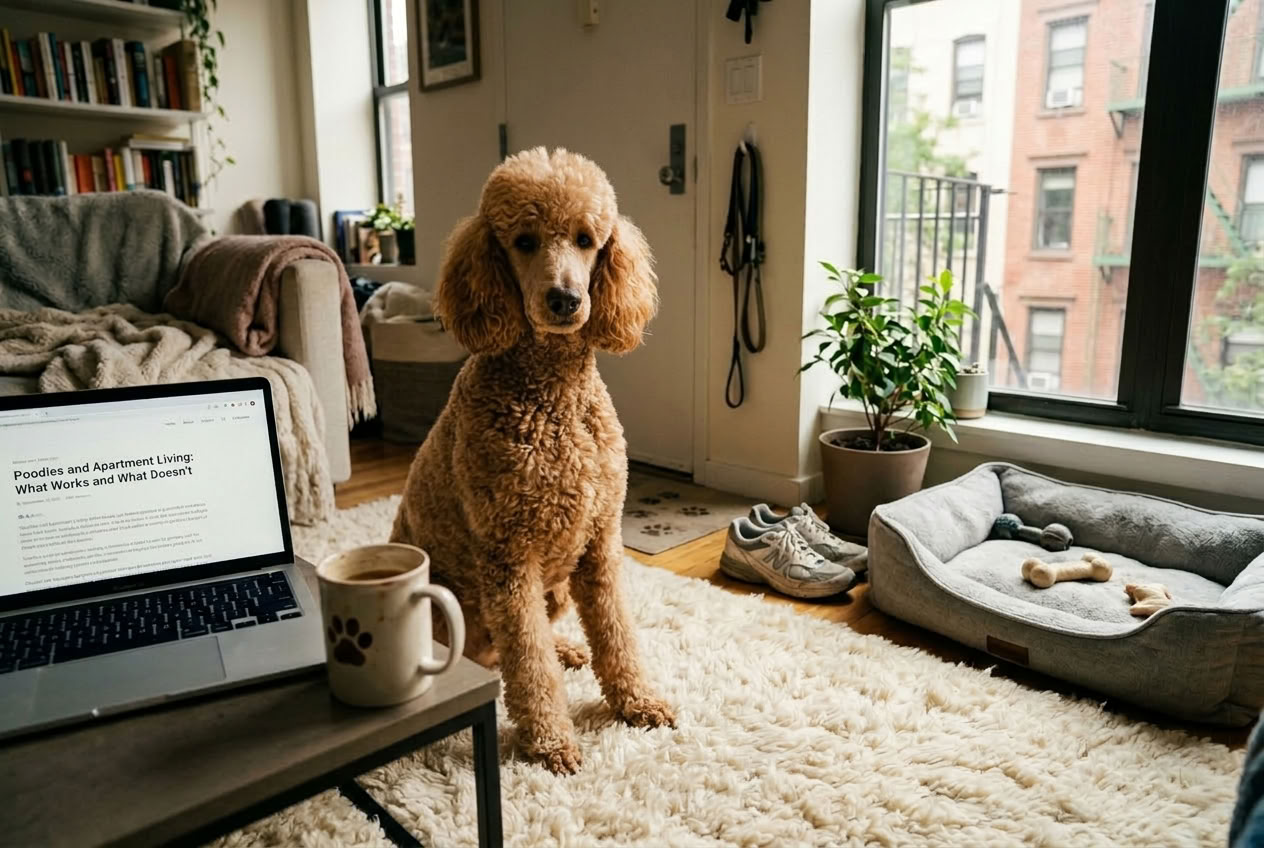
Poodles and Apartment Living: What Works and What Doesn’t
Walk into almost any apartment building in a major city and you will find Poodles thriving there. Walk into a different building and you will find a Poodle destroying baseboards, keeping the neighbors awake, and leaving its owner wondering what went wrong. Both situations exist. The breed does not determine which one you end up with. Your preparation, your daily routine, and your honest understanding of what apartment life requires of this particular breed does.
The claim that Poodles are good apartment dogs is true, but it is incomplete in a way that misleads people. What is more accurate is that Poodles can be excellent apartment dogs under specific conditions. Those conditions are well within the reach of most owners, but they require deliberate setup rather than wishful thinking. Understanding what those conditions actually are is the difference between a Poodle that enriches apartment life and one that makes it miserable for everyone on the floor.
This guide goes through the specific factors that determine whether apartment life works for a Poodle: the genuine advantages the breed brings to smaller-space living, the real challenges that most resources underplay, the size differences that matter, the noise and separation anxiety picture supported by current behavioral research, and the practical daily management that determines outcomes. The goal is to give you an honest picture so that you can make the decision and the daily choices it requires well.
The case for Poodles as apartment dogs is grounded in actual breed characteristics, not marketing. These advantages are not universal to all dogs and they matter concretely in an apartment context. They exist alongside real challenges addressed in the sections that follow, but they are the legitimate starting point for understanding why so many Poodle owners live successfully in apartments.
The Coat Does Not Shed
For apartment dwellers, a non-shedding coat is more than an allergen consideration. Shared hallways, elevator carpets, and hard-to-clean apartment surfaces that collect pet hair are real logistical concerns in a rental context. Security deposits held for pet-related cleaning, neighbor relations in shared laundry facilities, and general cleanliness in a smaller living footprint are all meaningfully affected by how much hair a dog puts into the environment. The Poodle Club of America and the AKC both describe the Poodle coat as single-layer and low-shedding, and this is consistently one of the most practically useful aspects of the breed for apartment owners. The coat does require brushing and professional grooming on a regular schedule, but what goes into the apartment largely stays on the dog rather than distributing itself across every surface.
The low-allergen quality of the Poodle coat is a related point worth addressing honestly. No dog is truly hypoallergenic. The American College of Allergy, Asthma, and Immunology is clear that all dogs produce dander regardless of coat type, and dander is the primary allergen trigger. What is accurate is that low-shedding dogs distribute dander into the environment at a lower rate than heavy shedders, which can make a meaningful practical difference for allergy-sensitive residents or neighbors. This is not a guarantee that anyone with dog allergies can tolerate a Poodle; it is a realistic reason why allergy-sensitive apartment living with a Poodle tends to go better than it would with a Labrador Retriever.
Intelligence Means the Dog Can Be Taught Apartment Manners
The Poodle has ranked second in working and obedience intelligence in Stanley Coren’s widely referenced research on dog intelligence, behind only the Border Collie. In the context of apartment living, this matters practically. A Poodle can learn a quiet command, learn to remain calm when the elevator dings, learn that people in the hallway do not require a vocal response, and learn to settle independently in a designated space while its owner is away. These are trainable behaviors in most dogs, but they are trainable faster and with greater reliability in a Poodle than in most breeds because the cognitive capacity to make those learned connections quickly is genuinely present.
The AKC breed standard describes the Poodle as “very active, intelligent” with shyness or sharpness listed as major faults, meaning the breed should be neither fearfully reactive nor sharply aggressive. A well-bred, well-socialized Poodle raised with appropriate early experiences is oriented toward engagement with people rather than defensiveness. That is a significant advantage in the social complexity of apartment living, where dogs regularly encounter neighbors, maintenance workers, children, and other pets in close proximity.
Relatively Inactive Indoors When Needs Are Met
This point is regularly overlooked in apartment dog discussions but it is practically important. When exercise needs are being met outside, Poodles, particularly Standard Poodles, tend to be relatively calm and settled indoors. Breed resources and breeder-community observation consistently note that a well-exercised Standard Poodle will rest comfortably indoors in a way that contradicts the assumption that large, athletic dogs require constant space to move. The operative phrase is “when exercise needs are being met outside.” The indoor calm is conditional on the outdoor activity happening. A Poodle that has not had adequate exercise or mental engagement is not a calm indoor dog. It is a restless, destructive, or noisy one. But a Poodle that has been adequately exercised and mentally engaged on a daily basis can be one of the more content apartment residents in the canine world.
People-Oriented Temperament Works in Favor of Shared Living
Poodles were bred for close partnership with humans, and they retain that orientation as a fundamental characteristic. This people-orientation is often cited as a reason Poodles can develop separation anxiety, which is addressed in detail later in this guide, but it is also a genuine advantage in apartment living. A Poodle closely bonded to its owner and oriented toward human direction is easier to manage socially than a breed with strong independent territorial instincts. Poodles can learn to be comfortable with the relatively high density of human activity that apartment buildings involve, including neighbors in hallways, voices through walls, and shared outdoor spaces with other dogs, in part because their baseline orientation is toward people rather than guarding against them.
✓ Genuine Apartment Advantages
- Non-shedding coat reduces hair in shared spaces
- High trainability enables apartment-specific manners
- Settles quietly indoors when adequately exercised
- People-oriented temperament suits social density
- No strong territorial guarding instinct
- All three sizes available, right-sized for any space
✗ Real Apartment Challenges
- Alert barking triggered by hallway and building noise
- Higher separation anxiety risk, research-documented in apartment dogs
- Mental understimulation causes behavioral problems
- Exercise needs do not disappear because the space is small
- Grooming logistics in a smaller living space
- Standard Poodles require real planning to exercise adequately
Barking is the single most common source of apartment-related problems for Poodle owners, and it deserves more than a brief mention. The behavioral dynamics involved are specific and well-documented, and understanding them is the practical prerequisite to doing anything useful about the problem.
Why Apartments Create Specific Barking Challenges for Poodles
Apartment environments expose dogs to a continuous, unpredictable stream of acoustic triggers: footsteps in hallways, elevator bells, doors opening and closing on other floors, voices through thin walls, dogs barking from adjacent units, delivery personnel, and the generally compressed acoustic environment of a building full of people living in close vertical proximity. For a breed with the Poodle’s alertness and working history, a dog selected over centuries to notice, process, and respond to its environment, this is a high-stimulus setting.
Research published in Frontiers in Veterinary Science found that sudden, unpredictable, high-frequency sounds produce the strongest anxious and reactive responses in companion dogs. The study specifically noted that sounds a dog cannot control its exposure to produce the most significant behavioral reactions. Apartment living, where a dog hears building sounds through walls and floors without corresponding visual information or any ability to investigate, creates exactly that combination: frequent, unpredictable sounds with no way to resolve the ambiguity they create. A Poodle hearing footsteps outside the door cannot see who is in the hallway, cannot determine whether they represent a concern, and responds with the alert bark that evolution and working history have made its default response to that uncertainty.
A 2020 study published in the Journal of Veterinary Behavior specifically examined noise reactivity in Standard Poodles alongside Irish Soft-Coated Wheaten Terriers. The research documented noise reactivity as a meaningful consideration in the breed, contributing to a body of literature suggesting that individual variation in noise sensitivity exists within the breed and can be influenced by both genetics and early experience.
Three Types of Poodle Barking in Apartments: Why the Distinction Matters
The ASPCA and AVSAB behavioral literature both emphasize that different types of barking have different causes and require different responses. Treating all barking as the same problem leads to interventions that work for one cause and actively make another worse. In an apartment context, three types are most relevant.
Alert barking is the most common in apartment settings. The dog hears or sees something potentially significant and vocalizes to notify its people and announce its awareness. This is functional behavior. It is the Poodle doing what working breeds were developed to do. It is not inherently anxiety-driven, and it responds well to training that teaches the dog its report has been received and that further vocalization is not needed. A calm acknowledgment of the alert followed by consistent non-reinforcement of continued barking is the appropriate training approach. The AVSAB emphasizes reward-based behavioral management as the evidence-based standard; confrontational responses to alert barking typically increase arousal rather than reduce it.
Boredom and frustration barking occurs in a dog that has not had adequate mental or physical stimulation. Research documented in a PMC review of canine separation-related behavior notes that boredom-driven destruction and vocalization in dogs left alone often looks like separation anxiety but is actually stimulus deprivation. A dog bored enough in an apartment may bark at everything, pace, and create noise even when its owner is present, because the underlying need is not for the owner’s presence but for engagement. The fix is not primarily training; it is increasing the quality and quantity of mental and physical activity.
Separation-related barking is a distinct category covered in the next section and requires the most structured behavioral approach of the three. The ASPCA notes that separation-related barking begins within minutes of the owner’s departure and is persistent rather than episodic. This differentiates it from alert barking, which responds to specific triggers, and boredom barking, which is more variable. The AVSAB’s position statement is explicit that punishment-based approaches to anxiety-driven barking, including shock, vibration, and citronella anti-bark collars, do not address the underlying anxiety and can worsen the dog’s distress. The only durable solution to anxiety-driven vocalization is resolving the anxiety itself through systematic behavioral treatment.
Consistent Training Is the Non-Negotiable Piece
Reducing barking in an apartment Poodle requires consistent training applied over weeks, not a single correction applied once. The high trainability that makes Poodles so capable also means that inconsistent responses to barking teach the dog that barking sometimes works. Intermittent reinforcement is, as behavioral science has consistently documented, one of the most powerful ways to entrench a behavior. If barking sometimes gets attention, sometimes gets a correction, and sometimes gets ignored, the dog has no consistent feedback from which to learn. Consistent, non-dramatic acknowledgment of alert barking followed by equally consistent non-reinforcement of continued barking is the training structure that produces durable results over time.
The absence of a private yard does not prevent adequate Poodle exercise. It changes the logistics of providing it and requires more active owner involvement than yard-based exercise management allows. For many apartment owners, this is a straightforward trade-off. For others, it is the piece they did not fully account for before getting the dog, and it is worth being clear-eyed about before rather than after.
The critical principle is this: a Poodle’s exercise needs are determined by its age, size, and health, not by the size of the apartment. The indoor space is largely irrelevant as a form of exercise provision. A Toy Poodle living in a 400-square-foot studio and a Toy Poodle living in a 4,000-square-foot house have the same exercise requirements. The studio apartment owner simply has to source all of it from outside the home rather than supplementing it with yard time.
What Outside Exercise Actually Needs to Look Like
For Toy and Miniature Poodles, two daily walks of 20 to 30 minutes each at a brisk pace appropriate to the dog’s size and energy level meet the basic physical exercise requirement for a healthy adult. These walks are more valuable when they include genuine sniff opportunities. Free sniffing engages the Poodle brain in a way that a straight-line heel walk does not, and the mental engagement of an interesting walk produces more settling behavior at home than a longer walk where the dog was kept tightly at heel throughout. For Miniature Poodles in particular, incorporating regular off-leash play sessions in a fenced dog park provides the free-running component that apartment life cannot offer inside.
For Standard Poodles, the logistics require more planning. An adult Standard Poodle needs 60 to 90 minutes of combined physical activity per day across at least two sessions. This is achievable from an apartment, but it is not casual. It means two substantial outings per day regardless of weather, schedule pressures, or personal energy levels. Owners who honestly assess their daily routines and conclude that two real exercise sessions per day will happen consistently are good candidates for a Standard Poodle in an apartment. Owners who suspect they will fall back on a quick trip around the block on busy days should honestly weigh whether a Standard Poodle is the right size for their living situation.
Dogwalkers and Daycare as Apartment Management Tools
Many successful Poodle owners in apartments treat professional dogwalking as a fixed line item in their budget rather than an optional luxury. A midday walk from a reliable dogwalker addresses both the physical and social exercise needs of an apartment Poodle during the workday, breaks up the duration of time the dog is alone, and provides the mental engagement of a new person and a different walking route. For full-time working apartment owners, a dogwalker is frequently the difference between a behaviorally stable Poodle and a dog that develops chronic anxiety or destructive patterns from spending eight or nine consecutive hours alone in a small space.
Doggy daycare, used a few days per week, addresses a different piece of the puzzle: social stimulation and physical activity in a setting where the dog is not alone. Not all Poodles take to daycare equally well. The breed’s people-orientation means some prefer human company to other-dog company. But for Poodles that enjoy it, daycare on working days can be a genuinely valuable management tool that reduces the stress of the apartment environment for both dog and owner.
Separation anxiety is where the Poodle’s greatest apartment strength, its deep bond with people, intersects with its most significant apartment risk. The breed’s person-orientation that makes it such an engaged, responsive companion is the same trait that can make time alone genuinely distressing for dogs that have not been prepared for independence. In an apartment setting, the consequences of separation anxiety are not private. They are heard by neighbors through thin walls, reported to building management, and can result in lease violations.
What the Research Actually Says About Apartments and Separation Anxiety
A review of canine separation-related behavior published in Veterinary Clinics of North America identified several risk factors for separation anxiety, with apartment dwelling appearing as a documented risk factor in the research literature. The PMC review of canine separation anxiety strategies notes that evidence of high rates of separation-related problems among apartment-dwelling dogs has been documented, with the incidence of separation-related problems in apartment dogs being higher than their incidence of aggression. The review also identifies several known protective factors against separation anxiety development: stable household routines, consistent and predictable owner absences during the 5 to 10 month developmental window, and a wide range of early experiences outside the home. These protective factors are particularly relevant for Poodle owners because they are actionable. They are things you can deliberately provide during puppyhood that meaningfully reduce the risk of separation anxiety developing.
The ASPCA documents that separation anxiety typically manifests within minutes of the owner’s departure. The AVSAB’s clinical documentation notes that dogs with true separation anxiety show signs of distress, including panting, pacing, salivating, destruction near exit points, and vocalization, that begin within the first 15 to 20 minutes of being left alone. For an apartment dog, the vocalization component is the part most likely to create immediate consequences with neighbors and building management.
Prevention During Puppyhood: The Window That Matters Most
The most effective time to address separation anxiety risk is before it develops. Research consistently identifies the 5 to 10 month developmental window as the period when appropriate exposure to independent time, meaning predictable, positive, brief absences that gradually build to longer ones, most reliably builds the capacity for comfortable solitude. A Poodle puppy that learns from its first weeks in a new home that the owner’s departure is predictable, temporary, and consistently followed by return, and that alone time is associated with enjoyable things like frozen Kongs and puzzle feeders, develops the emotional baseline that makes apartment life genuinely workable. A puppy that is never left alone during this developmental window, and then suddenly left alone for eight hours when the owner returns to work, is being set up for separation difficulties that require significant work to address.
The ASPCA recommends that alone-time training begin with very short departures. Going to another room, or leaving through the front door for 30 seconds and returning calmly, are the right starting points. Duration should build gradually in a way that never exceeds the dog’s current ability to remain calm. The key behavioral principle is that the dog should never be left to practice the full anxiety response during training; absences should be kept short enough that the dog stays settled, and duration built from there. For a puppy in an apartment, this means structured alone-time practice from the first week home, not waiting until the separation is forced by circumstances.
Miniature Poodle owner, Chicago, IL
What to Do If Separation Anxiety Is Already a Problem
If your Poodle is already showing separation anxiety signs in an apartment context, including consistent early-departure vocalization, destruction near the door, house soiling despite being house-trained, or neighbor complaints, the path forward has three components. First, video your dog home alone for the first 30 to 60 minutes after you leave. The AVSAB recommends this as the essential diagnostic step, because what you see on video may be different from what you assumed was happening. Some dogs that neighbors report barking are genuinely in distress; others are showing alert or boredom barking that requires a different approach. Knowing which you are dealing with determines what treatment actually makes sense.
Second, if the video shows genuine distress behaviors rather than episodic barking at triggers, bring this to your veterinarian or a veterinary behaviorist. Systematic desensitization and counterconditioning, combined with appropriate pharmaceutical support in moderate to severe cases, is the evidence-based treatment documented in veterinary behavioral literature. This takes weeks to months; there is no short version. Third, manage the practical apartment relationship during treatment: communicate openly with neighbors, consider dogwalkers or daycare to reduce alone time while treatment is underway, and where possible manage the total duration of absences to avoid the dog repeatedly practicing the full anxiety response.
Apartment suitability varies meaningfully across the three Poodle varieties, and the distinctions are worth being direct about rather than applying a single “adaptable breed” label to all three sizes.
Toy Poodle: The Most Naturally Apartment-Compatible
The Toy Poodle is physically the most straightforward apartment dog of the three. At under 10 inches and typically 4 to 6 pounds, the Toy requires less physical space for comfortable living, has proportionally lower caloric and exercise needs, and produces the smallest environmental footprint in a shared building. Two daily walks of 20 to 25 minutes each, supplemented with indoor play and regular training sessions, adequately meet the physical exercise needs of a healthy adult Toy Poodle.
Where owners consistently underestimate the Toy Poodle is in assuming that small size means low mental stimulation requirements. The Toy Poodle carries the full Poodle intelligence, sensitivity, and working orientation in a very compact package. A Toy Poodle that is carried everywhere, never given structured mental engagement, and treated as a decorative accessory rather than a working-brained companion will develop behavioral problems. Anxiety, excessive barking, and reactive behavior are the direct result of that intelligence going unmet. The mental exercise requirement is as high relative to body size as it is in any Poodle variety. Small body, same brain.
The Toy Poodle’s sensitivity also means it can be more reactive to the acoustic environment of an apartment than the calmer Standard Poodle. Some Toy and Miniature Poodles respond to building noises with more persistent alerting than their larger relatives, and managing that effectively requires the environmental and training interventions described in the noise section above.
Miniature Poodle: The Sweet Spot for Most Apartment Owners
In our experience, the Miniature Poodle is where the apartment compatibility equation most reliably balances. Miniatures are large enough to satisfy the owner’s desire for a substantive dog presence without being so large that their exercise needs become logistically demanding from an apartment base. Forty-five to sixty minutes of combined daily physical activity, two walks with off-leash park time incorporated regularly, is manageable for most owners who have honestly assessed their schedule. The Miniature’s energy tends to be more consistently channeled than the Toy’s sometimes-reactive quality, and its size makes it straightforwardly manageable in elevators, common areas, and public transit where apartment dogs regularly travel.
The Miniature Poodle’s need for mental engagement is fully present and not to be discounted, but its capacity for focused mental work through training and enrichment is arguably the highest of the three varieties in terms of sustained engagement with structured tasks. A Miniature Poodle with a rich training and enrichment routine is one of the most content apartment dogs you will encounter. One without that routine is one of the noisiest.
Standard Poodle: Achievable, but Requiring Genuine Commitment
Standard Poodles in apartments are not inherently a bad idea. They are a demanding one. Dog breed behavior resources consistently note that given enough exercise, Standard Poodles are relatively inactive indoors and can manage apartment life well. The operative phrase is “given enough exercise,” and for a Standard Poodle that is 60 to 90 minutes of combined physical activity per day, every day, across two sessions minimum.
The Standard Poodle’s working history is as a sustained-activity water retriever, a dog bred to work in cold lakes all day alongside human handlers. Its exercise requirement reflects that heritage, and it does not diminish simply because it lives on the 12th floor. Standard Poodle apartment owners who make this work typically do so through a combination of early morning and evening exercise, midday dogwalking or daycare, weekend outdoor adventures that provide more demanding activity, and a consistent indoor training and enrichment routine that fills the mental engagement requirement.
Standard Poodle apartment living also involves practical logistics worth thinking through in advance: elevator rides multiple times daily with a 50 to 70 pound dog, shared building spaces, and grooming appointments in a space where setting up a large grooming table requires some planning. None of these are reasons to rule it out. They are reasons to think it through before committing rather than after.
| Variety | Apartment Compatibility | Daily Exercise Required | Biggest Apartment Risk | Key Success Factor |
|---|---|---|---|---|
| Toy Poodle | High, naturally well-suited to smaller spaces | 30 to 45 min daily, 2 sessions | Under-stimulation leading to anxiety and barking | Rich mental enrichment routine; treat as a full dog, not a lap ornament |
| Miniature Poodle | High, the most consistently successful apartment variety in our experience | 45 to 60 min daily, 2 sessions | Separation anxiety if independence not built during puppyhood | Consistent daily routine, training program, and planned alone-time preparation |
| Standard Poodle | Moderate, achievable with real commitment rather than passive ownership | 60 to 90 min daily, 2 sessions minimum | Insufficient exercise producing indoor restlessness and behavioral problems | Honest daily exercise commitment; midday dogwalking or daycare strongly recommended |
This section is not a checklist with a pass/fail score. It is a set of questions designed to be answered honestly rather than aspirationally. The answers that matter are the ones about your actual daily life, not the version of your daily life you intend to have once you get the dog.
Questions to Ask Before Getting a Poodle for an Apartment
- What does my actual schedule look like on a typical workday? Not the ideal one. The one on a busy Tuesday when the commute ran long and the evening included an obligation. Can that day reliably include two meaningful exercise sessions, or is it honest to say that some days would mean only a quick trip around the block?
- What is my building’s actual pet policy? Not the general “pet-friendly” designation. The specific weight limits, breed restrictions, pet fee structure, and noise complaint policy. A building with a 30-pound weight cap rules out Standard Poodles. A building with a zero-tolerance noise complaint policy creates a higher management standard for alert barking than one with more flexibility.
- What happens to the dog on days I need to be away for 8 to 10 hours? Is there a plan for midday exercise and social contact, or does the dog spend the entire day alone? An adult Poodle can manage a reasonable workday alone if morning and evening exercise is substantial and the dog has been prepared for independence. But an entire day alone on a regular basis without midday intervention is a reliable path to the behavioral problems that make apartment dog ownership difficult for everyone involved.
- Am I able to consistently begin training and alone-time preparation from the first week the puppy comes home? Not starting it eventually. From day one. The early developmental window matters for separation anxiety prevention in a way that is difficult to replicate after the fact.
- What are my financial resources for the support systems that make apartment Poodle ownership work? Dogwalking, periodic daycare, professional grooming, training classes, and veterinary care including behavioral consultation if needed are not optional extras for a well-managed apartment Poodle. They are the infrastructure that makes it function. Being honest about budget before getting the dog prevents having to make difficult decisions about underfunding the dog’s needs after.
Signs the Current Situation Needs Adjustment
- Neighbor complaints about barking that you had not previously been aware of. Many apartment dogs bark more than their owners realize because the owner is not present when the barking happens. Video monitoring while away is the first diagnostic step.
- Destructive behavior targeting the area near the front door, including chewing door frames, scratching at the door surface, or destruction of items near the entry. This is a classic presentation of separation-related distress, not general misbehavior.
- Visible anxiety at departure cues, including pacing, whining, or following the owner with increasing distress as they put on shoes and pick up keys. The ASPCA notes that pre-departure anxiety is a documented component of separation anxiety rather than a response to the actual departure itself.
- Restlessness and inability to settle in the evening that does not resolve with a rest opportunity, suggesting that physical and mental exercise needs are not being adequately met during the day.
- Weight gain over time without a change in diet, indicating that activity levels have fallen below what the dog needs to maintain healthy body condition.
Frequently Asked Questions
Is a Standard Poodle truly manageable in an apartment, or is that just something people say?
It is genuinely manageable, and it is not easy, and those two things are both true. The Standard Poodle’s defining apartment advantage is that when its exercise needs are met, it is one of the calmer large breeds indoors. Its defining apartment challenge is that meeting those needs requires two real exercise sessions per day, every day, without the yard that would otherwise make some of that self-managing. Apartment owners who make it work for Standard Poodles typically live near parks or green space, have committed to a midday dogwalking arrangement during working hours, and treat the daily exercise commitment as a non-negotiable rather than something that gets scaled back on busy days. The owners for whom it does not work are typically those who underestimated what adequate exercise means in practice for a 60-pound athletic breed and assumed the dog would adapt to less. The dog does not adapt. It expresses its unmet needs in the apartment, and in a building context, that expression affects other people.
My Poodle barks at every sound in the hallway. What actually helps?
Three things work together, and none of them works well in isolation. Environmental management, including frosted window film on lower windows, a white noise machine near the front door, and moving the dog’s resting area away from the wall or door most adjacent to building traffic, reduces the frequency of trigger exposure. Consistent training, meaning calm acknowledgment of the alert and then clear non-reinforcement of continued barking through neutral disengagement, teaches the dog that its report has been received and that continued barking does not produce the outcome it was seeking. And adequate daily mental enrichment, including training sessions, puzzle feeders, and nose games, reduces the baseline arousal level that determines how reactive the dog is to environmental triggers. A dog that is mentally tired and genuinely satisfied is less reactive to the same sounds that would send an under-stimulated dog into sustained barking. Work all three together rather than picking one and wondering why it is not enough on its own.
How do I know if my Poodle has true separation anxiety or just barks occasionally when alone?
The AVSAB and ASPCA both recommend the same diagnostic step: video your dog home alone for the first 30 to 60 minutes after you leave, on multiple occasions. Dogs with separation anxiety typically begin showing distress within the first 15 to 20 minutes of the owner’s departure, and the behavior is sustained rather than episodic. This includes persistent vocalization, pacing, panting, and destruction near exit points. Dogs that bark briefly at a specific trigger in the hallway and then settle are showing alert barking, not separation anxiety, and the treatment approaches are different. Dogs that nap through most of the day and bark a few times at noises are not experiencing separation anxiety at all. You cannot reliably diagnose this from owner reports alone because owners are not present when the relevant behavior is occurring. The video is not optional. It is the diagnostic tool that determines whether you are dealing with a training problem, a stimulation problem, or a genuine anxiety disorder that warrants veterinary behavioral support.
Can a Poodle puppy be successfully raised in an apartment?
Yes, with the preparation that puppyhood requires in any setting and the additional apartment-specific planning that matters most during the first several months. Potty training requires quick and consistent outdoor access. Ground floor rooms or very close elevator access makes this dramatically easier, especially in the first eight to twelve weeks when trips outside need to happen every one to two hours during waking time. Alone-time preparation should begin in the first week and build gradually. Socialization should include the specific elements of apartment life, including elevator rides, lobby greetings with neighbors, building sounds, and shared outdoor spaces, in addition to the broader socialization that all Poodle puppies need. The apartment is not a disadvantage for puppy raising if the owner is engaged and prepared. It is simply a different set of logistics than a house, and the puppies that do best are the ones whose owners thought through those logistics before the puppy came home.
What grooming considerations are specific to apartment Poodle ownership?
The Poodle coat requires brushing three to four times per week to prevent matting. This commitment does not change based on living space. In an apartment, the practical questions are about where brushing and bathing happen. A dog that tolerates the human bathroom tub is the most straightforward solution for home bathing between professional appointments. Brushing can be done anywhere with a mat or towel underneath to catch any loose hair and dander. Professional grooming every six to eight weeks is the standard maintenance schedule for a Toy or Miniature Poodle in a pet clip; Standard Poodles may need more frequent appointments given their coat volume. Many apartment Poodle owners find it practical to locate a groomer within easy walking distance or with convenient drop-off hours, making grooming appointments a regular logistical feature of their urban routine rather than a major production. The non-shedding quality of the coat means that the between-appointment period is more manageable in an apartment than it would be with a shedding breed, provided the brushing routine is actually maintained.
What does your early preparation do to set puppies up for apartment life?
Every puppy in our program goes through Early Neurological Stimulation and Early Scent Introduction protocols during the first developmental weeks. Both build the neurological flexibility and sensory confidence that make novel environments, including the acoustic richness and social density of apartment buildings, less destabilizing. We also provide structured handling and exposure work specifically designed to build the calm, adaptable temperament that the AKC breed standard describes as the Poodle’s hallmark. The pre-training component we begin before puppies leave our care gives apartment-bound families a dog that already has the beginning of a training foundation. That dog has experienced positive reinforcement, human direction, and structured engagement rather than starting from zero in an environment where the stakes of getting it right are higher than in a house with a yard. We are available to families post-placement to help troubleshoot apartment-specific challenges as they come up, and we are glad to be that ongoing resource.
The Bottom Line
Poodles and apartments work, more reliably than most breeds of comparable intelligence and energy, and less automatically than the “great apartment dog” shorthand implies. The breed’s non-shedding coat, high trainability, people-oriented temperament, and ability to settle quietly when exercised are genuine advantages that make apartment life more workable with a Poodle than with many other breeds. The breed’s alertness, its intelligence that demands engagement, and its deep attachment to people, which research documents as a risk factor for separation anxiety in apartment settings, are genuine challenges that require honest preparation and consistent daily management.
The Poodle owners who thrive in apartments are not the ones who got lucky with an unusually calm dog. They are the ones who did the work before the puppy came home, built the daily routines the dog’s needs required, and treated the exercise, training, and enrichment commitments as non-negotiables rather than things that happen when convenient. Those owners and their dogs are genuinely thriving in apartments everywhere. The goal of this guide is to give you what you need to be one of them.