
By Furever Perfect Pups | April 27, 2026 | Poodle Resources
Poodles are ranked second of all breeds in Stanley Coren’s definitive research on working and obedience intelligence, behind only the Border Collie. Coren’s methodology, based on surveys of 208 professional obedience judges across North America, measured the ability to understand new commands in fewer than five repetitions and to obey on the first cue at least 95 percent of the time. The Poodle exceeded both thresholds. In practical terms, this means that a Poodle that understands what is being asked of it will learn the four foundational behaviors in this guide, sit, down, stay, and recall, faster than almost any other dog in the world. It will also remember what it learned reliably and generalize it to new contexts with relatively little additional work.
That intelligence comes with one responsibility the training process has to meet: the Poodle needs to understand clearly and consistently what is being asked. A training approach that is unclear, inconsistent, or that relies on physical coercion rather than communication produces confusion in a smart dog that learns as fast from inconsistency as from correct instruction. The AVSAB’s 2021 position statement on humane dog training is the foundation this guide is built on: based on current scientific evidence, the AVSAB recommends that only reward-based training methods are used for all dog training. Reward-based methods produce better outcomes, cause less stress, and build a stronger human-animal bond than aversive methods, and there is no credible evidence that aversive approaches are more effective in any context. For a breed as intelligent, sensitive, and people-oriented as the Poodle, those advantages are especially pronounced.
This guide covers the mechanics of reward-based training as applied specifically to the four behaviors that form the foundation of every well-mannered Poodle’s skill set, then addresses the Poodle-specific considerations that shape how the training process works best for this breed. The behaviors are presented in a logical teaching sequence: sit is the starting point and the foundation for both down and stay, while recall is taught separately from the start as a standalone high-priority behavior. Work through them in this order, and every behavior builds on the confidence and communication established by the one before it.
The principles that govern how Poodle intelligence responds to training, and the specific setup decisions that determine whether sessions are productive or frustrating
Understanding how Coren’s intelligence ranking translates into the training room helps owners set appropriate expectations and make the setup decisions that leverage the Poodle’s capability. Coren’s measure of working and obedience intelligence assessed how quickly dogs learn commands from humans and how reliably they obey them. Poodles in the top tier means they learn fast, remember reliably, and respond consistently to familiar cues. It also means they read human behavior and inconsistency with the same speed and reliability. A training rule that is enforced eight times and then skipped on the ninth is a training rule the Poodle will test. The intelligence that makes them such efficient learners applies equally to figuring out where the edges of the system are.
The AVSAB describes reward-based methods as involving giving rewards for behaviors you want to see more of, and the quality of the reward directly determines how much the dog will work to produce the behavior that earned it. Poodles, like all dogs, have a reward hierarchy. Kibble from the regular meal falls at the low end. A small piece of cooked chicken or beef, cheese, or a commercially produced high-value training treat sits at the high end. For a new behavior being taught for the first time, high-value rewards produce faster, more enthusiastic learning. For a well-established behavior being practiced in a low-distraction environment, lower-value rewards are appropriate. For a well-established behavior being asked in a high-distraction environment, the reward value needs to match the competition. A Poodle asked to recall away from a highly interesting smell in a park for a piece of kibble has been offered a poor deal that most dogs will evaluate accurately.
The AVSAB notes that reward-based trainers may use a combination of capturing, luring, and shaping to teach behaviors. Understanding the difference between these three approaches helps owners choose the right one for each behavior and moment.
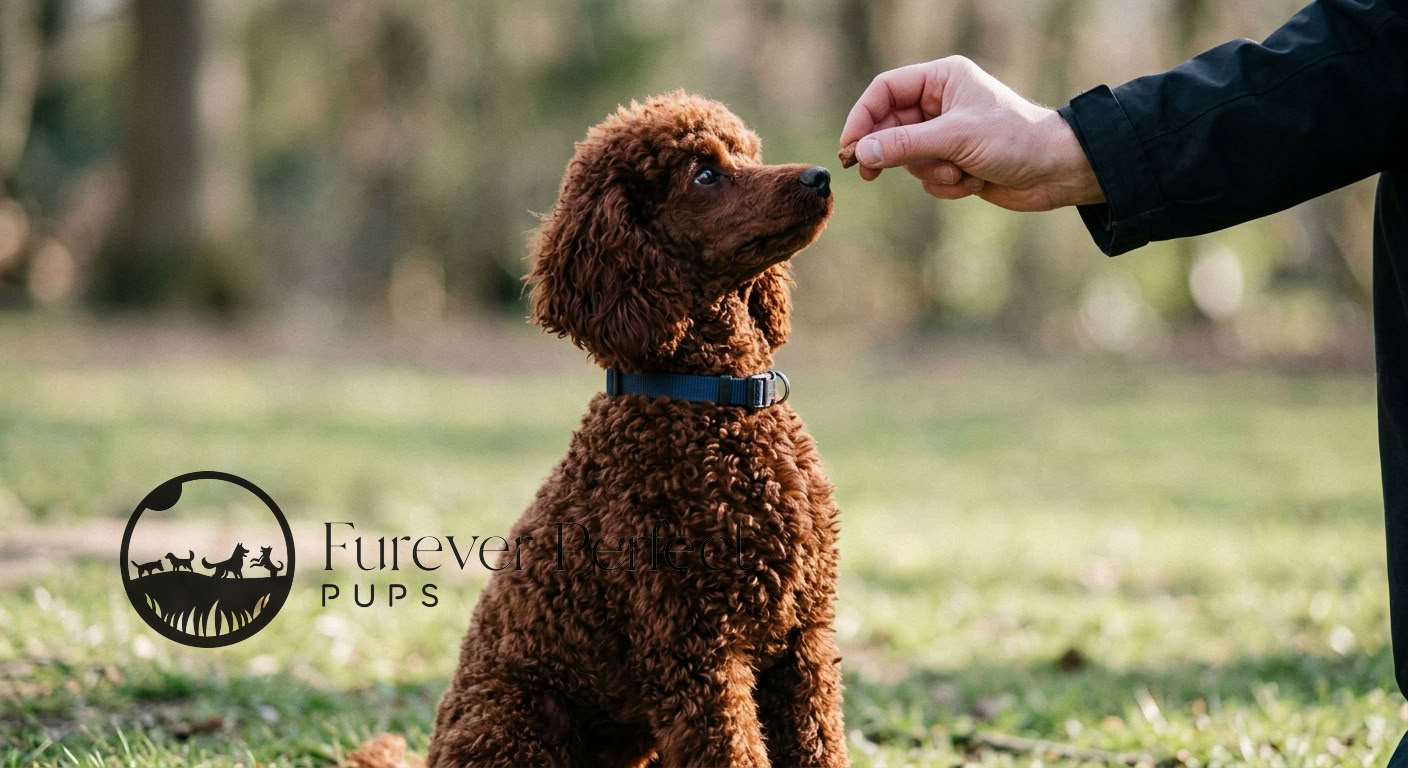
Luring means using a treat to guide the dog’s body into the desired position by moving the treat in a path the dog follows with its nose. Luring is fast and clear, which makes it the most natural starting point for teaching new behaviors. Its one limitation is that luring requires fading the lure quickly, or the dog learns to perform only when it can see a treat in the hand rather than in response to the cue itself.
Capturing means waiting for the dog to offer the desired behavior on its own, then marking and rewarding it immediately. Capturing produces behaviors that the dog already does naturally, and it produces them with particularly high enthusiasm because the dog chose them. Sit and down are both behaviors that Poodles perform on their own regularly, making them capturable without any luring at all.
Shaping means marking and rewarding successive approximations toward the target behavior, starting from wherever the dog is and building incrementally toward the full behavior. Shaping is the most cognitively demanding approach for the dog and produces the deepest understanding of what is being asked, but it requires more patience and precision from the handler than luring does. For a Poodle, shaping is often the approach that produces the most reliable final behavior because the dog has worked out the problem rather than been guided through it.
One of the most common training errors is adding a verbal cue, “sit,” “down,” “stay,” before the behavior it is meant to trigger is reliably happening in response to the handler’s lure or signal. If a dog hears “sit” while it is sniffing, jumping, or in any position other than sitting, it hears the word paired with all of those behaviors simultaneously, not just the one it is meant to cue. The word becomes noise rather than a clear signal. Add the verbal cue only after the dog is producing the target behavior reliably in response to the lure or hand signal, then say the word immediately before the lure, pair them across many repetitions, and then test whether the word alone produces the behavior. This sequence produces a cue that works the first time it is given rather than one that requires three repetitions to register.
Why sit is the right starting point, three methods for teaching it, and how to build a sit that holds up in the real world
Sit is the right starting behavior for three reasons. It is the most natural resting position for a dog, which means it occurs frequently enough to be captured easily. It is the position from which both down and the beginning of stay are most naturally built. And it is the first piece of clear, functional communication between a new puppy and its household, establishing from the earliest sessions that the dog can earn good things by offering a specific behavior on request.
STEP 1 Hold a treat between your thumb and first two fingers, let the dog smell it, and slowly move it back and slightly up over the dog’s head. As the nose follows the treat upward and backward, the hindquarters naturally lower toward the floor. Do not push the hindquarters down. The moment the dog’s hindquarters touch the floor, mark immediately with your clicker or your verbal marker, and deliver the treat.
STEP 2 Repeat five to eight times, then begin fading the lure. Move through the same motion with an empty hand, mark and reward when the dog sits, and deliver the treat from your other hand or a pocket. If the dog does not sit in response to the empty-hand signal, go back to the lure for two more repetitions before trying again.
STEP 3 Once the dog is sitting reliably in response to the hand signal with no lure visible, add the verbal cue. Say “sit” in a calm, neutral voice as you begin the hand signal. Practice until the word alone, without the hand signal, produces the sit response.
Carry treats and your marker with you throughout the day. Every time the Poodle sits on its own, mark the moment the hindquarters land and deliver a treat. This builds the sit behavior through the dog’s own choices rather than handler guidance. Add the cue word once the dog is sitting frequently and enthusiastically offering the behavior.
A sit that works in the living room with no distractions is not the same as a sit that works at the front door when a guest arrives. Teaching sits in varied locations, with varied people present, at different points in the day, and with increasing levels of environmental stimulation builds the generalized sit that functions reliably in the real-world contexts where it matters most. The Poodle’s intelligence means that generalization happens quickly once training is deliberately varied, and a behavior practiced in ten different locations becomes genuinely transferable to new locations with minimal additional work.
Why down is harder than sit for most dogs, the luring path that makes it easier, and how down becomes the foundation for both settle and stay
Down is harder than sit for most dogs because it places the dog in a more vulnerable position than standing or sitting, which can trigger hesitation in a sensitive or uncertain dog even when there is no actual threat. For a Poodle with high body awareness and sensitivity, a down that is taught with patience and positive reinforcement becomes a reliable comfort position that the dog chooses on its own. A down that is pushed or physically manipulated becomes something the dog tolerates rather than chooses, which produces the unreliable response under pressure that most owners describe as “he only stays down for a second before popping back up.”
STEP 1 Begin with the dog in a sit. Hold a treat in your closed hand at the dog’s nose, then slowly lower your hand straight down toward the floor between the dog’s front paws. Many dogs will follow the treat down as it moves toward the floor and slide into a down position naturally as they track the treat to the ground level.
STEP 2 If the dog stands up to follow the treat rather than sliding down, try the same motion with your hand moving toward the floor at a slight angle away from the dog. Some dogs find it easier to move into down when the treat is drawing them slightly forward and down rather than straight down. You can also try luring under a low object like a coffee table or chair, which physically encourages the dog to lower its body to move under the obstacle.
STEP 3 The moment elbows and hindquarters are both on the floor, mark and reward. Do not reward a dog that has its elbows on the floor but its hindquarters still elevated; wait for the full down position before marking. Repeat five to eight times, then begin fading the lure using the same empty-hand signal and delivering from a separate reward source.
STEP 4 Add the verbal cue “down” once the dog is responding reliably to the hand signal. Practice until the word alone produces a swift, confident drop into down position. A Poodle that has been rewarded extensively for downs begins offering them voluntarily as an attention-getting behavior, which is both charming and evidence that the training is working.
Do not physically push or pull a Poodle into a down by pressing on its back or pulling its front legs forward. The AVSAB’s position statement identifies physical manipulation as a form of aversive training that causes stress and damages the trust in the human-animal relationship. For a sensitive breed that reads human behavior closely, a physical correction during training produces the hesitancy and avoidance that makes every subsequent training session start from a slightly worse baseline. The luring approach takes perhaps two to four more sessions than physical placement but produces a dog that offers the behavior enthusiastically rather than one that tolerates being put into it.
Why stay is three separate skills taught sequentially, the specific progression that prevents the common collapse pattern, and what a genuinely reliable stay actually requires
Stay is the most commonly undertaught of the four foundational behaviors, and it is the one owners most frequently report as unreliable. The reason is almost always the same: duration, distance, and distraction were introduced simultaneously before any of them was individually reliable. Stay is three distinct skills: the ability to hold position as time passes, the ability to hold position as the handler moves away, and the ability to hold position when interesting things are happening in the environment. Each of these must be taught and made reliable separately before they are combined, because combining them before any one is solid produces a dog that breaks frequently and cannot reliably sustain the behavior under real-world conditions.
STEP 1 Ask the dog to sit. Say “stay” in a calm, flat voice, then mark and reward after three seconds of the dog remaining in the sit. Do not move. Do not add distance. Do not introduce anything interesting. Just three seconds of the dog staying in position at your feet, marked and rewarded.
STEP 2 Build duration in small increments across many sessions: three seconds, five, eight, twelve, fifteen, twenty. Mark and reward every successful hold. If the dog breaks, ask for sit again and reset with a shorter duration than the one that caused the break. Progress is not linear; a dog that held a twenty-second sit yesterday may hold only twelve seconds today due to higher distraction in the environment or a higher arousal starting point. This variability is normal and should be managed by adjusting the duration expectation rather than by escalating the cue or adding pressure.
STEP 3 Introduce a release word that tells the dog the stay is over and it is free to move. A short word like “free” or “okay” delivered with a distinct change in body language trains the dog that the stay continues until explicitly released rather than until the dog decides it is done. This is the piece most owners skip, and its absence is why dogs reliably break stay whenever they calculate it has been long enough.
Begin adding handler distance only after duration in place is solid to at least thirty seconds with you stationary at the dog’s side. Take one step back, mark and reward the dog for holding, return to the dog and deliver the reward at the dog’s position. Step one step to the side. Step one step forward while the dog holds the sit behind you. The key principle is to return to the dog to reward rather than calling the dog to you for the reward, because coming to you for the reward teaches the dog that movement toward you is the correct response to you moving away, which undermines stay. Only after distance is reliable does the recall from a stay become a useful exercise.
Distraction is the most demanding of the three variables and should be introduced with duration and distance reduced to easy levels when it first appears. Begin with mild distractions: another family member walking through the room, the sound of the television, a toy placed at a distance. Build toward more challenging distractions: food on the floor, a doorbell, a stranger approaching. The Poodle’s intelligence means that the distraction proofing process goes faster than with most breeds once it is started deliberately, but it requires deliberate introduction of each distraction at sub-threshold intensity before increasing the challenge.
Why recall is treated as a separate, permanent training project rather than a basic skill learned and checked off, and the specific practices that build a reliable emergency recall
Recall, the reliable return to the handler when called, is not a basic obedience skill in the way sit and down are. It is a safety behavior that can prevent injury or death if it functions reliably when it matters most. A Poodle that recalls reliably in the living room has a trained behavior. A Poodle that recalls reliably when it has spotted a squirrel fifty meters away, has been playing with other dogs for twenty minutes, and is at a distance from its handler has a safety skill. Those are different things that require different training investment to achieve, and understanding that distinction determines whether recall becomes genuinely reliable or remains a behavior that works only in ideal conditions.
The most important principle in recall training is this: only use the recall word when you are confident the dog will come, and never use it to summon the dog for something it finds unpleasant. A recall word used when the dog does not respond, and not followed through with retrieval and reward, teaches the dog that the word is optional. A recall word used to summon the dog to a bath it hates, to end play it is enjoying, or to receive a nail trim teaches the dog that coming when called sometimes produces bad outcomes. Both lessons erode recall reliability with every repetition.
Choose a distinct recall word you can commit to using correctly and exclusively. “Come” is the most common choice. Some trainers recommend a recall word that is different from any word used in daily casual speech, which reduces the familiarity effect that makes frequently heard words easier to ignore. Whatever word you choose, treat it as a promise that returning to you will produce the best thing that has happened to the dog all day, every single time you use it.
STEP 1 Begin in a low-distraction environment with the dog close by. Say the recall word in a happy, inviting tone. The moment the dog orients toward you or takes a step in your direction, begin marking enthusiastically and backing away while continuing to encourage. When the dog reaches you, deliver five to ten pieces of high-value reward in rapid succession, praise enthusiastically, and make the arrival at you the best event of the training session. Never ask for a sit or any other behavior at the end of a recall during early training; the return itself is the entire behavior being rewarded, and adding demands at the end reduces the enthusiasm of the return.
STEP 2 Build distance progressively across sessions. Practice in a long line before practicing in any off-leash context. A long line of twenty to thirty feet allows the dog to move freely while giving the handler the ability to prevent a practice failure, where the dog hears the recall word and does not come, from becoming a learned behavior. Every recall in which the dog is called and does not come teaches the dog that not coming is an option. Preventing those failures, not through punishment but through management with the long line, keeps the recall word strongly associated with reliable returning behavior.
STEP 3 Introduce distraction proofing using the same graduated approach described for stay. Practice recall from play sessions, from sniffing, from interactions with other dogs. In each case, begin at sub-threshold distraction intensity and build up. The recall from a highly engaging competing activity is only reliable if it has been practiced from that category of distraction many times with high-value reward for returning.
Poodles, as a people-oriented breed that the CKC describes as refusing to be ignored, carry one specific recall advantage: they tend to want to be near their people. That intrinsic motivation toward proximity is the raw material the recall builds on. A Poodle that has a strongly reinforced recall history is leveraging both its training and its temperament, which produces the kind of reliable return that owners of more independent breeds have to work significantly harder to achieve. Build the recall with the same systematic attention to reward quality, distraction graduation, and consistent positive association that the other behaviors in this guide require, and the Poodle’s people-orientation does meaningful work on top of the training.
Where the four basic behaviors lead, how quickly a Poodle can progress, and the continuing investment that matches the breed’s capability
Sit, down, stay, and recall are the foundation, not the ceiling. A Poodle that has these four behaviors on solid cue, working reliably in varied environments and at practical distance, has a communication system with its owner that can be expanded indefinitely. The AKC’s Canine Good Citizen program, which tests ten specific real-world behaviors and is administered at training facilities across the country, is a natural next step that validates the foundation training and provides both a structured evaluation and a concrete goal to work toward. The CGC certificate is also used by some housing communities and insurance providers to demonstrate trained dog status.
Beyond the CGC, the Poodle’s intelligence and working heritage make it a natural candidate for every activity that formal dog sports involve. Agility, which requires the dog to navigate an obstacle course with the handler, leverages the breed’s athleticism, attention to handler cues, and drive for interaction. Obedience competition, which evaluates the precision and reliability of the foundational behaviors under show conditions, rewards exactly the systematic training this guide describes. Nose work and scent detection, which tap the olfactory capability that the Poodle’s retrieving heritage developed, are among the most cognitively satisfying activities available to the breed and accessible to any owner with a small space and a willingness to learn the sport. Rally obedience, which is a more casual version of formal obedience competition with handler communication allowed throughout, is a particularly good entry point for households with children who want to participate in formal training activities with the dog.
| After the Foundations | What It Involves | Why It Suits Poodles |
|---|---|---|
| AKC Canine Good Citizen | 10-behavior real-world test administered by AKC evaluators | Validates foundation training; recognized by housing and insurance providers; natural milestone for any trained dog |
| AKC Rally Obedience | Handler-guided course of obedience stations; communication with dog allowed throughout | Entry-level competitive obedience; good for families with children who want to participate; less formal than competition obedience |
| AKC Agility | Timed obstacle course with jumps, tunnels, weave poles, and contact obstacles | Leverages Poodle athleticism, handler attunement, and drive for interaction; physically and mentally demanding in the right balance |
| AKC Obedience Competition | Precision heeling, stays, retrieves, and directed exercises evaluated in the show ring | Poodles have historically excelled; rewards systematic training and the attention to handler that the breed provides naturally |
| AKC Scent Work | Dog identifies target odors in containers, rooms, exteriors, and vehicles | Accesses the Poodle’s retrieving heritage nose-brain connection; highly cognitively satisfying; accessible to all fitness levels |
Training in the form of positive reinforcement basics can begin the day the puppy comes home at eight weeks. Young puppies have short attention spans and tire quickly, which is why five-minute sessions are more appropriate than extended ones, but the learning capacity is fully operational at eight weeks and the socialization window simultaneously open. The behaviors in this guide, sit, down, and the beginning of stay and recall, can all be introduced in their luring form within the first week of the puppy being home. The AVSAB’s socialization position statement notes that the period before twelve weeks is the primary window for positive exposure and learning, which makes early positive training investment genuinely higher-return than the same investment made at six months. Begin at eight weeks, keep sessions short and joyful, and build the vocabulary that the dog will use for the rest of its life.
This is not disobedience; it is a generalization gap, and it is one of the most common training plateaus owners encounter. A behavior trained in one environment is associated with that environment’s specific context as much as with the cue itself. The solution is deliberate distraction proofing: practicing the behavior in many different environments, starting with mildly more challenging ones than the living room and building toward more demanding contexts, with reward quality matched to the competition level. A sit cued at the park with ten exciting things competing for the dog’s attention needs a higher-value reward than the same sit in the living room with nothing competing. The park sit also needs to have been practiced many times at sub-threshold distraction levels before it is expected reliably in full park conditions. Increase the challenge gradually and systematically rather than jumping from the living room to full park exposure and expecting the same behavior quality.
Both are effective, and the choice comes down to personal preference and practical logistics. A clicker produces a distinct, consistent sound that is not affected by the handler’s emotional state or vocal tone, which some trainers argue produces more precise learning because the marker is always identical. A verbal marker like “yes” is always available without needing to carry an object, which matters in contexts where hands are occupied or a clicker is inconvenient. The most important requirement for either is that it is used consistently, delivered at the precise moment the desired behavior occurs rather than slightly after, and always followed by a reward. Imprecise marking, where the marker is delivered a second too late and actually captures the dog’s position after the behavior rather than during it, is a common source of the training confusion that owners attribute to the dog not understanding rather than to the handler’s timing. Whichever marker you choose, practice your timing without the dog present until it is reliably within one second of the target moment.
A bored Poodle in a training session is almost always being asked to practice behaviors it already knows reliably, at a level of challenge well below its capability, with insufficient variety across the session. Poodles are Coren’s second-ranked breed for intelligence and they habituate to sameness quickly. The session structure that works best for this breed involves three to five different behaviors per session rather than drilling a single one, working at the edge of the dog’s current capability rather than the comfortable center of what it already knows, and varying the reward type and delivery pattern to prevent habituation to a predictable reward structure. Variable reward scheduling, where the dog cannot predict exactly when the jackpot will appear, produces more sustained effort than fixed ratio scheduling where the reward appears on every repetition. If training feels like work for both you and the dog, the sessions are probably too long, too repetitive, and too predictable. Make them shorter, more varied, and more surprising, and observe what changes.
The AVSAB’s position is that there is no role for aversive methods in training, which means no punishment, no corrections, and no expressions of frustration directed at the dog for a training error. The appropriate response to a mistake during training is to ask yourself what the mistake tells you about where in the progression the dog actually is, as opposed to where you thought it was. A dog that breaks a stay at fifteen seconds reliably was probably not ready for fifteen seconds and needs more work at ten. A dog that does not sit on cue in a new environment does not have the behavior generalized and needs distraction proofing from a lower challenge level. Every mistake is diagnostic information about where to go back to in the training sequence rather than an offense requiring correction. Taking this view produces more effective training and a more confident, trusting dog, because the dog is never associated with negative consequences for effort that simply did not yet meet a standard it had not fully reached.
No. The idea that dogs can only be effectively trained during puppyhood is not supported by behavioral research or by the consistent practical experience of professional trainers working with adult dogs. A two-year-old Poodle with no formal training has no ingrained behaviors to undo before the new ones can be built, which actually makes some aspects of starting with an adult easier than starting with a puppy whose impulse control and attention span are still developing. The primary difference between training an adult and a puppy is that an adult is more likely to have established patterns of attention and response that need to be redirected, and the initial sessions may require more environmental management to prevent practiced behaviors from competing with the new training. The same principles in this guide apply, the same methods work, and the same systematic progression produces the same outcome. Poodles retain the intelligence and people-orientation that makes them efficient learners at any age in their adult life.
The Poodle’s second-ranked working and obedience intelligence is not a free pass to a well-trained dog. It is an asset that reward-based training converts into one. The intelligence that makes a Poodle capable of learning new commands in fewer than five repetitions also makes it capable of learning unintended patterns, inconsistent rules, and the edges of enforcement just as fast. The training investment this guide describes, clear mechanics, high-value rewards, systematic progression through distraction proofing, and absolute consistency in the rules being taught, is what converts the Poodle’s capability into the reliable, elegant, responsive companion the breed is capable of being.
These four behaviors are the beginning. They establish the communication, the mutual trust, and the trained vocabulary that every subsequent behavior is built on. A Poodle with a genuine sit, a reliable down, a solid stay, and a recall that works under real conditions is a dog whose household life, whose safety in the world, and whose relationship with its people is fundamentally better than it would be without that training. The investment is measured in five-minute sessions and consistent practice. The return is measured in years of a genuinely excellent companion doing what you ask because you have taken the time to make it worth its while.