Bernedoodle Colors and Coat Patterns: What the Genetics Actually Predict
Color is the first thing most families ask about and the last thing any honest breeder can promise. In a Bernese Mountain Dog litter it is close to a settled question. The breed standard calls for one pattern: a jet black ground color with rich rust and clear white markings, with a blaze up the muzzle, rust above each eye and on all four legs, and white on the chest and tail tip. The Bernese Mountain Dog Club of America standard treats any ground color other than black as a disqualification, so a well-bred Berner litter is a set of variations on one theme.
Cross that dog to a Poodle and the certainty evaporates. The Poodle carries a range running through black, blue, silver, brown, cafe-au-lait, apricot, cream, and white, plus pattern genes the Bernese does not have at all. It also carries a strong tendency for coat color to change with age. A Bernedoodle litter can contain puppies that look nothing like each other, and individual puppies can look nothing like themselves eighteen months later.
None of that is a problem until it goes undisclosed. Families pay premiums for tri-color, for merle, for a particular shade of silver, and then feel misled when the dog matures into something else. In our program the color conversation happens early, because setting an accurate expectation in week one is easier than explaining a disappointment in month fourteen.
What follows is where each color and pattern comes from, which ones hold and which do not, and the two situations where a coat pattern carries a health consequence rather than an aesthetic one.
Every color a dog can be is built from two pigments. The Veterinary Genetics Laboratory at UC Davis describes them as eumelanin, which is black, and phaeomelanin, which is red or yellow. Whether a dog produces one, the other, or both is decided by three genes working together: Agouti at the A locus, MC1R at the E locus, and Dominant Black at the K locus. Everything else in canine color is a modifier layered on top.
The Bernese Mountain Dog sits in one narrow corner of that system. The classic tri pattern is black-and-tan with white spotting, which requires the tan point version of the A locus and the absence of dominant black. There is no “tri gene.” The breed is simply fixed for a combination of ordinary color genes, which is why Berner litters are predictable and Bernedoodle litters are not.
The Poodle side is where variation enters. A Poodle can be any of several solid colors and can carry pattern genes without showing them. Two of those explain most of the “why doesn’t my Bernedoodle look like a Berner” questions we field.
Two further genes modify whatever black pigment gets produced. The B locus turns black to brown, which is where chocolate Bernedoodles and their liver-colored nose leather come from. The D locus dilutes pigment, turning black to a true blue and brown to a silvery lilac while also lightening nose and eye color. Both are recessive, so both can travel invisibly through generations of black dogs before appearing.
White is its own subject and a genuinely unresolved one. UC Davis notes that white spotting patterns across breeds do not share a single uniform genetic basis, that the genetics are complex, and that markings frequently land asymmetrically. Remember that when a breeder describes an unborn litter as perfectly marked. Placement of white is the least controllable element in the picture, which is why Bernese breeders selecting for symmetry across generations still produce puppies with a crooked blaze.
Bernedoodle color terminology mixes legitimate genetic description, kennel club vocabulary borrowed from the parent breeds, and marketing language invented in the last twenty years. Here are the patterns you are most likely to encounter, described by what is happening genetically.
Traditional Tri-Color
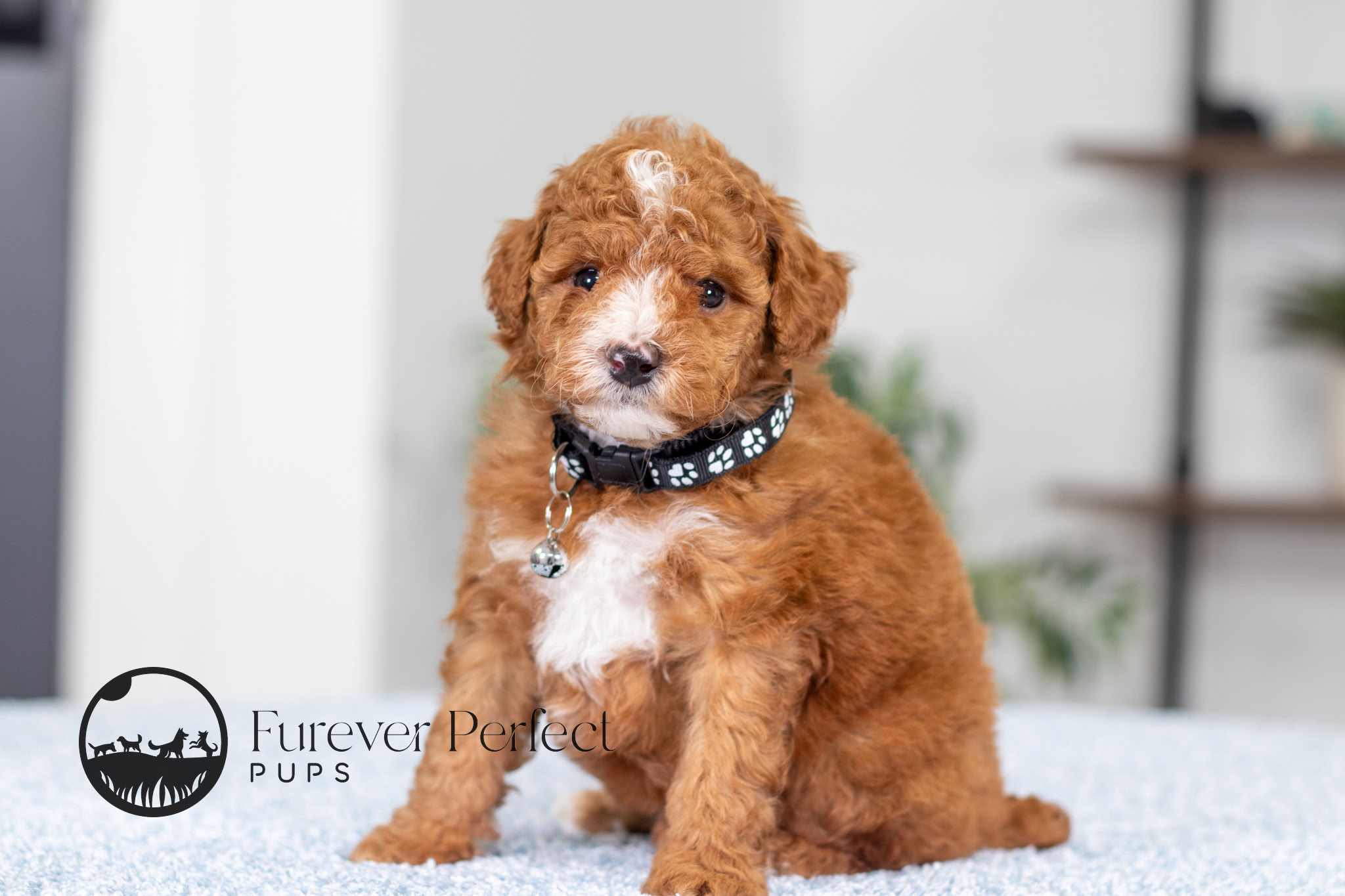
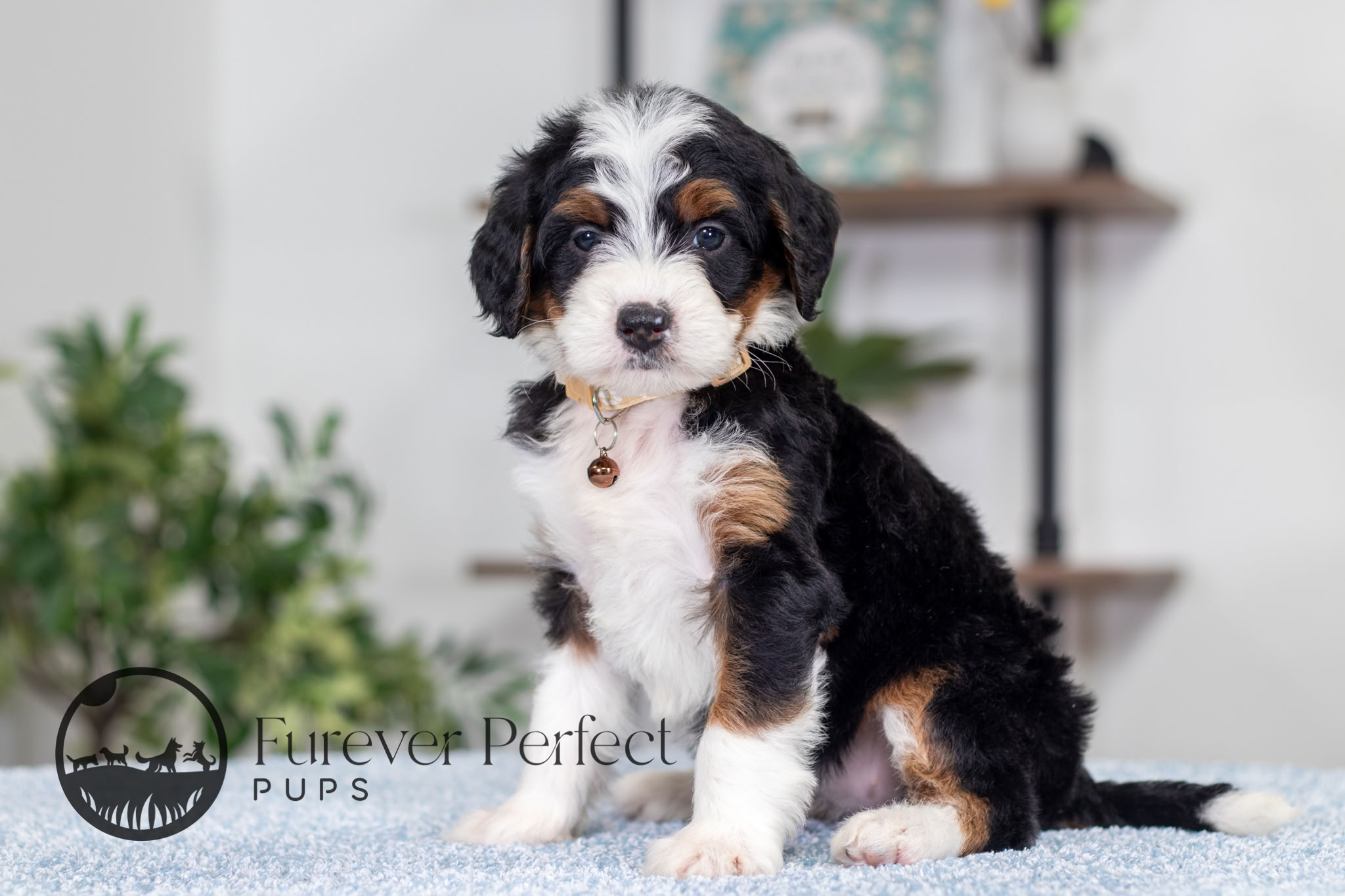
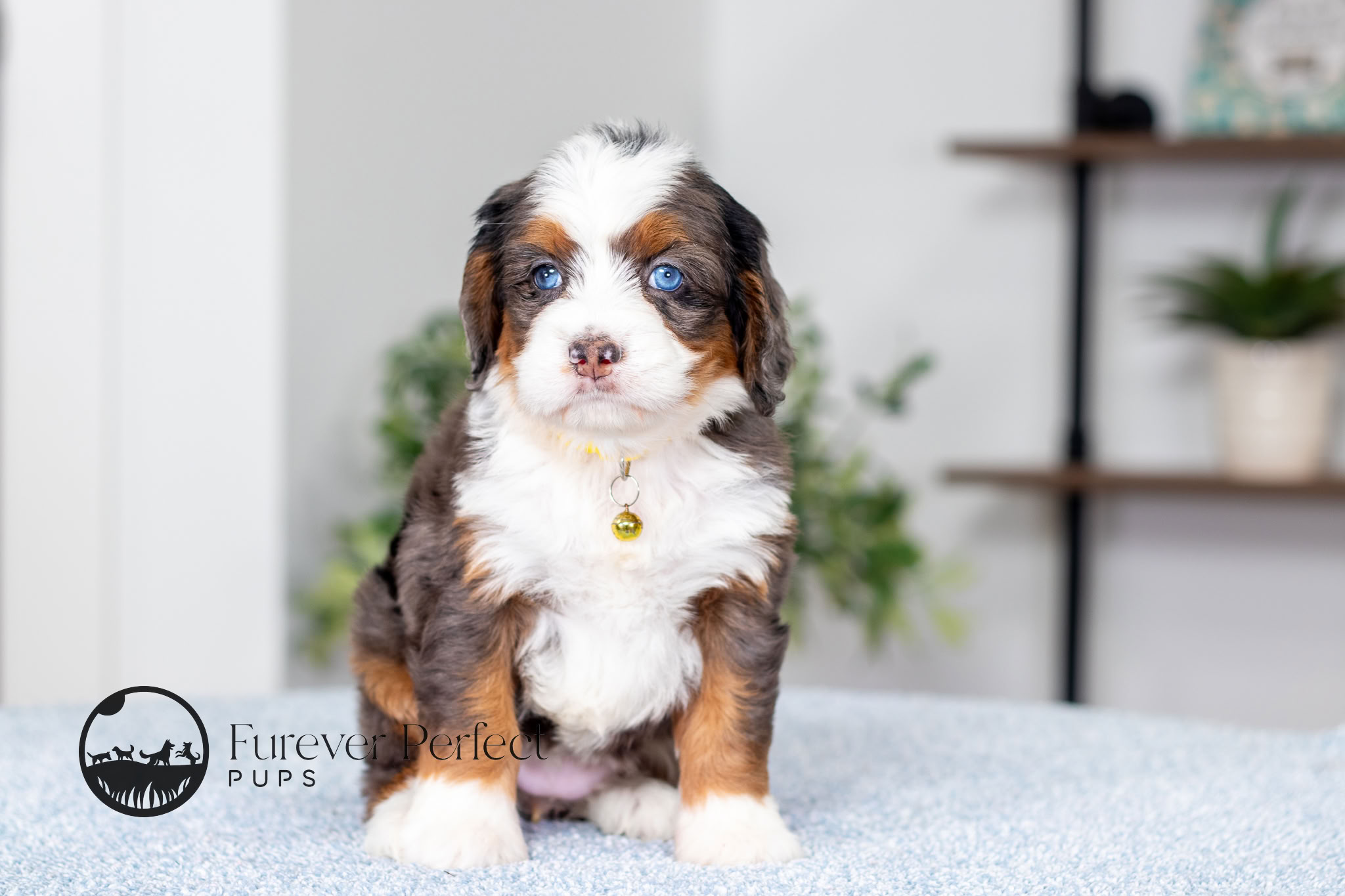
The pattern most families picture, and the one requiring the most genetic cooperation, since three separate conditions have to line up at once. Expect asymmetry in the white. In our experience, families who fall for a photograph of a textbook-marked tri dog are the most likely to be disappointed by an actual litter, because that photo sits at the far end of a distribution rather than the middle. Rust markings also tend to soften with maturity in Poodle-cross coats, so vivid copper eyebrows at eight weeks may be noticeably paler at two years.
Phantom
Genetically identical to tri except that the dog did not inherit the white spotting component. You get rust eyebrows, cheeks, chest, and legs on a black or brown body with no blaze and no white feet. The United Poodle Association documents this and related patterns well back into Poodle history, which is worth knowing when a listing presents phantom as a rare modern development.
Sable
Sable puppies are born dark, often nearly black, with lighter roots visible if you part the coat. As dark tips are shed or trimmed away the dog lightens substantially, sometimes ending gold or light brown with shading left only on the ears, spine, and tail. This is the pattern most likely to genuinely surprise an owner. A sable Bernedoodle is not a black dog that faded; it was always going to end up lighter, and a breeder who understands the pattern says so at pickup rather than letting you discover it at six months.
Parti, Abstract, and Tuxedo
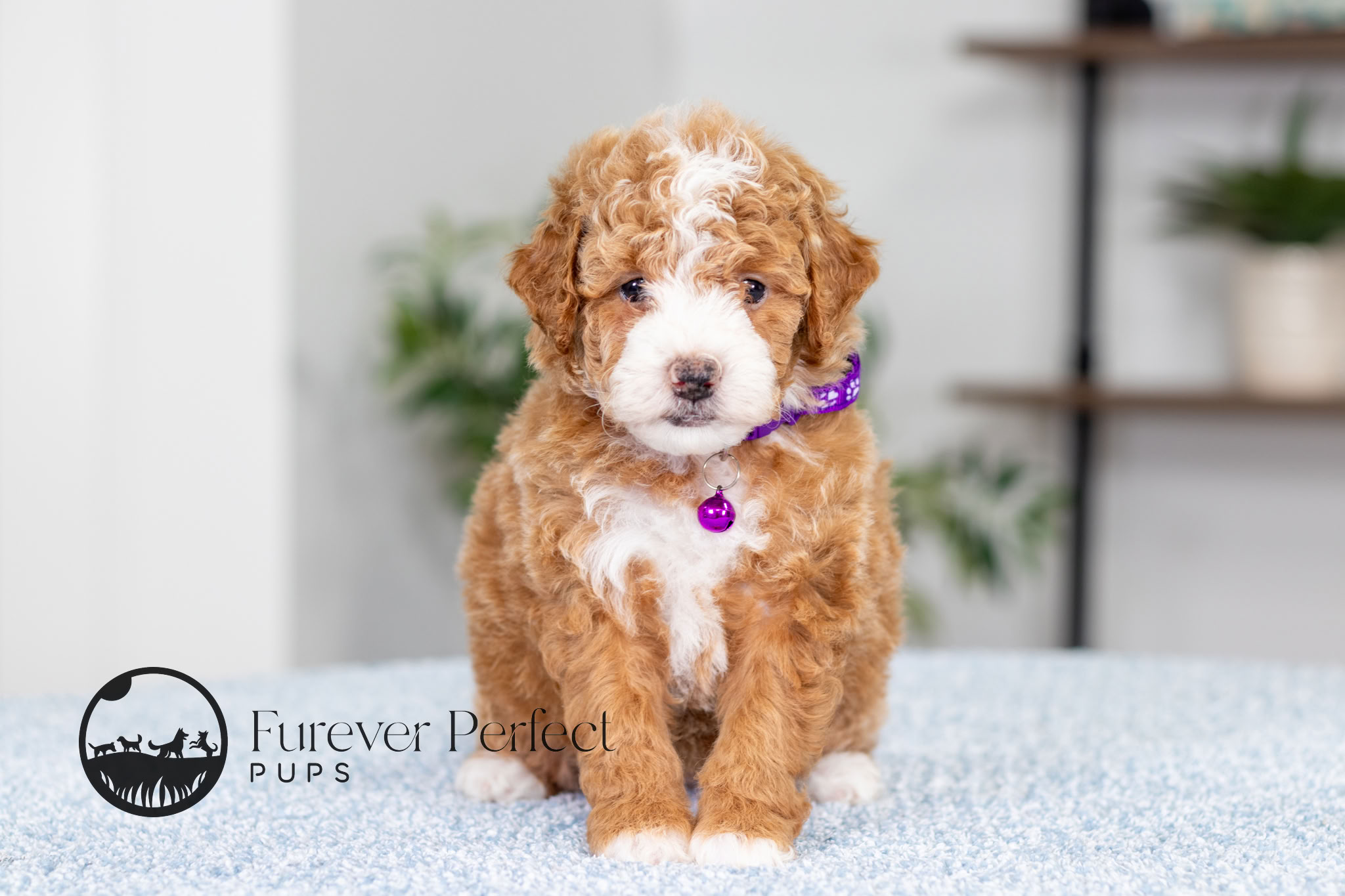
Parti describes roughly half or more of the body in white with patches of color. Abstract, sometimes called mismark, is the same white spotting expressed to a lesser degree, confined to chest, feet, muzzle, and tail tip. Tuxedo is a nickname, not a separate gene. The Poodle Club of America standard disqualifies parti-colored dogs from AKC conformation, a show ring rule about even color at the skin rather than a health statement, while the United Kennel Club welcomes multi-colored Poodles in its conformation events. Neither position says anything about whether a given dog is sound.
Merle
Merle produces the marbled, patchy dilution that makes a coat look torn between two colors, often with blue or partially blue eyes. It is the one pattern here with documented health consequences, and the one native to neither parent breed. The Bernese standard treats blue eye color and any non-black ground color as disqualifications, and merle has historically not appeared in Poodle standards either; its presence in these lines is generally attributed to outcrossing somewhere in the pedigree. Anyone considering a merle puppy should read the health section below before putting down a deposit.
The most consequential thing about a Bernedoodle’s coat has nothing to do with color. In 2009 Cadieu and colleagues published a genome-wide association study in Science, drawing on more than 1,000 dogs across 80 breeds, that reduced the variety of dog coats to variants in three genes. FGF5 governs length, KRT71 governs curl, and RSPO2 governs furnishings, meaning the mustache, beard, and eyebrows that give a doodle its face. The AKC, summarizing work from the National Human Genome Research Institute, notes these three mutations explain roughly 95 percent of coat types across dogs.
For a Bernedoodle, three things are therefore decided independently of color. The dog will be curly, wavy, or straight depending on KRT71. It will have the classic doodle face or a smooth Bernese-style face depending on RSPO2. Shedding volume is influenced by a further gene, MC5R, alongside furnishings status. A tri-colored Bernedoodle can be a heavy shedder with a flat retriever-like coat, and a solid black one can be tightly curled and barely shed at all.
This matters most for families choosing on the basis of allergies. A dog whose coat resembles the Bernese parent’s is called unfurnished, and these dogs shed considerably more than furnished littermates. Generation labels are a poor proxy: an F1B is statistically more likely to be furnished and curly than an F1, but the determinant is the parents’ genotypes, not the label on the litter.
Poodle-influenced coats commonly lighten with age. Black fades toward charcoal, slate, or silver. Brown fades toward cafe-au-lait or silver beige. Red and apricot lighten toward cream, and rust points soften. Most of this happens as the adult coat comes in, typically between eight months and two years.
Here is the honest part. Breeders and testing companies call this progressive greying or the fading gene, often assigning it a “G locus,” but the causal mutation has not been identified. The Animal Medical Center in New York, writing on exactly this question in 2025, reported being unable to find any scientific description of a specific poodle fading gene in the literature, and noted the available online information contradicts itself on whether the trait is even dominant or recessive. Candidates such as KITLG have been proposed, nothing is confirmed. Any breeder guaranteeing a puppy will not fade is claiming something the science does not support.
What does work is observation. Fading runs in families and shows up reliably in a line. The most useful predictor available to a buyer is not a DNA panel; it is photographs of both parents at three or four years old, plus adults from previous litters out of the same pairing. A black Poodle parent who is slate gray at four tells you something no color guarantee can.
One smaller effect is worth knowing. Shorter-coated areas such as the ears, muzzle, and tail often hold pigment longer than the body, so a fading dog frequently ends up darker at the extremities than through the back and sides. Regular grooming accelerates the appearance of fading, because clipping removes older, darker length and leaves newer, lighter growth behind.
Most coat colors are cosmetically interesting and medically irrelevant. Two are not.
Merle and the pigment cells that build the ear and eye
Merle comes from a retrotransposon insertion in the PMEL gene, also called SILV. The same pigment-producing cells that create coat color are required for normal development of the inner ear and parts of the eye, which is how a pigment pattern becomes a sensory issue. Strain and colleagues, in the Journal of Veterinary Internal Medicine in 2009, tested hearing in 153 merle dogs across ten breeds. Among single merles, 2.7 percent were deaf in one ear and 0.9 percent in both. Among double merles, carrying two copies, 10 percent were deaf in one ear and 15 percent in both. Double merles also commonly show eye abnormalities including undersized eyes and malformed pupils.
The complication is that visual assessment is not reliable. Work published in 2018 by Langevin and colleagues in PLOS ONE, and independently by Ballif and colleagues in Mobile DNA, established that the merle insertion varies in length and that length determines how strongly the pattern expresses. Ballif’s group measured lengths spanning 25 to 105 base pairs, with distinct ranges corresponding to cryptic, dilute, standard, and harlequin expression. The shortest versions produce a dog that looks entirely solid while still carrying a merle allele it can pass on. Langevin’s group described a series of six merle alleles and argued directly for refined length-based testing across merle-carrying breeds.
The consequence for a buyer is specific. A solid-colored parent from a line where merle exists can be a cryptic merle, and breeding that dog to a visible merle without length testing can produce double merle puppies from a pairing that looked safe. Ask for merle results that report allele length rather than a simple positive or negative, and ask for BAER hearing testing on any merle puppy.
Dilute coats and follicular disease
Dogs inheriting two copies of the dilute variant in the MLPH gene, producing a true blue or silvery lilac coat, can develop color dilution alopecia. Dilute color comes from pigment granules clumping unevenly in the hair shaft, and in some dogs those clumps damage the follicle, producing progressive hair loss and recurrent skin inflammation. Penetrance varies enormously by breed. The University of Minnesota’s veterinary dermatology handbook cites roughly 93 percent of blue and 73 percent of fawn Doberman Pinschers affected, while most Weimaraners, also a dilute breed, never develop it. No figure has been established for Bernedoodles, and honest breeders should say so rather than dismissing or exaggerating the risk.
A related condition, black hair follicular dysplasia, affects only the black areas of bi-colored and tri-colored coats. The same reference describes signs appearing as early as four weeks, starting with black hair losing its luster and progressing toward near-complete hair loss in those regions by six to nine months while lighter areas stay normal. It is uncommon and not a reason to avoid tri-colored dogs, but it is a reason to look at a puppy’s black areas rather than only admiring the markings.
Color is a reasonable thing to care about. It becomes a problem only when it outranks everything else. These questions cost nothing to ask and reveal a great deal about how a program operates.
- Ask what each parent’s coat genotype is: a breeder testing furnishings, curl, and the relevant color loci can tell you what a pairing can and cannot produce instead of guessing from appearance.
- Ask for photographs of both parents as adults: puppy photos of the parents are useless for predicting fading, and grown dogs from previous litters out of the same pairing are the most informative thing a breeder can show you.
- Ask directly whether merle is present anywhere in the pedigree: if the answer is yes, ask for length-based merle testing on both parents and for BAER hearing results on any merle puppy you are considering.
- Ask what the breeder expects this puppy to look like at two: the answer should be specific and appropriately hedged, and a breeder promising no change at all is overselling.
- Ask whether pricing varies by color within the litter: there is no health or temperament basis for charging more for one pattern, and a program that prices uniformly is telling you something about its priorities.
- Ask for the parents’ OFA results by registered name: this is the question that matters more than every color question combined, and results are searchable in the public OFA database, so you can verify rather than take anyone’s word.
The parent breed clubs have published what that testing should cover. The Bernese Mountain Dog Club of America and the OFA’s Canine Health Information Center specify hips, elbows, an annual CAER eye exam by a board-certified ophthalmologist, a cardiac evaluation, and DNA testing for degenerative myelopathy, plus one test from von Willebrand disease, thyroid, or histiocytic sarcoma risk. The Poodle Club of America’s guidance covers hips, a yearly ACVO eye exam, the prcd-PRA DNA test, and patellar evaluation, and strongly recommends the osteochondrodysplasia test for Miniature Poodles, noting research suggesting roughly 10 percent of Minis carry that mutation.
At a Glance: Bernedoodle Colors and Patterns
| Pattern or color | What causes it | How it typically changes | What to verify |
|---|---|---|---|
| Traditional tri | Tan points plus white spotting, with no dominant black present | Rust markings often soften and lighten with the adult coat | Adult photos from the same pairing; expect asymmetric white |
| Phantom (black and rust) | The same tan point pattern without white spotting | Points commonly lighten; body may fade if greying is present | Whether the line fades, checked against adult relatives |
| Sable | A different Agouti variant producing dark-tipped hairs | Lightens substantially as dark tips are shed or clipped away | That the breeder has identified it as sable, not as black |
| Parti or abstract | White spotting expressed to a greater or lesser extent | Placement is stable; ticking may develop in white areas | Nothing health-related; a show ring rule, not a soundness issue |
| Merle | A variable-length insertion in the PMEL gene | Pattern is stable, but expression depends on allele length | Length-based testing on both parents; BAER hearing test |
| Solid black | Dominant black masking the patterns underneath | Frequently fades toward charcoal, slate, or silver | Adult parent photos; ask what patterns are hidden underneath |
| True dilute blue or silver | Two copies of the dilute variant in MLPH | Stable in shade; distinct from a faded black | Coat and skin condition; ask about color dilution alopecia |
Frequently Asked Questions
Will my Bernedoodle puppy stay the color he is now?
Possibly not, and nobody can honestly promise otherwise. Poodle-influenced coats frequently lighten as the adult coat comes in, generally between eight months and two years, with black going toward charcoal or silver and brown toward cafe-au-lait. Breeders call this progressive greying or the fading gene, but no causal mutation has been confirmed in the published literature, so DNA testing cannot settle the question the way it settles curl or furnishings. The best available prediction comes from seeing both parents as mature adults and grown dogs from previous litters out of the same pairing. If a breeder can show you neither, treat any color guarantee with skepticism.
Is a tricolor Bernedoodle rarer or more valuable than a solid one?
Tri-color is less common than solid or phantom, because it requires several genetic conditions to line up and can be erased by a single dominant black allele from the Poodle parent. Less common is not more valuable in any way that affects the dog. A tri-colored puppy is not healthier, calmer, longer-lived, or easier to train than its solid littermate. Programs that price by color are pricing scarcity, not quality, and a family choosing primarily on markings is optimizing for the thing that will matter least by month six.
Are merle Bernedoodles safe to buy?
A single merle from tested parents is generally a normal dog, and Strain’s 2009 figures put single merles at 2.7 percent unilateral and 0.9 percent bilateral hearing loss. The risk concentrates in double merles, produced when two merle-carrying dogs are bred together, where the same study found 10 percent unilateral and 15 percent bilateral deafness alongside a documented pattern of eye malformations. The complication is that merle alleles vary in length, and the shortest produce dogs that look entirely solid while still carrying and passing on merle, so a pairing can look safe and not be. Ask for testing that reports allele length rather than a yes or no result, ask for BAER hearing testing, and ask where in the pedigree merle entered, since it is native to neither parent breed.
Does coat color affect shedding or how much a Bernedoodle triggers allergies?
No. Shedding and texture are governed by a different set of genes from color: FGF5 for length, KRT71 for curl, RSPO2 for furnishings, MC5R for shedding volume. A tri-colored Bernedoodle can shed heavily and a solid black one can barely shed at all. On allergies specifically, no dog is genuinely hypoallergenic. All dogs produce the Can f 1 allergen, which lives in dander, saliva, and skin oils rather than hair, and the 2012 Vredegoor study in the Journal of Allergy and Clinical Immunology found no evidence for classifying any breed as hypoallergenic, with airborne allergen levels in homes showing no difference between breed groups. A tightly curled, furnished coat can meaningfully reduce how much hair and dander circulates, which helps some mildly sensitive people. It is not a solution for a severely allergic family member, and we would rather say so plainly than place a puppy into a home that has to return it.
Both parents are tri-colored. Why is my puppy black and white with no rust?
White spotting and tan points are inherited separately, and the extent of white varies widely even between littermates. UC Davis notes that white spotting patterns do not share a single uniform genetic basis and that markings are frequently asymmetrical, so one pairing can give you a puppy with a full blaze and four white feet and another with white only on the chest. Tan points can also be present genetically but so pale or restricted that they read as absent, and rust visible at eight weeks sometimes fades to near-invisible as the adult coat arrives. If the rust was never there at all, the likely explanation is a dominant black allele from the Poodle side masking the pattern underneath, which happens routinely in this cross.
What does Furever Perfect Pups do to prepare puppies before they go home?
Every litter goes through Early Neurological Stimulation from days three through sixteen, five brief daily exercises originating in the U.S. military’s Bio Sensor program, which was associated with improved cardiovascular performance, stronger stress tolerance, and greater disease resistance in the dogs that received it. Alongside that we run Early Scent Introduction, presenting a different scent each day through the neonatal and transitional periods and recording each puppy’s response, which builds early olfactory engagement and lays groundwork for the nose work this cross tends to suit. Both parents in every pairing are OFA health tested with results submitted to the public database, so families can look them up by registered name rather than taking our word for it. Before placement each puppy meets the foundations of positive reinforcement training: leash desensitization, the marker concept, an introduction to sit, and a calm association with being handled, and every family receives documentation of the vocabulary and mechanics we used so the transition home continues something rather than starting from zero. Afterward we stay available, because the questions at nine months in adolescence are nothing like the ones at twelve weeks, and being reachable through all of it is part of placing a puppy responsibly.
Final Thoughts
The genetics here are not mysterious. Two pigments, a handful of switches deciding which shows where, a few modifiers lightening or browning the result, and a separate system governing curl, furnishings, and shedding. What makes the subject confusing is not the biology. It is that the vocabulary used to sell puppies has drifted from the vocabulary used to describe them accurately, and families get disappointed in that gap.
The distinction that matters is between color as a preference and color as a risk. Preferring a tri-colored dog is entirely reasonable. Paying a premium for a shade with a good chance of fading, or accepting a merle puppy from parents who were never length-tested, is a different category of decision. The first costs you a slightly narrower set of options. The second can cost a dog its hearing.
Our advice has stayed the same for years. Decide on color last. Start with the parents’ health results, which are public and verifiable, then the temperament of the two dogs in front of you, then coat type if allergies or grooming capacity matter, and then pick whichever remaining puppy you like the look of. Families who work that order rarely regret the dog they end up with. Families who work it backwards sometimes do, and the markings that drove the decision stopped mattering long before the dog turned two.