

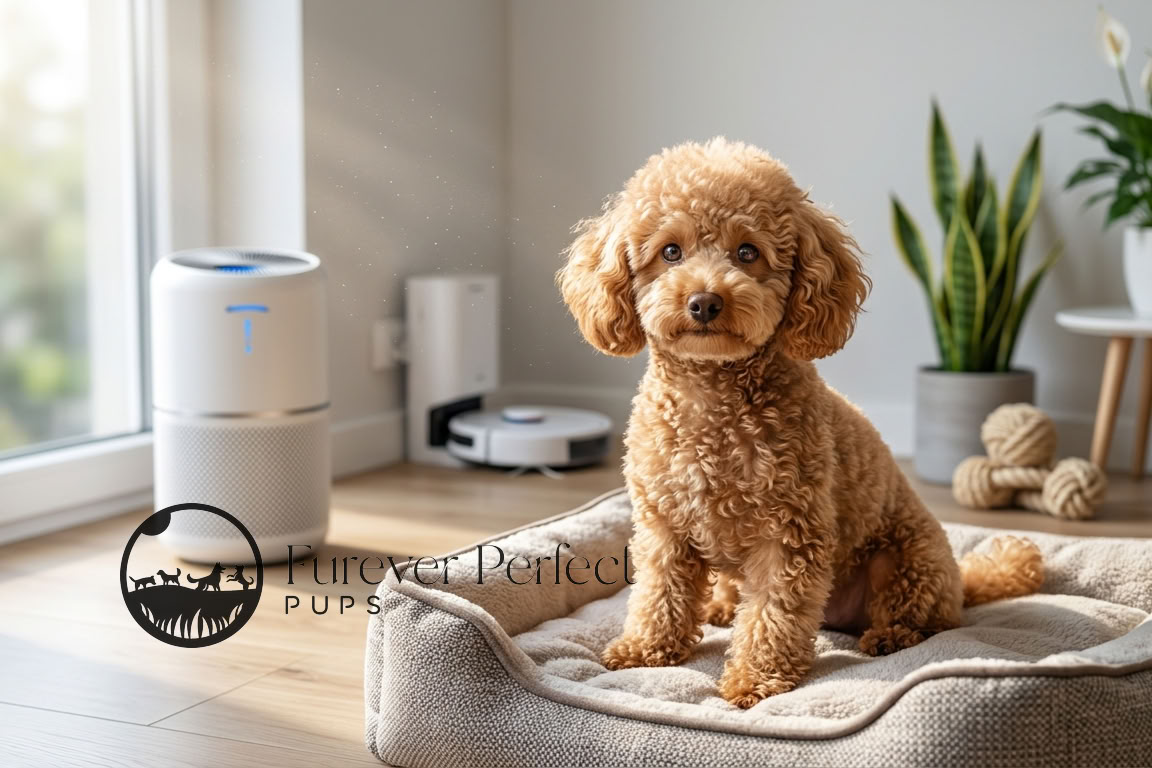
Air Quality in Homes with Dogs: What Actually Works
Most conversations about dog allergens focus on the visible stuff: hair on the couch, fur on the floor, the dog itself. The air gets less attention, and that is where the problem actually lives. Pet allergens in a home are primarily airborne particles, not hair. The protein that triggers allergic reactions in humans is Can f 1 in dogs, found in saliva, dander, and urine. When a dog moves, shakes, or is touched, these microscopic particles become suspended in the air, remain there for extended periods, and settle on every surface in the room, including ones the dog has never entered. Research published in the journal Clinical and Experimental Allergy found that baseline airborne Can f 1 levels were nearly four times higher in rooms where a dog was present compared to rooms where the dog was elsewhere in the house. The air matters more than most owners realize.
The reason this is worth understanding clearly is that the interventions that reduce airborne allergen exposure are different from those that reduce surface allergen accumulation, and doing one without the other leaves a significant part of the problem unaddressed. Surface cleaning removes settled allergens. Air filtration captures allergens before they settle. Grooming reduces the amount of allergen produced at the source. Ventilation dilutes and removes airborne particles. These are four distinct strategies, and the households that manage indoor air quality most effectively tend to run all four consistently rather than relying on any single one.
This guide covers the specific evidence on what each strategy actually accomplishes, what the relevant research says about tools like HEPA filtration, what honest caveats apply, and how these strategies apply specifically to homes with Poodles and Bernedoodles, whose low-shedding coats change part of the picture without eliminating it.
Dog allergen in the home does not behave the way most people picture it. The visible hair that collects on furniture is not itself the allergen trigger for most people. The trigger is Can f 1, a protein produced primarily in a dog’s salivary glands and distributed through saliva, dander, and urine. When the dog grooms itself, Can f 1 is deposited onto the coat and skin. As the skin dries and flakes, particles carrying the protein become airborne. These particles are microscopic, often smaller than 10 microns, and some fractions are small enough to remain suspended in the air for hours before settling.
The U.S. Environmental Protection Agency identifies indoor air pollution as one of the top five environmental health risks, noting that the air inside homes is often more polluted than outdoor air. Pet allergen is one of the contributors to that indoor load, and it behaves differently from the gross particles that air looks to contain: it is invisible, persistent, and mobile. A 2022 PMC-published study of air filtration effects on household allergens confirmed that dog allergen, measured as Can f 1, is primarily carried by fine airborne particulate matter rather than large visible particles, and that reducing that fine particle load through active filtration produces measurable reductions in allergen concentration.
A second important feature of pet allergens is their persistence on surfaces and in settled dust. The same PMC study noted that cat and dog allergens can be present at significant levels even in homes where the animal has been absent for extended periods, because allergen accumulates in carpets, upholstery, and settled dust in ways that are not disrupted by the animal leaving. This is directly relevant to management strategy: cleaning and filtration need to be ongoing rather than event-driven, because the allergen reservoir in surfaces continues releasing particles into the air whenever dust is disturbed.
HEPA air filtration is the most evidence-supported tool available for reducing airborne pet allergens in indoor spaces. The EPA specifies that HEPA filters remove at least 99.97 percent of airborne particles at 0.3 microns in size, which includes pet dander and the fine particulate matter that carries Can f 1. The ACAAI’s guidance on air filters confirms that using an air purifier with a HEPA filter can help eliminate pet dander found in the air and that air filtration reduces airborne allergens in ways that may provide relief for sensitized individuals.
A published study specifically examining HEPA filtration in homes with dogs, referenced in multiple subsequent allergen research papers, investigated the effect of a HEPA air cleaner in nine homes with dogs. The study found that HEPA air cleaners measurably reduced airborne Can f 1 in those homes. Furthermore, preventing the dog’s access to the bedroom and possibly the living room was identified as an additional factor that could reduce the total allergen load inhaled, operating alongside rather than instead of filtration. The combination of filtration and restricted room access was more effective than either intervention alone.
The 2022 PMC study of HEPA filtration effects across twenty-two homes found improvements in allergic rhinitis and asthma symptoms alongside reductions in allergen levels, and noted that HEPA air purifiers reduced both dog allergen and dust mite allergen concentrations in the rooms where they were placed. These are the strongest peer-reviewed findings on indoor pet allergen reduction available, and they consistently point to the same conclusion: HEPA filtration in the rooms where people spend the most time produces meaningful reductions in airborne allergen exposure.
How to Use HEPA Filtration Effectively
Portable HEPA air purifiers are designed for single-room use. The EPA’s guidance on portable air cleaners specifies that they are most effective when matched to the square footage of the room where they are placed and run consistently in spaces where people and pets spend the most time. A HEPA unit in the bedroom is typically the highest-return placement because it reduces exposure during the eight or so hours per night that sleeping adults spend in a single room breathing deeply. A unit in the primary living space where the dog spends the most time addresses the highest-source-density room.
For homes with central HVAC systems, upgrading the system filter to a MERV 13 rating extends filtration to the entire home’s circulated air. The ACAAI specifically notes that a central HVAC system can be turned into a whole-house filtration system by installing a high-efficiency filter, and that this approach complements rather than replaces portable room units. The combination of a MERV 13 HVAC filter and portable HEPA units in primary rooms provides the broadest indoor coverage available through filtration alone.
What to Look for When Choosing a Unit
- True HEPA certification, not “HEPA-style” or “HEPA-like” filters, which do not meet the 99.97 percent capture standard. The ACAAI specifically recommends confirming the filter meets the actual HEPA standard.
- A Clean Air Delivery Rate (CADR) matched to the room size. The ACAAI guidance explicitly recommends checking that the filter’s CADR matches the square footage of the intended room. A unit sized for a small bedroom will not be effective in a large open-plan living space.
- An activated carbon layer in addition to the HEPA filter. HEPA filters capture particles. Activated carbon addresses odor-causing molecules, which are a separate category from allergen particles and require a different filtration mechanism.
- Consistent run time rather than occasional use. Air filtration only reduces airborne allergen concentration while it is running. Units placed in rooms and turned on periodically provide limited benefit compared to those running continuously in the spaces where people spend the most time.
Surface cleaning is the other essential component of indoor allergen management, and it interacts with air quality in a way that most owners do not fully appreciate. The ACAAI’s air filter guidance includes an important practical note: vacuuming temporarily stirs up dust that takes a couple of hours to settle back down. A standard vacuum without a HEPA filter or sealed filtration system effectively moves allergen from the floor into the air and then exhausts it back into the room through the motor and filter gaps, temporarily increasing airborne allergen concentration before the particles settle again.
A HEPA-equipped vacuum addresses this problem. HEPA filters attached to vacuum cleaners reduce dust by trapping small particles and do not re-release dirty air, according to the National Jewish Health guidance on HEPA filters. This distinction matters practically: vacuuming with a non-HEPA vacuum in a dog household may be doing less good than owners assume, and may be temporarily worsening the airborne allergen situation during and immediately after the cleaning session.
Surface Cleaning Priority Areas
Floors are the primary allergen reservoir that feeds the airborne cycle through resuspension. High-traffic areas and rooms where the dog spends the most time warrant the most frequent attention. For homes with carpet, HEPA vacuuming at least twice per week in dog-inhabited rooms is a reasonable baseline; carpet holds allergen at significantly higher levels than hard flooring and releases it into the air with normal foot traffic throughout the day.
Hard flooring is easier to manage but still requires attention to prevent allergen accumulation in joints, edges, and under furniture. Damp mopping rather than dry sweeping is more effective for hard floors because it traps particles rather than redistributing them into the air. Microfiber cloths used damp are similarly more effective for surface wiping than dry dusting, which suspends particles rather than capturing them.
Upholstered furniture in rooms where the dog spends time warrants regular vacuuming with a HEPA vacuum and periodic washing of any removable covers. Bedding washed weekly in hot water reduces the allergen accumulation that happens even in bedrooms where the dog sleeps on the floor. Curtains and fabric window coverings collect settled allergen over time and benefit from regular washing or vacuuming. These are not areas that need attention daily, but a consistent monthly or weekly schedule for each category prevents the accumulation that produces chronically elevated indoor allergen levels.
Soft surfaces, including upholstered furniture, bedding, curtains, rugs, and carpets, function as allergen reservoirs. They accumulate Can f 1 over time, hold it in their fibers, and release it back into the air through daily disturbance. Managing the soft surface allergen load is the component of indoor air quality most directly within the owner’s control, and it requires a consistent schedule rather than periodic deep cleaning events.
Dog Bedding
The dog’s own bedding is typically the highest-concentration allergen surface in the home and the one most consistently overlooked. A dog bed that is washed weekly in hot water, typically above 130 degrees Fahrenheit based on the same guideline used for dust mite allergen reduction, removes the accumulated dander, saliva, and skin cells that the dog deposits through contact and grooming. A washable cover on the dog bed makes this practically easier. Placing the dog bed in a location with hard flooring rather than carpet reduces the total allergen load in the area around it because spilled dander settles on an easily cleanable surface rather than embedding in carpet fibers.
Human Bedding in Dog-Accessible Rooms
If the dog sleeps in or regularly enters the bedroom, human bedding accumulates Can f 1 through direct contact and airborne settling. Weekly washing in hot water reduces this load. Allergen-proof mattress and pillow encasements create a barrier between the accumulated allergen in the mattress and the sleeping surface, which is particularly relevant for allergy-sensitive household members. The 2022 PMC allergen study specifically cited pillow encasements as an effective additional layer in reducing inhaled allergen during sleep hours.
Managing Furniture Access
The research consistently supports that restricting the dog’s access to specific rooms, particularly the bedroom, reduces total inhaled allergen load more effectively than any filtration or cleaning intervention in that room. A dog that sleeps in the bedroom deposits allergen directly onto the sleeping surface throughout the night. A dog that never enters the bedroom produces allergen levels in that space through airborne particle migration from the rest of the home, which filtration can meaningfully reduce. The difference between the two scenarios in allergen concentration is significant, and for allergy-sensitive household members, keeping the bedroom as a dog-free zone is one of the highest-return single decisions available.
Ventilation dilutes indoor airborne allergen concentration by exchanging indoor air with outdoor air. Opening windows in rooms where the dog spends time, when weather and outdoor pollen levels permit, increases the rate at which airborne particles are displaced and reduces their steady-state concentration in the indoor environment. This is effective and costs nothing, but it has real limits that determine when it helps and when it does not.
The primary limit on ventilation as an allergen management tool is outdoor pollen. For households with pollen-sensitive members, opening windows during high-pollen periods introduces outdoor allergen at the same time it removes indoor pet allergen, which may worsen symptoms net even while improving pet allergen levels. Checking daily pollen counts, available through local weather services and apps, and timing window ventilation for periods of low outdoor pollen concentration is the practical refinement that makes this tool work better for allergy-sensitive households.
The secondary consideration is HVAC air recirculation. A central HVAC system that recirculates indoor air without filtration effectively distributes allergen from rooms where the dog spends time throughout the entire home. Upgrading the HVAC filter to a MERV 13 rating converts this distribution system into a filtration system, capturing particles as they circulate rather than simply moving them between rooms. The ACAAI specifically recommends this upgrade for households looking to address indoor allergens systematically. MERV 13 filters should be checked and replaced on the schedule recommended by the filter manufacturer, typically every three months for average-use homes and more frequently in households with dogs spending significant time indoors.
Every strategy discussed so far addresses allergen that has already entered the indoor environment. Grooming is the only tool that reduces the allergen load at the source, before it enters the air. Regular grooming removes accumulated dander, dried saliva deposits, and loose coat material from the dog’s body, reducing the volume of allergen available to become airborne through normal movement and contact. IQAir’s research summary on pet allergens notes that there are pet shampoos and solutions available that can help neutralize allergens and remove dander as part of source control. Regular professional grooming combined with brushing between appointments keeps the coat and skin in a condition that produces less airborne allergen than a neglected coat.
For Bernedoodles and Poodles specifically, the grooming schedule that maintains coat health, brushing three to four times per week and professional grooming every six to eight weeks, also serves the air quality management function. A Poodle or Bernedoodle coat that mats holds more dead skin cells and dander close to the body than a clean, brushed coat. Keeping up with that schedule serves both the dog’s comfort and the household’s indoor air quality simultaneously.
Outdoor Reentry Management
Dogs entering the home from outdoor activity carry outdoor allergens, including pollen, mold spores, and environmental dust, on their coat and paws. During peak pollen seasons, wiping the dog’s paws and coat with a damp towel at the door before entering the main living space is a simple practice that meaningfully reduces the outdoor allergen load imported into the indoor environment. This is a brief habit that costs almost no time and prevents a category of allergen introduction that is independent of the dog’s own allergen production.
The Layered Approach at a Glance
| Strategy | What It Accomplishes | Practical Minimum | Key Source |
|---|---|---|---|
| HEPA air purifier | Captures airborne Can f 1 and fine particles before they settle; reduces airborne allergen concentration in the room where it runs | Bedroom and primary living area; run continuously, not occasionally | ACAAI, PMC allergen study (2022), EPA |
| MERV 13 HVAC filter | Converts the central air system into whole-home filtration; prevents allergen recirculation between rooms | Replace every 3 months; check more frequently in high-dog-activity households | ACAAI air filter guidance |
| HEPA vacuum | Removes settled allergen from floors and upholstery without re-releasing it into the air | Twice weekly in dog-inhabited rooms; immediately followed by running the air purifier | National Jewish Health, ACAAI |
| Hot-water fabric washing | Removes accumulated Can f 1 from bedding, dog beds, and washable covers | Dog bedding weekly; human bedding in dog-accessible rooms weekly; slipcovers every 2 to 4 weeks | PMC filtration study (2022) |
| Bedroom restriction | Prevents direct allergen deposit onto sleeping surfaces; produces the largest single-room reduction available | Dog-free bedroom for allergy-sensitive household members where practical | Can f 1 HEPA study, PMC (2022) |
| Regular grooming | Source reduction; removes dander and dried saliva before it enters the indoor air | Brushing 3 to 4 times per week; professional grooming every 6 to 8 weeks for Poodles and Bernedoodles | IQAir pet allergen summary |
| Ventilation | Dilutes indoor allergen concentration through outdoor air exchange | Open windows during low-pollen periods; check daily pollen counts before ventilating in allergy-sensitive households | EPA indoor air quality guidance |
Frequently Asked Questions
We have a Poodle, not a Bernedoodle. Does this guide apply?
Yes, in full. The allergen management principles are the same regardless of the specific breed. The ACAAI is clear that no dog is allergen-free, and Can f 1 is produced by Poodles as it is by all dogs. The low-shedding quality of a Poodle coat means the starting airborne allergen load is lower than it would be with a heavy-shedding breed, but it is not zero, and the strategies in this guide apply to the same category of fine airborne particles regardless of the dog producing them. Poodle owners in allergy-sensitive households benefit from the same layered approach as Bernedoodle owners.
Does an air purifier need to run all the time to be effective?
Yes, in the rooms where it matters most. The EPA’s guidance on portable air cleaners is specific that these units are most effective when run continuously in the spaces where people and pets spend the most time. An air purifier that runs for a few hours and then is turned off allows airborne allergen levels to rebuild during the off hours. For bedrooms specifically, running the unit throughout the night is when it delivers the most meaningful reduction in inhaled allergen, since that is the period of longest single-location occupancy in the typical household. Modern HEPA units are designed for continuous operation and are quiet enough for bedroom use at lower fan settings.
Are ionizing air purifiers or ozone generators useful for pet allergens?
Neither is recommended for this purpose. Ozone generators produce ozone at levels that the ACAAI and EPA note can irritate the lungs and exacerbate respiratory conditions, which is the opposite of the intended outcome for allergy-sensitive households. Ionizing purifiers charge particles to make them stick to surfaces rather than capturing them in a filter, which removes them from the air temporarily but deposits them on walls, furniture, and floors where they are then available for resuspension. True HEPA filtration, which physically captures particles in a filter medium and retains them, is the technology with the strongest research support for allergen reduction.
How long does it take for these strategies to make a noticeable difference?
Research and clinical observation both suggest that meaningful reductions in airborne allergen concentration are detectable within days of running HEPA filtration continuously in primary rooms. Symptom relief for sensitized individuals typically takes longer because the allergen reservoir in surfaces, carpets, and settled dust takes weeks of consistent management to meaningfully reduce. The IndoorAirHQ summary of pet allergen management strategies noted that families using a layered approach combining MERV 13 HVAC filters, HEPA purifiers, and HEPA vacuuming saw up to 70 percent allergy symptom relief within 30 days. Individual results vary considerably based on the severity of sensitivity, the starting allergen load, and the consistency of the management approach. The consistent thread across all the research is that outcomes improve with consistency over time rather than with intensive single interventions.
My family member is allergic to dogs and we are considering a Bernedoodle. Will these strategies be enough?
This is a question that genuinely depends on the severity and specifics of the individual’s allergy, and the most useful step before committing to a dog is spending time with Bernedoodles or Poodles specifically and assessing the individual’s reaction. Allergists can also perform specific sensitivity testing. The low-shedding coat reduces but does not eliminate Can f 1 distribution, and the strategies in this guide meaningfully reduce airborne exposure but do not create a zero-allergen environment. Many allergy-sensitive families live comfortably and happily with Poodle crosses using layered management. Others find that the residual exposure remains more than they can manage comfortably regardless of precautions. The honest answer is that this varies by individual, and testing the specific reaction to the specific breed type before deciding is worth the time it takes.
What is your recommendation for the single most impactful first step?
Based on both the research and what we hear from families in our program, a true HEPA air purifier running continuously in the bedroom is the single highest-return first step for allergy-sensitive households. The bedroom represents the longest single period of allergen exposure in the typical day, and reducing the airborne allergen concentration in that room produces the most consistent benefit for allergy-sensitive household members. Once that is in place, adding a MERV 13 HVAC filter and a HEPA vacuum provides the next tier of benefit. Regular grooming, consistent surface cleaning, and hot-water washing for bedding and dog beds round out the layered approach. Each step adds meaningfully to the others; the bedroom air purifier is simply the place where the investment-to-benefit ratio tends to be highest as a starting point.
Final Thoughts
Managing indoor air quality with a dog in the home is genuinely achievable with the right tools used consistently. The research is clear that HEPA filtration reduces airborne Can f 1 measurably, that combining filtration with surface management and source reduction through grooming produces better outcomes than any single strategy, and that consistency over time matters more than any individual cleaning event. The U.S. Environmental Protection Agency describes indoor air pollution as one of the top five environmental health risks, and in a dog household, managing the pet allergen contribution to that load through the layered approach described here is entirely within reach for families committed to doing it well.
For families with Poodles and Bernedoodles specifically, the low-shedding advantage reduces the starting load relative to higher-shedding breeds and makes the management approach more effective. It does not make the management unnecessary. The combination of a well-groomed low-shedding dog, a HEPA unit in the primary living and sleeping spaces, a MERV 13 HVAC filter, and a consistent vacuuming and washing schedule is the practical picture of a household where indoor air quality is genuinely managed rather than simply hoped about. That combination is what works.