

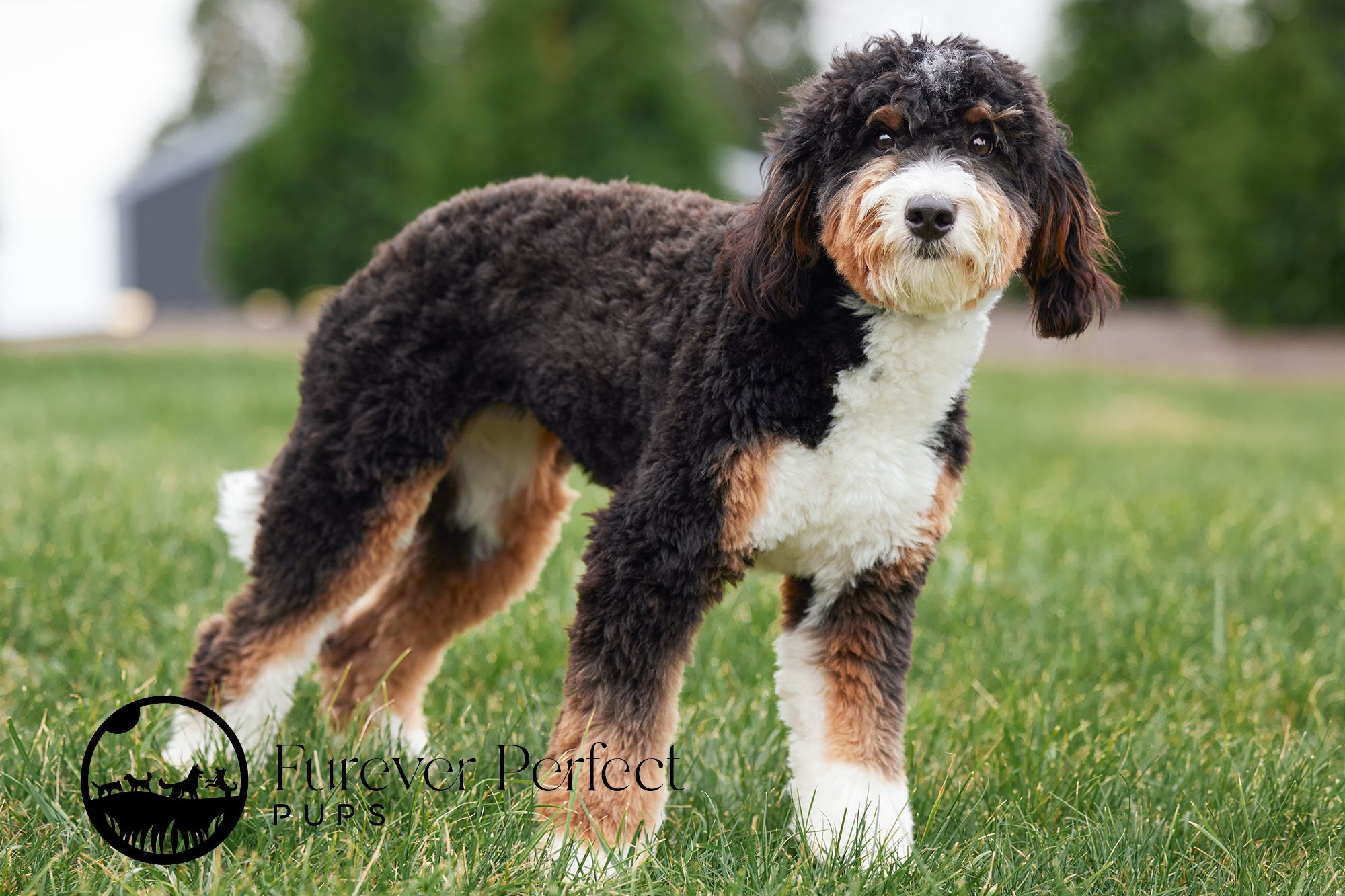
Bernedoodle Temperament by Life Stage: Puppy, Teen, and Adult
One of the most common things new Bernedoodle owners say – usually somewhere around the eight-month mark – is: “My puppy used to be so good. What happened?”
The short answer is that they grew up. Or more accurately, they’re in the process of growing up – and that journey looks very different depending on which stage they’re in. Bernedoodles don’t arrive fully formed. They go through distinct developmental phases, each with its own personality quirks, challenges, and genuine joys. The owners who navigate each stage most successfully are the ones who know what’s coming before it arrives.
This guide walks you through Bernedoodle temperament at every stage of life – from the chaos and sweetness of early puppyhood through the “what happened to my good dog?” teenage months, and into the calm, deeply bonded adult dog that all of that hard work produces.
Why Life Stage Matters More Than You Might Think
Bernedoodles don’t have a single, fixed temperament – they have a temperament in development. The same dog that melts your heart with their velcro-puppy neediness at 10 weeks might test every ounce of your patience at 10 months. And the dog who drove you a little crazy during adolescence is likely to become one of the most emotionally attuned, steady, and loving companions you’ve ever had.
Understanding what’s actually happening biologically and behaviorally at each stage changes how you respond to your dog. Instead of interpreting normal teenage stubbornness as a character flaw or worrying that your easy puppy has “turned bad,” you can approach each phase with the right expectations, the right tools, and a realistic sense of how temporary the hard parts really are.
It’s also worth noting that size plays a role in developmental timing. Smaller Mini and Tiny Bernedoodles tend to move through each stage a little faster. Standard Bernedoodles are larger dogs and take longer to reach full maturity – their adolescent phase can stretch well past 18 months, and some aren’t fully settled until closer to three years old.
Bringing home a Bernedoodle puppy is one of the most heartwarming experiences there is – and one of the most exhausting. These puppies are equal parts scientist and comedian. Everything is new, everything is interesting, and everything deserves to be investigated with their nose and, inevitably, their mouth.
What Puppies Are Actually Like Day to Day
Young Bernedoodle puppies are naturally curious, affectionate, and eager to engage. The Bernese Mountain Dog side shows up early in the form of deep people-orientation – these puppies will shadow you from room to room, making eye contact as if their life depends on it. The Poodle side shows up as rapid learning and surprising emotional sensitivity. Even very young Bernedoodle puppies respond to tone of voice and can pick up on your mood in ways that feel almost human.
Energy comes in intense, unpredictable bursts. A puppy will tear around the living room at full speed for five minutes and then crash completely. This cycle of chaos and sleep is entirely normal and actually important – puppies this age need significant amounts of sleep (often 16–18 hours per day) for healthy brain and body development. Resist the urge to keep them engaged when they need rest.
Chewing, mouthing, and nipping are universal at this stage. It’s how puppies explore their world and is a completely expected part of development – not a sign of aggression or bad temperament. Redirecting to appropriate chew toys consistently is the right approach. Never use harsh corrections for puppy mouthing; Bernedoodles are sensitive dogs and can be easily discouraged by punitive responses.
The First Fear Period: What It Is and Why It Matters
Between 8 and 11 weeks of age – right around the time most puppies come home – dogs go through what behaviorists call their first fear imprint period. During this window, the brain is particularly impressionable, and negative experiences can leave lasting marks. This is why reputable breeders work hard to ensure those early weeks are filled with gentle, positive exposure rather than stressful events.
During this period, your puppy may seem suddenly cautious about something they were fine with the day before. They might startle more easily, be hesitant in new environments, or seem momentarily overwhelmed. This is normal. The correct response is patience, gentle encouragement, and positive reinforcement – never force or flood a fearful puppy into a stressful situation. The experiences (positive and negative) that occur during this window have an outsized impact on who this dog becomes.
What Puppy Temperament Looks Like Across the Bernese/Poodle Spectrum
Because Bernedoodles can lean more toward either parent breed, puppy temperaments vary more than many new owners expect. Puppies with stronger Poodle influence tend to be more alert, quick-learning, and high-energy – they’re picking up patterns and routines before you even realize you’ve established them. Puppies with stronger Bernese Mountain Dog influence tend to be more velcro-like, emotionally sensitive, and slower to engage with training tasks but incredibly warm and people-focused from the start.
Most Bernedoodle puppies fall somewhere in the middle – which is part of what makes this breed so appealing. But paying attention to which side your individual puppy leans toward helps you tailor your approach to training and socialization from the very beginning.
What to Prioritize in the Puppy Phase
- Socialization, socialization, socialization. Expose your puppy to as many positive people, animals, sounds, surfaces, and environments as you safely can before 16 weeks. This window doesn’t come back.
- Crate training. Building a positive association with the crate early sets you up for easier alone-time training later and gives your puppy a safe space to decompress.
- Short, positive training sessions. 3–5 minutes, 2–3 times per day is plenty at this age. Keep sessions upbeat, always end on a success, and use high-value treats.
- Bite inhibition. Teach your puppy early that teeth on skin ends all playtime. Consistency here prevents adult-dog mouthing problems.
- Handling exercises. Regular, positive handling of paws, ears, mouth, and body prepares your puppy for a lifetime of grooming, vet visits, and human contact.
- Protecting sleep. Don’t over-stimulate a tired puppy. Crankiness and nipping often increase when puppies are overtired – just like human babies.
Puppy Phase Snapshot
| What You’ll See | Why It’s Happening | What Helps |
|---|---|---|
| Constant following, shadows your every move | Imprinting on their new family; Bernese attachment instinct | Normal and healthy – enjoy it while building gentle independence |
| Explosive energy bursts followed by deep sleep | Brain and body development requires rest; normal puppy cycle | Protect nap time; don’t over-stimulate |
| Mouthing and nipping everything | How puppies explore; teething discomfort peaks around 4 months | Redirect to chew toys; remove attention when teeth touch skin |
| Surprising fear of something familiar | First fear imprint period (8–11 weeks) | Patience, don’t force; use high-value treats to build positive associations |
| Picks up commands faster than expected | Poodle intelligence + socialization window wide open | Keep short, fun training sessions going daily |
If the puppy phase is all sunshine and possibility, the adolescent phase is where reality sets in – and it’s also the stage that catches more first-time Bernedoodle owners off guard than any other. The dog who used to come when called every single time now seems to be weighing up whether it’s really worth the effort. The puppy who nailed “sit” before the treat even appeared now looks at you like you’re speaking a foreign language.
Here’s the thing: this is normal. It’s not a training failure. It’s not a character flaw. It’s adolescence – and understanding what’s actually happening in your Bernedoodle’s brain and body during this phase changes everything about how you navigate it.
What’s Actually Happening Neurologically
Dog adolescence is a period of profound neurological reorganization. The prefrontal cortex – the part of the brain responsible for impulse control, decision-making, and the ability to override distractions – is still actively developing. Meanwhile, the amygdala (the brain’s fear and emotional response center) is highly active. Hormonal surges are amplifying emotional reactivity. The result is a dog that is literally less able to access learned behaviors reliably, more sensitive to novelty and stress, and more likely to be pulled toward stimulating distractions than toward you.
Research from the University of Lincoln confirms that adolescent dogs show a measurable temporary decrease in responsiveness to their caregiver – not because they’ve forgotten their training or stopped caring, but because the developing brain genuinely processes information differently during this period. Knowing this helps you stay consistent rather than frustrated when your Bernedoodle seems to “forget” everything they once knew.
The Second Fear Period: The One That Surprises Everyone
One of the most misunderstood aspects of canine adolescence is the secondary fear period, which typically occurs somewhere between 6 and 14 months – though it can emerge as late as 18 months, especially in larger Standard Bernedoodles. Unlike the first fear period in puppyhood, this one arrives without warning and often shocks owners who have done everything right.
A dog who has been beautifully socialized may suddenly become wary of people they’ve met before, bark at objects they’ve walked past hundreds of times, or become hesitant in environments they previously loved. One day they’re confident; the next they seem inexplicably unsettled. This Jekyll-and-Hyde quality is disorienting but temporary.
Typical Adolescent Bernedoodle Behaviors
The specific ways adolescence shows up can vary depending on whether your Bernedoodle leans more Poodle or more Bernese Mountain Dog – but there are common threads across the breed.
Selective hearing. Your dog hears you perfectly well. They’re simply processing whether responding is worth overriding whatever is currently more interesting. This isn’t defiance so much as a developing prioritization system that hasn’t been fully wired yet. Consistent reinforcement of recall and commands during this period – even when it’s harder – is what closes the gap.
Boundary testing. Adolescent Bernedoodles will probe the edges of rules that seemed fully established. They may try jumping on guests again, pull harder on leash, or revisit behaviors you thought were long extinct. This is their way of mapping the social landscape and confirming where the consistent lines are. Maintaining those lines calmly and consistently (without escalating frustration) is the right approach.
Increased energy and intensity. Many owners are surprised to find that their dog’s energy actually increases during adolescence compared to later puppyhood. Physical size and capacity are growing faster than behavioral maturity, which creates a dog that can do a lot of things but hasn’t yet learned to moderate that impulse. Exercise needs increase significantly during this phase.
Stubbornness. This is where the Bernese Mountain Dog’s independent streak tends to surface most clearly. Unlike the Poodle-influenced eagerness to please that usually makes early training feel easy, adolescence can bring out a more “I’ll do it on my own terms” quality. Patience and positive reinforcement continue to be far more effective than any kind of coercion or punishment.
Emotional sensitivity. Even in the middle of all the boundary-pushing, adolescent Bernedoodles remain genuinely sensitive dogs. They can be hurt by harsh words or tones, and a sharp correction at the wrong moment can set back your training relationship significantly. Staying firm without being harsh is both possible and necessary with this breed.
How Size Affects the Teen Phase
| Size | Adolescence Typically Begins | Full Maturity | Notes |
|---|---|---|---|
| Tiny Bernedoodle | ~5–6 months | ~14–18 months | Shorter, more compact adolescence; tends to calm faster |
| Mini Bernedoodle | ~6 months | ~18–24 months | Most common size – teen phase well-managed with consistent training |
| Standard Bernedoodle | ~6–8 months | ~24–36 months | Longest adolescence; physical size outpaces maturity – leash training is especially important |
What to Prioritize in the Adolescent Phase
- Don’t stop training. This is the exact phase when owners often give up on structure because it feels like nothing is working. In fact, this is when consistency matters most. The habits built during adolescence stick.
- Increase exercise. A well-exercised Bernedoodle teenager is a more manageable one. Channel that physical energy appropriately before asking for focus and calm.
- Continue socialization. Don’t let adolescent uncertainty pull you back from new experiences. Keep getting your dog out into the world – just be thoughtful about not pushing past their current comfort threshold.
- Reinforce the basics, constantly. Recall, leash manners, sit and stay – keep practicing these every single day even if they feel “learned.” Adolescent brains need more repetitions to wire behaviors solidly.
- Be boring about rule enforcement. Calm, consistent, emotionless repetition of the rules is far more effective than escalating frustration. Your Bernedoodle isn’t trying to upset you – they’re developing.
- Consider structured classes. Group training classes during adolescence serve double duty: obedience practice and continued socialization in a controlled environment.
Adolescent Phase Snapshot
| What You’ll See | Why It’s Happening | What Helps |
|---|---|---|
| Ignoring commands they knew perfectly | Prefrontal cortex still developing; impulse control is genuinely harder | More practice, shorter sessions, higher-value rewards |
| Sudden fear of familiar things | Secondary fear period (6–14 months) | Don’t force; reward calm behavior at a comfortable distance |
| Testing old rules again (jumping, pulling) | Mapping the social hierarchy; normal boundary exploration | Calm, consistent enforcement without frustration |
| More energy, more intensity | Physical capacity growing faster than behavioral maturity | Increase daily exercise; channel energy before asking for focus |
| Stubborn, independent streaks | Bernese Mountain Dog independence emerging; hormonal influence | Positive reinforcement; patience; never punitive methods |
If you’ve made it through puppyhood and adolescence with your training intact and your patience mostly in one piece – this is your reward. Adult Bernedoodles are genuinely extraordinary dogs. The emotional intelligence that was present in hints during puppyhood deepens into something remarkable. The trainability that was unpredictable during adolescence becomes reliable and even effortless. The velcro-puppy attachment matures into a steady, deep bond that adjusts to the rhythm of your life.
This is the dog you imagined when you first decided to get a Bernedoodle.
What Adult Bernedoodle Temperament Actually Looks Like
Calm confidence. The most dramatic shift owners notice when their Bernedoodle reaches full maturity is a fundamental settling. The unpredictable energy spikes smooth out. The reactivity that cropped up during adolescence fades. Adult Bernedoodles move through the world with a relaxed confidence that makes them easier to take anywhere – restaurants with outdoor seating, hikes, family gatherings, road trips.
Deep emotional attunement. Adult Bernedoodles are often described by their owners as having an almost psychic awareness of human emotion. This comes from both sides of the family – the Bernese Mountain Dog’s legendary empathy and the Poodle’s sensitivity to cues – but it deepens significantly with age. A mature Bernedoodle will often position themselves next to a family member who is sad, anxious, or unwell without being asked to. It’s one of their most remarkable qualities and a big reason why they make such exceptional therapy and emotional support dogs.
Settled independence. Unlike the clingy puppy phase or the volatile adolescent phase, adult Bernedoodles develop a healthier balance around independence. They still love being close to their people – that never fully changes – but they’ve also learned to settle calmly when you’re busy, handle reasonable periods alone, and self-regulate in a way that earlier stages made feel impossible.
Retained playfulness. One of the most beloved qualities of the adult Bernedoodle is that they don’t fully lose their puppy heart. Even well into adulthood, Bernedoodles will initiate play, bring you toys, and approach the world with a kind of joyful engagement that makes them wonderful family companions. The chaos is gone; the joy remains.
Physical Maturity vs. Emotional Maturity
It’s worth separating these two things, because they don’t arrive on the same timeline. Most Bernedoodles reach their full adult size well before they reach full behavioral and emotional maturity. A Standard Bernedoodle may stop growing physically at around 18 months but continue maturing temperamentally until age 2.5 or even 3. Mini Bernedoodles typically reach emotional maturity a bit earlier, around 18–24 months.
This is an important distinction because it helps owners set realistic expectations. A physically large two-year-old Standard Bernedoodle is not the same as a fully emotionally mature adult, even if they look the part.
Does a Bernedoodle’s Temperament Keep Changing After Adulthood?
In meaningful ways, yes. Adult Bernedoodles continue to develop emotionally throughout their lives, particularly in response to their environment, their relationships, and their experiences. Dogs that are well-trained, regularly socialized, and given consistent mental and physical stimulation throughout adulthood tend to remain more emotionally flexible and adaptable as they age. Dogs whose training and socialization lapse in adulthood can become more anxious, reactive, or stubborn over time.
The takeaway is that reaching adult maturity isn’t the end of the work – it’s the beginning of the relationship in its fullest form. Ongoing training, continued socialization, and regular mental enrichment aren’t just for puppies. They’re what keeps an adult Bernedoodle thriving.
The Senior Years (7+ Years for Standard, 8–10+ for Mini/Tiny)
As Bernedoodles enter their senior years, the pace of life naturally slows. Exercise needs decrease, naps become more frequent, and the deep emotional bond they’ve built with their family becomes even more central to their wellbeing. Senior Bernedoodles are often described as the easiest and most rewarding phase by longtime owners – a quiet, steady companionship built on years of trust.
Health monitoring becomes more important in the senior years. Joint support, regular veterinary checkups, and a diet appropriate for an older dog all help preserve quality of life. Mental stimulation remains valuable even as physical activity decreases – short, low-key training sessions and puzzle toys keep the mind engaged and contribute to overall cognitive health.
What to Prioritize in the Adult Phase
- Maintain training, even informally. Regular “refreshers” on commands and manners keep an adult Bernedoodle sharp and reinforce good habits
- Continue socialization. An adult dog that stops encountering new people, places, and experiences can become less adaptable over time. Keep getting them out into the world.
- Adjust exercise as they age. Energy needs peak in early adulthood and gradually decrease. Adjust activity levels to match your individual dog, particularly as they move into middle and senior years.
- Watch for early health signs. Joint stiffness, changes in appetite, weight shifts, or behavioral changes in an adult or senior dog warrant a veterinary conversation.
- Lean into their emotional intelligence. Adult Bernedoodles make exceptional therapy dogs, emotional support animals, and family anchors. Nurturing this quality through continued relationship-building pays dividends throughout their life.
Adult Phase Snapshot
| What You’ll See | Why It’s Happening | What Helps |
|---|---|---|
| Reliable, consistent behavior | Full neurological maturity; habits are solidly wired | Maintain with periodic refresher training |
| Deep emotional attunement to family | Years of bonding; Bernese emotional intelligence fully expressed | Nurture with quality time and relationship-building |
| Settled, calm demeanor in most situations | Emotional maturity; confidence built through good socialization | Continue socialization to maintain adaptability |
| Retained playfulness | Part of Bernedoodle character; doesn’t fade fully with age | Enjoy it – make time for play throughout adult life |
Life Stage Comparison at a Glance
| Characteristic | Puppy (8 wks – 6 mo) | Teen (6 mo – 2 yrs) | Adult (2–3 yrs+) |
|---|---|---|---|
| Energy Level | High, bursty | Very high, sustained | Moderate, steady |
| Trainability | High – rapid learning window | Variable – distractible, tests limits | Excellent – reliable and consistent |
| Emotional Sensitivity | High – impressionable | High – reactive, fear periods | Deep attunement, well-regulated |
| Independence | Low – strong velcro phase | Increasing – boundary testing | Balanced – confident independence |
| Socialization Priority | Critical (window closes ~16 wks) | Very Important – continue carefully | Ongoing – maintains adaptability |
| Biggest Challenge | Mouthing, sleep schedules, crate training | Selective hearing, boundary testing, fear periods | Joint health, ongoing enrichment |
| Greatest Reward | Rapid learning, deep early bonding | Watching them develop and grow | Steadiness, emotional intelligence, full companionship |
Frequently Asked Questions
When do Bernedoodles calm down?
Most Bernedoodle owners notice a significant shift in energy and impulse control somewhere between 18 months and 2 years. Standard Bernedoodles often take a little longer – some aren’t fully settled until closer to 3 years. The key is staying consistent with training and exercise through the adolescent phase, rather than waiting for the calm to arrive on its own.
My Bernedoodle was great at 4 months and suddenly seems anxious and reactive. What happened?
Almost certainly, the secondary fear period. This developmental phase typically arrives between 6 and 14 months, and it’s notorious for catching well-prepared owners off guard. A previously confident dog may suddenly become wary of familiar things, reactive on walks, or hesitant in situations they previously loved. It’s temporary. Don’t force exposure, use positive reinforcement, and stay consistent. It passes.
Does a Bernedoodle’s personality change a lot from puppy to adult?
Yes – considerably. The fundamental temperament stays consistent (a naturally gentle, people-oriented Bernedoodle will always be those things), but the expression of that temperament shifts significantly at each stage. The chaos and intensity of puppyhood gives way to adolescent complexity, which resolves into the steady, emotionally rich adult dog that Bernedoodles are truly known for.
Are male and female Bernedoodles different temperamentally across life stages?
There are generalized tendencies – males often mature slightly later and can be more playful and exuberant into adulthood, while females may show more independence and can sometimes be more focused in training. But individual variation within each sex is wide, and the influence of early socialization, training quality, and environment far outweighs gender in determining adult temperament.
Will my Bernedoodle always need as much exercise as they do during adolescence?
No. Exercise needs peak during adolescence and early adulthood and gradually decrease as the dog matures. Senior Bernedoodles need regular but lower-intensity activity. The important thing is that mental stimulation – puzzle toys, training, exploration – remains valuable at all life stages, even when physical exercise naturally scales back.
How does a puppy’s start with their breeder affect adult temperament?
Profoundly. The experiences a puppy has between 3 and 16 weeks – the critical socialization window – lay the neurological foundation for everything that comes after. Puppies raised in enriched environments with Early Neurological Stimulation (ENS), exposure to varied sounds and surfaces, handling by different people, and positive early interactions are measurably more confident, adaptable, and emotionally resilient as adults. This is one of the most important things to ask about when choosing a breeder.
Final Thoughts: The Journey Is Worth It
Bernedoodles are not a “set it and forget it” dog. They grow, they change, and they need owners who understand what they’re going through at each stage of the journey. The puppy phase demands patience and intentionality. The teen phase demands consistency when consistency is hardest to maintain. And the adult phase – the long, deep, beautiful main act of the relationship – rewards every bit of that investment with a dog that is genuinely one of a kind.
What makes Bernedoodles special isn’t just how they look or how smart they are. It’s that emotional thread that runs through every stage of their development – from the wide-eyed puppy shadowing you around the kitchen to the wise, calm adult who somehow always knows when you need them most. That quality is worth every challenging moment in between.
If you have questions about a specific stage you’re navigating with your Bernedoodle, we’re always here. And if you’re still searching for the right puppy to start this journey with, we’d love to talk about what we breed and how we set every puppy up for success from day one.