

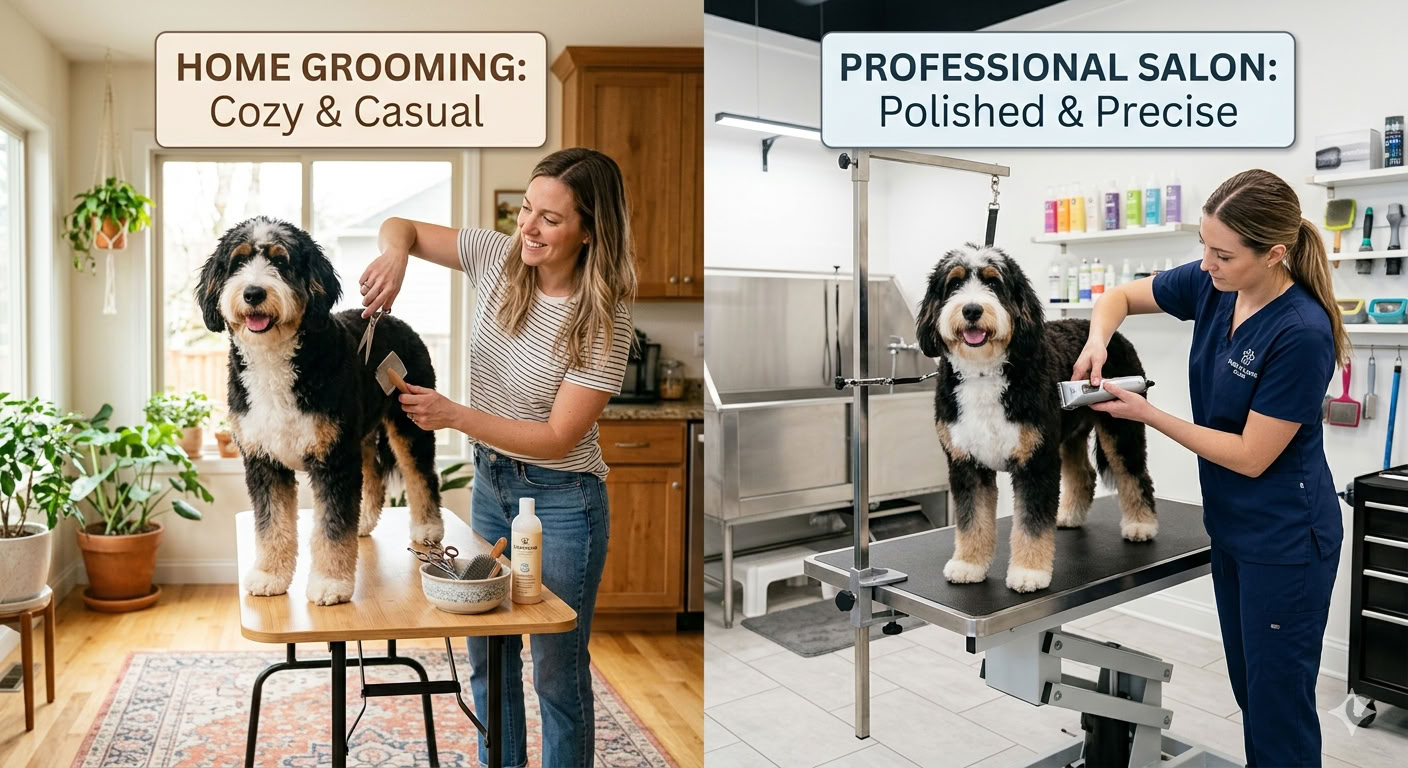
Home Grooming vs Professional Grooming for Bernedoodles: Costs and Tradeoffs
Bernedoodle grooming is one of the most consistent sources of sticker shock for new owners, and one of the most misunderstood aspects of what ownership actually costs over time. The breed’s low-shedding coat, which is a genuine and practical asset in a household, requires active maintenance that does not happen on its own. The question is not whether your Bernedoodle needs regular grooming. It does. The question is who does it, at what cost, and with what tradeoffs across the dog’s twelve to fifteen year lifespan.
The choice between home grooming and professional grooming is rarely all-or-nothing in practice. Most owners who do any meaningful amount of home grooming still rely on professional groomers for haircuts, and most owners who use professional groomers exclusively still need to brush between appointments to prevent the matting that makes those appointments more expensive. The realistic picture for almost every Bernedoodle owner is some version of a hybrid approach, and the useful question is not “should I groom at home or use a professional” but rather “which tasks belong at home, which belong at the groomer’s, and what does each option actually cost.”
This guide gives you the specific cost picture for both professional and home grooming by Bernedoodle size, explains what each approach requires in terms of time and skill, addresses the coat-type variables that change the calculation significantly, and provides the practical framework for building a grooming plan that fits your household’s budget, schedule, and ability level. Every figure in this guide reflects current 2025 to 2026 pricing from grooming industry sources and real grooming service price lists.
Bernedoodles inherit coat characteristics from both parent breeds, and the coat that shows up in any individual puppy determines its grooming requirements more than any other single factor. Hound Therapy’s comprehensive Bernedoodle grooming guide identifies three distinct coat types that appear in the breed, each with its own maintenance profile.
Wavy coats, most common in F1 Bernedoodles, have a looser texture that falls somewhere between the Bernese Mountain Dog’s flat coat and the Poodle’s tight curl. They shed minimally, mat less readily than curly coats, and are generally the most forgiving for owners doing home maintenance. A wavy-coated Bernedoodle that is brushed three to four times per week can go eight to ten weeks between professional grooming appointments without significant matting risk, and home brushing sessions are manageable for most owners with moderate grooming experience.
Curly coats, more common in F1B and multigeneration Bernedoodles with higher Poodle percentage, have tight curls that provide maximum low-shedding quality and are the most allergy-friendly coat type. They are also the highest-maintenance coat in the breed. Hound Therapy specifically notes that curly coats require regular professional grooming to prevent matting disasters and are the most high-maintenance option. A curly-coated Bernedoodle that is not brushed with discipline will mat faster than most owners anticipate, and those mats form preferentially in the friction zones that are hardest to reach: behind the ears, in the armpits, between the back legs, and under the collar. Professional grooming frequency for curly coats is typically every four to six weeks rather than the six to eight week interval that works for wavy coats.
Straight or flat coats, less common and typically seen in dogs with lower Poodle percentage, have the simplest maintenance requirements of the three. They are also the most likely to shed and the least allergy-friendly, which is why most Bernedoodle breeders select for wavy or curly coats in their programs.
Professional grooming costs for Bernedoodles and Poodle crosses are higher than for many breeds because the coat type requires more time, more specialized skill, and more equipment to manage well. A doodle coat groomed correctly takes significantly longer than a short-coated breed, and professional groomers price accordingly. The Pet Station’s October 2025 price list, one of the cleaner real-world examples of current doodle-specific grooming pricing, shows doodle and Poodle mixes starting at $90 for dogs under 20 pounds, $103 for 21 to 30 pounds, $116 for 31 to 40 pounds, $128 for 41 to 50 pounds, and $141 for 51 to 60 pounds. Standard Bernedoodles at 70 to 90 pounds typically fall in the $150 to $180 range per full groom appointment at comparable pricing tiers in most markets.
Across multiple current sources including Fox Creek Farm, Fawn River Doodles, and Dogster’s 2026 cost guide, the range most commonly cited for professional Bernedoodle grooming is $75 to $150 per session for Mini and Medium Bernedoodles and $120 to $180 for Standard Bernedoodles. Urban markets with higher costs of living, as the We Love Doodles grooming guide notes, sit at the higher end of these ranges or above them. Rural and suburban markets tend to be closer to the lower end. The figures below represent a reasonable mid-market estimate for each size.
| Size | Typical Groom Cost | Recommended Frequency | Estimated Annual Cost |
|---|---|---|---|
| Mini Bernedoodle 25 to 50 lbs | $75 to $110 per session | Every 6 to 8 weeks (6 to 9 appointments per year) | $550 to $990 |
| Medium Bernedoodle 35 to 55 lbs | $90 to $130 per session | Every 6 to 8 weeks (6 to 9 appointments per year) | $650 to $1,170 |
| Standard Bernedoodle 70 to 90 lbs | $120 to $180 per session | Every 6 to 8 weeks, sometimes every 4 to 6 weeks for curly coats | $870 to $1,980 |
What a Full Professional Groom Includes
A full groom appointment from a professional includes bath with shampoo and conditioner appropriate to the coat type, blow-dry and brush-out, full body haircut or trim to the owner’s specified style, nail trim, ear cleaning, and often ear hair removal from the ear canal to prevent infection. Some groomers include anal gland expression and teeth brushing as standard; others offer these as add-ons at $10 to $20 each. The Golden Paw Pet Services grooming guide notes that add-on services including de-shedding treatments, specialty shampoos, and teeth cleaning increase the final bill, so clarifying what is included in the base price before booking avoids checkout surprises.
What Professional Groomers Provide That Home Grooming Cannot Fully Replace
The argument for professional grooming is not purely about convenience. Professional groomers who specialize in doodle coats bring skill, equipment, and an objective perspective on coat condition that most home groomers cannot replicate regardless of how much they invest in tools. A professional groomer working on a Bernedoodle can reach and properly groom areas that are genuinely difficult to manage at home, including the ear canal, the tight areas between the paw pads, and the interior of dense mat zones that require a specific technique to address without causing pain. A trained groomer also conducts a thorough physical inspection of the dog’s skin and coat during every appointment, which regularly identifies skin irritations, early hot spots, lumps, ear infections, and other health issues before they escalate.
For curly-coated Bernedoodles especially, the quality difference between a professionally groomed coat and a home-groomed one is significant. Achieving the clean lines and proportional styling of a Bernedoodle haircut requires clipper work, scissoring skills, and breed-specific knowledge that takes months to develop even with dedicated practice. Owners who want their Bernedoodle to look like the groomed photos that attracted them to the breed will, in most cases, rely on professional grooming for the haircut portion of the process regardless of what they handle at home.
Home grooming for Bernedoodles is a spectrum rather than a binary, and the most useful framing is task-by-task rather than all-or-nothing. Some home grooming tasks are straightforward, require modest equipment investment, and are well within the capability of any owner willing to learn. Others require meaningful skill development and equipment investment to do well. And a few, particularly the full body haircut on a curly coat, are genuinely difficult to do at a quality level that matches professional work without significant practice.
What Every Owner Should Be Doing at Home
Regardless of how much professional grooming a Bernedoodle receives, every owner needs to handle the maintenance tasks that happen between appointments. These are not optional, and they determine whether professional appointments are routine or remedial.
- Brushing three to four times per week, or daily for curly coats. The Freshly Bailey grooming guide recommends brushing your Bernedoodle at least three to four times per week, daily if they have a curly coat. This is the most important single maintenance task in any Bernedoodle grooming program and the one most owners underinvest in during the first year.
- The line brush technique rather than surface brushing. Working through the coat section by section from the skin outward, ensuring the brush reaches the skin rather than gliding over the surface of the coat, is the technique that prevents mat formation at the root level. Surface brushing that does not reach the skin leaves mats forming close to the skin while the top layer looks fine. This is the most common brushing mistake and the one that produces the dematting emergencies owners experience at grooming appointments.
- Ear inspection and basic cleaning weekly. Bernedoodles are prone to ear infections due to the floppy ear conformation and hair growth in the ear canal. Lifting the ear flap and checking for redness, odor, or discharge weekly takes thirty seconds and regularly catches early infections before they become painful and costly veterinary issues.
- Nail trimming every two to four weeks. Nails that grow too long alter the dog’s gait, create discomfort on hard surfaces, and can curl and grow into the pad if severely neglected. Most dogs that receive professional grooming every six to eight weeks will still need nail trimming between appointments. A pair of quality nail clippers costs $15 to $25 and reduces veterinary nail trim fees significantly over the dog’s lifespan.
- Post-outdoor paw wipe and coat check. Running a hand through the coat after every outdoor session, paying particular attention to the armpits, behind the ears, and between the back legs, catches burrs, debris, and early mat formation before they become embedded problems.
The Essential Home Grooming Tool Kit
A properly equipped home grooming setup for a Bernedoodle does not require professional-grade clippers to maintain the coat between professional appointments. It does require quality tools in the specific categories that matter for this coat type. Buying cheap versions of these tools is a false economy: a low-quality slicker brush that does not penetrate a Bernedoodle’s dense coat is effectively useless regardless of how regularly it is used.
| Tool | What It Does | Approximate Cost | Notes |
|---|---|---|---|
| Quality slicker brush | Primary brushing tool; penetrates the coat to the skin to prevent mat formation at the root | $20 to $50 | The Chris Christensen Big G is widely recommended by professional doodle groomers; avoid cheap versions with thin, flexible pins that bend on contact with a dense coat |
| Metal greyhound comb | Finishing comb used after the slicker brush to confirm no tangles remain; the test is combing from skin to tip with no resistance | $10 to $20 | If the comb snags, the brush-out is incomplete regardless of how good the coat looks on the surface |
| Dematting comb | Removes stubborn mats by cutting through them; use only on mats that cannot be worked out with the slicker brush | $12 to $25 | Start at the mat’s edges and work inward; never drag through a mat from the base |
| Detangling spray | Applied before brushing to soften the coat, reduce static, and ease brush passage through tangles | $10 to $20 | Makes brushing faster and more comfortable for the dog; particularly useful on a coat that has gone more than two days without brushing |
| Nail clippers | Routine nail maintenance between professional appointments | $15 to $25 | A clipper with a safety guard prevents cutting the quick; introduce gradually with positive reinforcement before the first trim |
| Dog-specific shampoo and conditioner | Home bathing every four to six weeks between professional appointments if desired | $15 to $35 per set | Human shampoos disrupt the skin’s pH balance; use a product formulated for dogs with a low-shedding or doodle-specific coat formula |
The total investment for a complete home maintenance tool kit from the above list runs approximately $80 to $175 for quality versions of each item. This is a one-time cost that, amortized across the dog’s lifespan, represents a very small per-session investment. The ongoing consumable cost is the detangling spray and shampoo, which run perhaps $50 to $80 per year for most dogs.
Taking Home Grooming Further: The Full Haircut
Some owners progress beyond maintenance into doing full haircuts at home using clippers. The BestBernedoodles grooming guide notes that DIY trimming requires investing in quality clippers and taking a basic dog grooming course. This is accurate and worth taking seriously. Professional-grade clippers for a Standard Bernedoodle run $150 to $300 for quality models recommended by professional doodle groomers. Learning to clip a Bernedoodle coat well enough to produce even lines, appropriate proportions, and a clean finish takes meaningful practice and will involve at least several appointments’ worth of imperfect results during the learning curve.
The owners for whom full home clipping works well are typically those who have time to invest in learning the skill, who are comfortable with a utilitarian trim aesthetic rather than a styled finish, and who have a dog that tolerates the grooming process calmly. The owners for whom it works less well are those who expect professional-quality results from the start, whose dog is anxious or difficult to handle during grooming, or whose coat is curly enough that clipper work requires more technique than a brushing-only approach.
The following projections use mid-range professional grooming costs based on current 2025 to 2026 market pricing, a ten-year lifespan (conservative for a Mini Bernedoodle, roughly appropriate for a Standard), and the assumption of consistent maintenance throughout. They illustrate the real financial scale of the decision rather than the per-appointment cost that most owners focus on.
| Approach | Mini Bernedoodle (10 years) | Standard Bernedoodle (10 years) | Key Assumptions |
|---|---|---|---|
| Full professional grooming Every 6 to 8 weeks, all tasks at groomer | $7,500 to $9,900 | $10,800 to $18,000 | No home clipping; brushing done at home between appointments; all nails, ears, baths at groomer |
| Hybrid: professional haircuts, home maintenance Professional every 8 to 10 weeks; all brushing, bathing, nails at home | $4,500 to $7,000 professional + $800 to $1,200 tools and consumables | $7,200 to $11,000 professional + $1,000 to $1,500 tools and consumables | Quality home tools purchased once; bathing and nail trimming done at home; professional does haircut only |
| Mostly home grooming Professional twice yearly for full groom; all else at home including clipping | $1,500 to $2,200 professional + $1,500 to $2,000 tools and consumables | $2,400 to $3,600 professional + $2,000 to $3,000 tools and consumables | Requires quality clippers ($150 to $300), skill development, and reliable home grooming discipline; professional touch-ups twice annually |
The hybrid approach, where professional groomers handle the haircut and any dematting while owners handle brushing, bathing, nail trimming, and ear maintenance between appointments, represents the best balance of cost, quality, and time investment for most families. It captures most of the savings from home grooming while preserving the quality and health-monitoring benefit of regular professional contact. It also reduces the chance of the matting emergencies that drive up professional grooming costs, because a dog whose coat is maintained at home between appointments arrives at the groomer in manageable condition every time.
The hybrid approach is not simply “do some things at home and go to the groomer sometimes.” It requires deliberate task allocation based on what the dog’s coat actually needs, what each party does best, and what the home groomer is realistically able to maintain consistently. The following framework is what works in practice for most Bernedoodle owners.
Tasks That Belong at Home
- Brushing three to four times per week. This is non-negotiable regardless of grooming approach. No professional grooming schedule eliminates the need for regular brushing between appointments.
- The finish comb-through after every brushing session. Running a metal comb through the fully brushed coat from skin to tip with no snagging is the quality check that confirms the brush-out was thorough.
- Nail trimming every two to three weeks. With a quality pair of nail clippers and a dog that has been positively introduced to the process, this takes under five minutes and eliminates one of the most common add-on charges at grooming appointments.
- Ear inspection and wipe-out weekly. A clean cotton ball or soft cloth with a veterinarian-recommended ear cleaning solution applied to the visible inner ear takes thirty seconds and prevents the infections that develop in floppy-eared dogs with neglected ear hygiene.
- Post-outdoor coat checks for burrs, debris, and friction mat formation in the armpits and between the back legs.
- Bathing every four to six weeks if the owner is comfortable doing this at home. Dog-specific shampoo and conditioner appropriate to the coat type, warm water, and thorough drying with a blow dryer on a low heat setting reduces grooming appointment frequency and allows the owner to keep the coat fresher between professional visits.
Tasks That Belong at the Professional Groomer
- The full haircut every six to eight weeks, or every four to six weeks for tightly curly coats. This is where professional skill, equipment, and breed-specific knowledge produce results that most home groomers cannot match reliably.
- Ear hair removal from the ear canal, which requires specific tools and technique to do safely and which most veterinarians agree should be left to professionals unless the owner has been specifically trained.
- Any dematting required when home brushing has fallen behind. A professional groomer with the right dematting tools can often save a coat that an inexperienced home groomer would make worse by pulling through incorrectly.
- The puppy coat transition groom at six to ten months, which manages the transition period that produces peak matting risk. Having a professional groom timed to the start of this transition reduces the severity of the matting challenge during it.
Matting in Bernedoodle coats follows predictable patterns and develops faster than most owners realize the first time it happens. Understanding both of these things allows owners to invest their grooming time where it actually prevents the problems rather than discovering them at a grooming appointment.
Where Mats Form First
Friction zones are the primary culprit. The areas where the coat rubs against itself during movement, including the armpits, the area behind the ears where the collar sits, the groin area between the back legs, and the belly where the dog lies on surfaces, develop mats significantly faster than the top of the back or the sides. These areas are also the hardest to see without deliberately looking for them, which is why owners who think they are brushing regularly often discover mats in these specific locations at grooming appointments. A deliberate check of these friction zones during every brushing session catches mat formation early, when it can be worked out with the dematting comb in a few minutes rather than requiring professional dematting or a shave-down.
Moisture accelerates mat formation. A Bernedoodle that has been swimming, caught in rain, or bathed without being thoroughly dried and brushed while wet will mat significantly faster than one that has been kept dry. The Freshly Bailey brushing guide includes a specific warning: always brush a completely dry coat. If you bathe your dog, brush the coat thoroughly before the bath and again after it is completely dry. Brushing a wet or damp coat drives moisture down the hair shaft and creates the conditions for mat formation at the root.
The Puppy Transition Period Requires Extra Vigilance
As noted in the coat type section above, the puppy-to-adult coat transition is the highest-risk matting period in the dog’s life. During the months when both coat types are present simultaneously, the softer puppy coat and the developing adult coat interlock in ways that create dense mats close to the skin even in dogs whose owners are brushing regularly. Increasing brushing frequency to daily during this period, scheduling a professional grooming appointment at the start of it rather than at the usual interval, and accepting that extra effort during this window will save significantly more effort later are the practices that get owners through it successfully.
Frequently Asked Questions
How do I find a good groomer for a Bernedoodle specifically?
Ask specifically whether the groomer has experience with doodle coats, because Bernedoodle and doodle grooming is a specialized skill that not every generalist dog groomer has developed. A groomer who primarily cuts short-coated breeds will struggle with the dense, curly coat that requires specific techniques to manage well. Word of mouth from other Bernedoodle or doodle owners in your area is the most reliable sourcing method. Doodle-specific Facebook groups, local Bernedoodle owner communities, and asking your breeder for groomer recommendations in your area are all more reliable than general review sites where grooming quality is difficult to assess from written reviews alone. Before the first appointment, ask whether the groomer does a pre-groom consultation to understand the style you are looking for, whether they have photos of doodle haircuts they have done, and what their policy is for severely matted dogs. The answers tell you a great deal about whether this groomer has the right background for your dog.
My Bernedoodle hates being groomed. What should I do?
Grooming resistance in adult dogs is almost always rooted in either insufficient early handling and grooming introduction during puppyhood, or a specific negative experience, often a painful mat removal or a clumsy nail trim that cut the quick, that created an aversion. The approach depends on the severity. A dog with mild resistance, pulling away and tolerating but not enjoying grooming, responds well to high-value treat reinforcement throughout every session, keeping sessions short and ending on a positive note, and gradually building duration as the dog accumulates more positive than negative experiences. A dog with significant grooming anxiety, showing escape attempts, growling, or snapping, warrants a consultation with a certified professional dog trainer before continuing home grooming sessions that are reinforcing the aversion. Some professional groomers also specialize in anxious dogs and can provide a lower-stress professional experience while the owner rebuilds positive associations at home between appointments.
Can I bathe my Bernedoodle at home, and how often?
Yes, and most owners can manage this with reasonable comfort once the dog is accustomed to the process. The Bestbernedoodles grooming guide recommends bathing every four to six weeks, noting that excessive bathing strips natural oils from the coat. The practical requirements for home bathing are warm water, dog-specific shampoo and conditioner appropriate to the coat type, and thorough drying with a blow dryer on a low heat setting because leaving a Bernedoodle coat damp accelerates mat formation. A dog that has been brushed before the bath, bathed thoroughly with proper products, and dried and brushed again immediately after is a dog whose coat is in excellent condition between professional appointments. Home bathing reduces grooming appointment frequency, keeps the coat smelling clean, and, for a dog that has been positively introduced to it, is a manageable part of the regular grooming routine.
How long does a typical home brushing session take?
For a Mini Bernedoodle in good coat condition, a thorough brush-out including the friction zones takes approximately 10 to 20 minutes. For a Standard Bernedoodle, 20 to 40 minutes depending on coat density and how recently the dog was last brushed. These times increase substantially if the coat has gone more than three or four days without brushing, because the mat formation that begins in the friction zones in that window requires more careful, slower work to address. The owners who find brushing most burdensome are typically those who let four to seven days pass between sessions and then face a longer, more difficult session rather than building the shorter, easier sessions into the routine three to four times per week as recommended. Brushing is faster and easier for both the owner and the dog when done frequently enough that there is nothing serious to address.
Is there a grooming style that requires less maintenance between appointments?
Yes, and it is one of the most useful practical decisions available to owners who find the full maintenance routine challenging. A shorter overall clip length, sometimes called a teddy bear clip in a shorter version, significantly reduces mat formation between appointments because there is simply less coat length for tangles to develop in. A dog kept in a two to three inch clip on the body will mat less quickly than the same dog in a longer four to five inch style, and the brushing sessions required to maintain it are shorter and easier. The tradeoff is that a shorter style requires more frequent professional grooming appointments to maintain a neat appearance, since shorter hair grows out more visibly over six to eight weeks. For owners who find the brushing commitment challenging, discussing a shorter maintenance clip with your groomer is a practical option that reduces the home burden while accepting somewhat more frequent professional visits.
What grooming preparation do your puppies have before coming home?
Every puppy in our program is introduced to brushing, handling, and basic grooming procedures from the earliest weeks of life using positive reinforcement and patient, calm handling. Puppies are touched and handled on their paws, ears, face, and body daily, which builds the tolerance for grooming contact that makes every future brushing session and professional appointment easier. We provide every family with specific guidance on the brushing technique, tool recommendations, and frequency that applies to their puppy’s specific coat type, and we are available to troubleshoot grooming questions post-placement as the coat develops through the puppy transition and into adulthood. The puppy’s first professional grooming appointment is something we encourage families to schedule within the first three to four months for socialization to the experience specifically, ideally as a positive puppy visit that builds a good relationship with the groomer before any significant coat work is needed. Starting that relationship early, while the puppy coat is easy and the puppy is in the socialization window, produces a dog that approaches professional grooming as ordinary rather than alarming throughout its life.
Final Thoughts
Bernedoodle grooming is a real, significant, ongoing commitment that should be understood clearly before rather than after a puppy comes home. The coat is worth it: the low-shedding quality, the aesthetic appeal, and the practical household benefits of a breed that does not distribute hair across every surface in the home are genuine advantages that owners value consistently. But those advantages come with the maintenance requirement that the breed’s coat demands, and the owners who are happiest with their grooming routines are those who understood this going in and planned accordingly.
The hybrid approach, professional haircuts every six to eight weeks and consistent home maintenance between appointments, serves most Bernedoodle owners better than either extreme. It controls cost without sacrificing coat quality, keeps the professional appointments straightforward rather than corrective, and builds the home grooming habits that protect the dog’s comfort and coat health across its full lifespan. Starting with quality tools, learning the line brush technique, and committing to three to four brushings per week from the first week the puppy comes home is the foundation that everything else builds on. It is genuinely manageable. It just has to be consistent.