


Month-by-Month Growth Timeline of a Poodle Puppy
By Furever Perfect Pups | May 11, 2026 |

By Furever Perfect Pups | July 27, 2026 | Bernedoodle Resources
The single most common mistake we see families make with a new Bernedoodle is treating the first meeting between animals as a formality rather than the most important thing they will do in the first month. A front-door introduction with two excited animals, tight leashes, and everyone talking at once is not a greeting. It is a pressure test, and the animals often fail it in ways that take weeks or months to undo. The good news is that this is one of the most controllable variables in your dog’s early life. How your Bernedoodle meets the other animals in your home is almost entirely up to you, and the protocols that work are well established.
Bernedoodles bring a specific temperament profile to this process, and understanding it changes how you should approach every introduction. The Bernese Mountain Dog side of the cross contributes a calm, deeply bonded, emotionally sensitive dog that reads the atmosphere in a room and responds to it. The Poodle side contributes intelligence, a quick learning curve, and a retriever’s history that carries a mild but real interest in things that move. In our experience, this combination tends to produce a dog that coexists beautifully with other animals when the introduction is done carefully, and one that can be genuinely rattled by a bad first encounter because the sensitivity that makes them wonderful family dogs also makes them slower to recover from fear.
This post covers the full picture: meeting a resident dog, meeting a cat, living safely with small animals like rabbits and birds, and reading the body language that tells you whether an introduction is going well or heading somewhere you do not want it to go. It also covers the parts that complicate the appealing story, because a Bernedoodle’s easygoing reputation is a tendency, not a guarantee, and the families who prepare for the harder version are the ones who rarely need to deal with it.
Why this specific cross behaves the way it does around other animals
Every introduction protocol in this post applies to dogs in general, but a Bernedoodle is not a generic dog, and the way you apply these protocols should account for what this cross actually is. The Bernese Mountain Dog was a Swiss alpine farm and draft dog, bred to work closely alongside a family and livestock. It contributes a temperament that is calm by default, profoundly loyal, and emotionally sensitive to handler tone and atmosphere. It is not broadly social in the way a Labrador is. It bonds deeply to its own people and reads its environment carefully. The Poodle, ranked second among all breeds in Stanley Coren’s canine intelligence research, contributes speed of learning and a water-retriever heritage that carries a modest chase instinct.
The practical result, in our experience, is a dog that tends to approach other animals with curiosity rather than aggression, but one that also feels stress acutely and can shut down or grow fearful if an early encounter overwhelms it. This matters because the Bernese sensitivity cuts both ways. A Bernedoodle who has a calm, positive first meeting with the resident cat tends to file that cat under “family” and move on. A Bernedoodle who is frightened or overwhelmed in that first meeting can form a lasting negative association that is far harder to reverse than it would have been to prevent.
On the question of prey drive, honesty matters more than reassurance. Bernedoodles as a group carry a lower prey drive than terriers, sighthounds, or many hound breeds, and this is part of why they earn a reputation for getting along with cats and other small companions. But the Poodle’s retriever ancestry means the drive is not absent. Poodles will chase small, fast-moving animals given the opportunity, and a fleeing cat or a darting rabbit can trigger a chase sequence in a dog who is perfectly gentle the rest of the time. Treating “low prey drive” as “no prey drive” is the kind of assumption that puts a small pet at risk.
Parallel walks, loose leashes, and why the front yard is the worst place to start
If you already have a dog at home, the first meeting should never happen at your house. This is the most important structural decision in the entire process, and it is the one families most often get wrong. A resident dog on its own property, whether that is the yard, the porch, or the usual walking route, treats a newcomer as an intruder. The same dog meeting the same newcomer on genuinely neutral ground treats it as a curiosity. Humane societies and behavior organizations are consistent on this point: introductions belong somewhere neither dog owns, such as a quiet park, an unfamiliar street, or a trailhead that is not part of your resident dog’s normal territory.
The method that produces the calmest outcomes is the parallel walk, and it looks nothing like the face-to-face sniff most people imagine. Head-on greetings put social pressure on both dogs before they have had any chance to gather information or feel safe, and that pressure is often what turns a neutral meeting into a tense one within seconds. Instead, you let the dogs move through space near each other without any demand to interact.
STEP 1 Start with two handlers, one per dog, and begin on opposite sides of a wide space walking in the same direction, roughly twenty to forty feet apart. Each time one dog notices the other and stays calm, mark it with a cheerful word and deliver a high-value treat. Noticing the other dog now predicts good things.
STEP 2 Keep walking and gradually close the distance over the session, but only as fast as both dogs stay loose and relaxed. If either dog fixates, stiffens, or reacts, add distance back until they can walk, take treats, and largely ignore each other again. This is not a race, and several short sessions produce better results than one long one.
STEP 3 Once both dogs are walking comfortably in close parallel, allow a brief, curved approach for a few seconds of side-to-side or rear-end sniffing, then lead them apart again before anyone gets overstimulated. Twenty to thirty minutes total is plenty for a first session, and you always want to end on a calm note.
Puppies add a specific wrinkle here that trips up a lot of families. A puppy has spent its whole life communicating only with littermates and its mother, and its social skills are still developing. It does not reliably read the subtle signals an adult dog uses to say “that is enough.” An adult dog correcting a pushy puppy with a growl, a snap, or a snarl that makes no contact is normal, appropriate communication, and it is how the puppy learns manners. Your instinct will be to intervene and protect the puppy. Resist it, as long as the adult’s correction is fair and restrained. What you should not allow is an adult who escalates past a warning, or a puppy who ignores repeated corrections and keeps pestering. In both cases, you calmly separate and give everyone a break.
The first weeks, resource guarding, and keeping your existing routine intact
A good neutral-territory meeting is the beginning, not the end. The transition into shared living space is where many relationships that started well quietly deteriorate, usually over resources rather than personality. When you first bring the new dog inside, do it deliberately. Take the resident dog out for a short walk while a helper settles the newcomer, then bring the resident dog back in on a loose leash and let the dogs continue the low-arousal coexistence they practiced outside. Keep both leashed for the first stretch indoors so you can calmly interrupt anything that starts to tighten.
The most reliable source of conflict in a new multi-dog home is resource guarding, and the fix is management rather than confrontation. Dogs guard food, chews, toys, favorite resting spots, and sometimes people because those things matter to them, not because they are being dominant or spiteful. You prevent the problem by removing the competition entirely in the early weeks.
Expect some friction, and do not panic when it appears. Mild posturing, a warning growl over a resting spot, and a bit of stiffness as two dogs negotiate a new relationship can all be normal, even after a few good days. What you are watching for is whether it de-escalates on its own or ramps up. If a real altercation happens, separate the dogs for a few days before resuming, because stress hormones can take that long to return to baseline, and pushing forward too soon tends to make the next encounter worse rather than better.
Scent first, sight second, and never a face-to-face meeting on day one
Bernedoodles and cats often become genuinely fond of each other, and the lower prey drive of the cross is part of why. But the introduction has to respect the fact that dogs and cats communicate in different languages, and a dog who “just wants to play” can frighten, injure, or in the worst case kill a cat without any aggressive intent at all. The whole point of a careful introduction is to make sure the cat’s first experience of the dog is calm and non-threatening, because a frightening first encounter can sour the relationship in a way that is very hard to repair.
The universal starting point, endorsed by shelters and behavior organizations across the board, is scent before sight. To animals that rely heavily on smell, becoming familiar with each other’s scent in safety does most of the work before the two ever see each other.
STEP 1 Set up a completely separate safe space for the cat with food, water, litter, and vertical perches, physically divided from the dog by a solid door. Let the cat settle and feel secure there before anything else happens.
STEP 2 Swap scents deliberately. Rub a soft cloth on one animal and place it in the other’s space, or trade bedding between the two areas, keeping the scented item away from the cat’s food and resting spots at first in case it causes worry. Reward calm behavior around the scent. Repeat over several days until both animals are relaxed or indifferent to the other’s smell.
STEP 3 Let each animal explore the other’s space while the other is absent. The cat investigates where the dog has been, and vice versa, with no confrontation. Around this stage, feeding both animals on opposite sides of the closed door builds a positive association: the other animal’s presence predicts a meal.
STEP 4 Move to controlled visual contact through a baby gate, a cracked door, or with the cat safely up high and the dog on a leash. Keep these sessions short and positive, reward the dog for calm attention rather than fixation, and end before either animal grows tense.
STEP 5 Only when both are consistently calm in sight of each other, allow a supervised face-to-face meeting with the dog on a loose leash and the cat entirely free to move and retreat. Never restrain the cat and never force proximity. The cat controls the pace.
A note specific to this cross: the Bernedoodle’s tendency to defer often works in the cat’s favor, and many owners report their dog happily letting the household cat take the socially dominant role. That is a lovely outcome, but it is earned through the gradual process above, not assumed on day one. Supervise every interaction until you have weeks of consistent, relaxed evidence that the two are genuinely comfortable, and understand that some dog-and-cat pairs need supervision indefinitely.
Where honest risk assessment matters more than optimism
This is the section where overselling the Bernedoodle’s gentleness would do real harm, so we will be direct. Rabbits, guinea pigs, birds, rodents, and other small animals occupy a different category from cats and dogs, because they are prey-sized, they move in ways that trigger chase instincts, and they cannot defend themselves. Even a Bernedoodle with a genuinely low prey drive retains the Poodle’s retriever heritage, and a small animal that suddenly darts or flutters can flip a calm dog into a chase sequence in an instant. Predatory behavior is often quiet and focused rather than noisy, which means a dog frozen and staring intently at a rabbit’s cage is already partway into the sequence even though nothing dramatic has happened yet.
None of this means a Bernedoodle cannot live peacefully in a home with a rabbit or a bird. Many do. It means the safe version of that household is built on structure rather than hope. Introduce the animals only with the small pet fully secured in its enclosure, keep your dog leashed and rewarded for calm, and watch for the stalking, freezing, and fixated staring that signal the chase sequence beginning. If your dog cannot disengage from the small animal when you ask, you are not ready to reduce the separation, and you may never be, which is a perfectly acceptable outcome.
The signals that tell you to continue, slow down, or stop
Every protocol in this post depends on your ability to read what the animals are telling you, and dogs tell you a great deal before anything goes wrong. Norwegian trainer Turid Rugaas documented more than thirty ways dogs try to defuse tension and calm themselves, and learning even a handful of them turns you from a bystander into an advocate who can intervene before stress escalates into conflict. The Bernese sensitivity in your Bernedoodle means these signals often appear early and clearly, which is a gift if you know how to read them.
Signals need to be read as a cluster rather than in isolation, and always in context. A yawn on a lazy morning means one thing; a big, exaggerated yawn in the middle of meeting a new dog means something else entirely. The same is true of lip-licking, which is a delicious-meal behavior in one moment and a stress signal in another. Watch for the whole picture the animal is painting.
A relaxed dog carries itself loosely. You will see a soft, wiggly body, a wide sweeping tail wag roughly level with the spine, soft eyes with a neutral forehead, and a relaxed open mouth. During play you want to see frequent role reversals, play bows, and natural breaks where the animals pause and reset. These are the signs that you can, slowly, continue.
Calming and stress signals are requests for relief, and honoring them early prevents escalation. Lip-licking or quick tongue flicks when no food is present, exaggerated yawning, turning the head or body away, sniffing the ground suddenly, shaking off as if wet when not wet, and a lowered or crouched posture all say the animal is uncomfortable. When you see these, increase distance, lower the intensity, and give the animal a moment before continuing.
Some signals mean the interaction needs to end now, calmly and without punishment. A stiff, frozen body, a hard unblinking stare, “whale eye” where the dog turns its head away but keeps the other animal fixed in the whites of its eyes, raised hackles paired with a tense posture, a tucked tail, ears pinned flat, growling, showing teeth, or a high rigid tail over a stiff body are all telling you to break off the interaction. Get the animals’ attention with a treat or a cheerful sound, increase the distance, and reset. Interrupting early and often is not overreacting; it is exactly the skill that keeps a small problem from becoming a lasting one.
| Animal | Where to start | Core method | Ongoing supervision |
|---|---|---|---|
| Resident dog | Neutral territory, never your home or yard | Parallel walk, two handlers, loose leashes, gradual approach | Separate until reliably comfortable; manage resources long-term |
| Cat | Separate rooms divided by a solid door | Scent swap, then feeding across the door, then visual, then leashed meeting | Supervise until weeks of calm; some pairs need it indefinitely |
| Rabbit, bird, small pet | Small pet fully secured in its enclosure | Dog leashed and rewarded for calm; strong “leave it” and recall | Never unsupervised; often a lifelong management arrangement |
There is no fixed timeline, and anyone who gives you one is guessing. A calm, well-matched dog-and-dog pairing introduced correctly on neutral territory can be cohabiting comfortably within a few weeks, while a cautious cat or a dog recovering from a rough first meeting can take months. What matters more than speed is direction: as long as each week looks a little more relaxed than the last, the process is working. The Bernese sensitivity in your Bernedoodle can mean a slightly longer settling period, because these dogs feel change deeply, but it also means they tend to form stable, lasting bonds once they decide another animal is family.
No. This is one of the most persistent and harmful pieces of advice in dog ownership. Leaving animals to sort out a hierarchy on their own tends to produce exactly the conflicts, injuries, and lasting bad associations that careful management prevents. Dogs do communicate and negotiate on their own, and a fair warning growl or a puppy correction is part of that, but your job is to structure the environment so that negotiation happens safely and never escalates past a warning. Management is not interference; it is what makes a good relationship possible.
Back up several steps. Fixation and chasing mean the introduction moved faster than your dog could handle, and continuing at that pace only rehearses the behavior you want to eliminate, since a successful chase is self-rewarding and makes the next one more likely. Return to physical separation, rebuild the scent and controlled-visual stages, and put real work into a “leave it” cue and a redirect that pulls your dog’s attention back to you when it notices the cat. Make sure the cat always has escape routes and high perches. If the fixation is intense or you cannot interrupt it, involve a certified positive-reinforcement trainer or a veterinary behaviorist rather than pushing through it alone.
They can live peacefully alongside them, but “safe” is the wrong frame, because it implies a level of trust that no responsible owner extends to a dog around a prey-sized animal. Bernedoodles carry a lower prey drive than many breeds, which helps, but the Poodle’s retriever heritage means the drive is real and a sudden movement can trigger a chase in an otherwise gentle dog. The honest answer is that a home with a Bernedoodle and a rabbit is safe when it is managed: secure enclosures, physical separation when you are not actively supervising, and no unsupervised access, often for the life of the small animal. Plenty of families live this way happily, but they do it through structure, not optimism.
Meeting the animals already in your own home is different from meeting unknown dogs in public. The American Veterinary Society of Animal Behavior is clear that early socialization is critical and that the benefits of safe, well-managed exposure during a puppy’s first three months outweigh the infection risk, because behavioral problems, not infectious disease, are the leading cause of death in dogs under three. That said, “safe and well-managed” is the key phrase. AVSAB advises against dog parks and other high-traffic areas frequented by dogs of unknown vaccination status until your puppy is more fully protected. Controlled introductions to known, healthy, well-socialized dogs are encouraged; free-for-alls with strangers are not.
A great deal of the work that makes introductions go smoothly happens before a puppy ever arrives at your house. Every litter in our program goes through Early Neurological Stimulation from days three through sixteen, a set of brief daily exercises that build the stress tolerance and resilience that let a puppy meet new animals with curiosity rather than fear. We run Early Scent Introduction alongside it, exposing puppies to a new scent each day, which is especially relevant to introductions built on scent-swapping, because a dog whose olfactory system was engaged early tends to process new smells with confidence. Both parents are OFA health tested, so the puppy you are integrating starts from a foundation of documented physical soundness. We also begin a pre-training program before placement, introducing the marker concept, leash desensitization, and calm-with-handler association, which means the “leave it,” recall, and focus cues that keep introductions safe are being built on vocabulary your puppy already recognizes. And because the questions you have at twelve weeks are different from the ones you will have at nine months, our post-placement support stays available through every developmental stage, including the multi-pet questions that come up long after the first meeting.
The families who have the smoothest multi-pet households are almost never the ones who got lucky. They are the ones who treated the first introduction as the significant event it is, went slower than felt necessary, and read what the animals were telling them instead of what they hoped was true. A Bernedoodle gives you a real advantage in this process, because the calm, people-oriented temperament of the cross and its comparatively low prey drive mean the deck is tilted toward a good outcome. But an advantage is not a guarantee, and the same sensitivity that makes these dogs bond so deeply is the sensitivity that makes a bad first meeting stick.
Start on neutral ground with a resident dog. Lead with scent, not sight, with a cat. Manage rather than trust around small prey animals, sometimes for life. And throughout all of it, let the animals’ body language set the pace, honoring the early calming signals so you never have to deal with the louder ones. None of this is complicated, but all of it takes patience, and the patience pays for itself many times over in the years of easy cohabitation that follow.
If you hit a wall, ask for help early rather than late. The difference between a problem that resolves in a week and one that hardens into a lasting pattern is usually just how quickly someone with experience got involved. That is a large part of why we stay in our families’ corner well past the day a puppy goes home, and why we put so much of the groundwork in place before that day ever arrives.
Our Bernedoodle puppies are raised with health tested parents, our signature pre training program, and more love than we can measure. When one is ready to go home, we want it to be with the right family.
View Available BernedoodlesBy Furever Perfect Pups | May 11, 2026 |

By Furever Perfect Pups | May 8, 2026 |

By Furever Perfect Pups | May 4, 2026 |
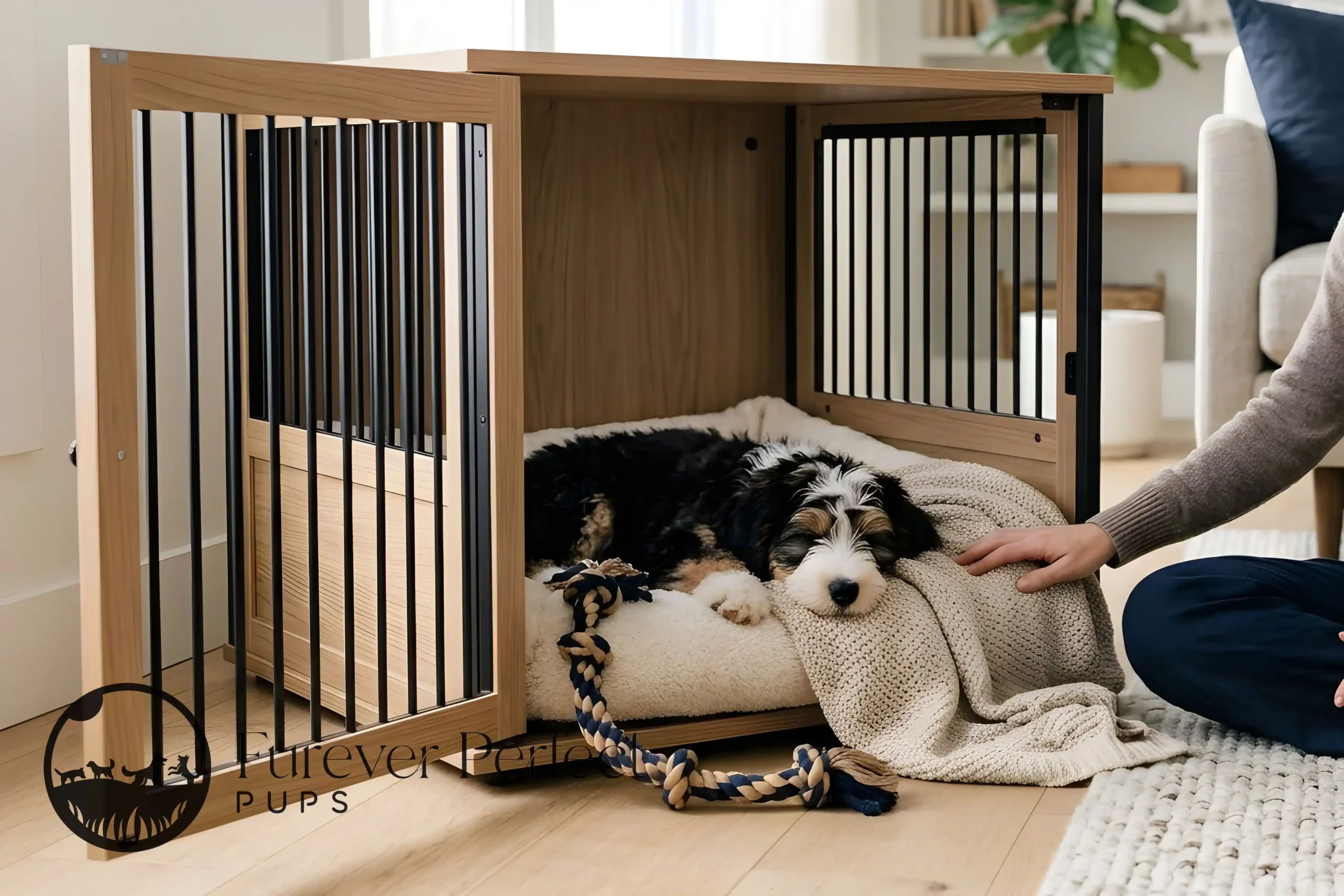
Crate Training a Bernedoodle: A Gentle, Positive Approach By

By Furever Perfect Pups | April 27, 2026 |

By Furever Perfect Pups | April 11, 2026 |