

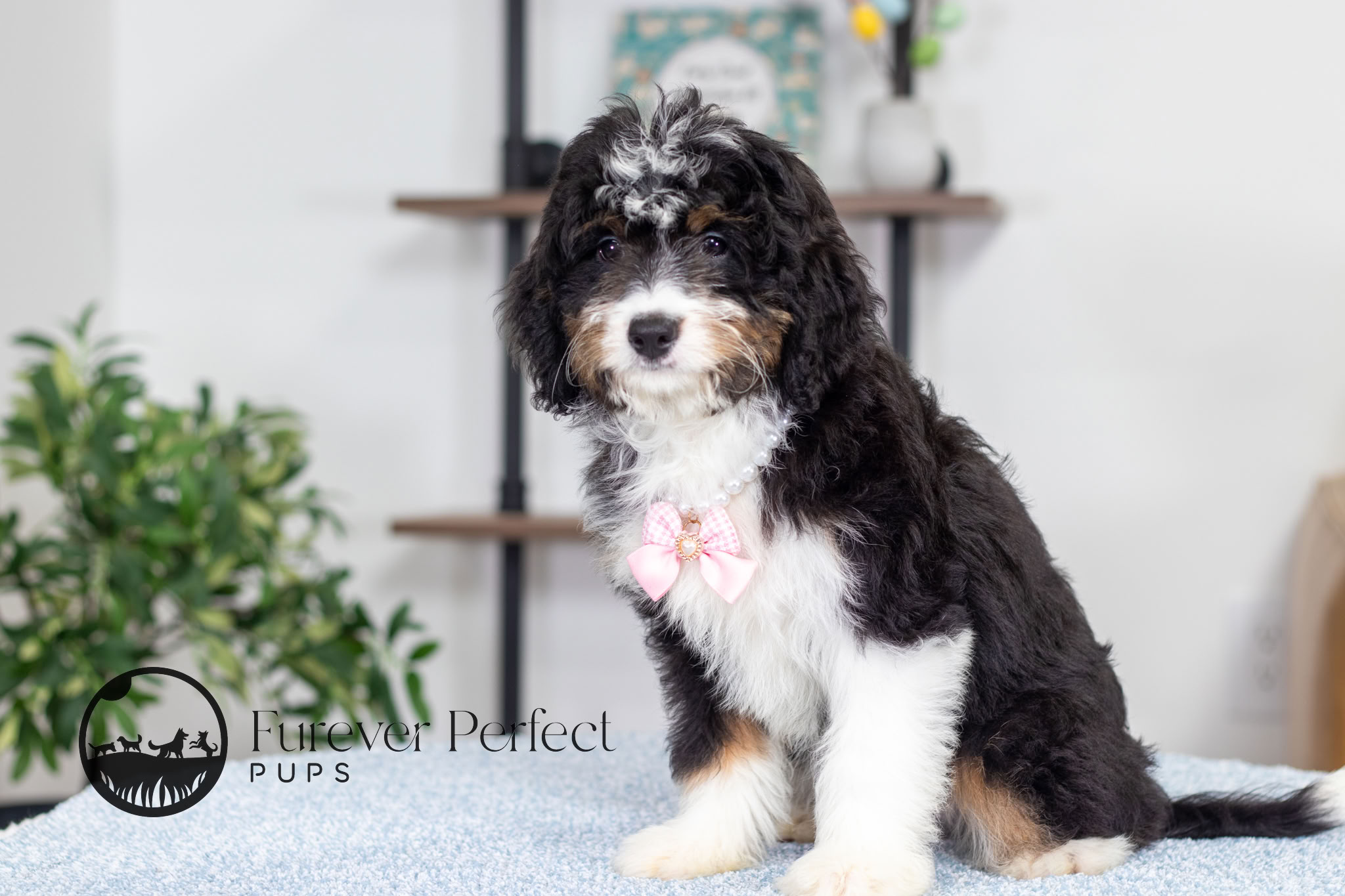
Puppy Coat vs Adult Coat: What to Expect as Your Bernedoodle Grows
The puppy coat is one of the first things people fall in love with on a Bernedoodle. It is impossibly soft, lower maintenance than what is coming, and often a very different color and texture than the adult coat that will replace it. Understanding what is actually happening during the transition, when it starts, how long it lasts, and what specific changes to expect in texture, color, and grooming demand, is one of the most practically useful things a Bernedoodle owner can learn before that first appointment at the groomer comes back with a dog they almost do not recognize.
This guide covers everything: the biology of the puppy-to-adult coat transition, how coat type affects the timeline and degree of change, what the fading gene does to color and which coats are most affected, why the transition window is the highest-risk matting period of the dog’s life, and what a grooming routine that gets you through it without emergency dematting looks like. It also covers what the coat looks like after the transition has settled, because the adult coat that emerges is a genuinely different management proposition than either the puppy coat that preceded it or the mid-transition mess that can make owners wonder what they signed up for.
The Bernedoodle puppy coat is softer, thinner, and less dense than the adult coat will be. The AllGroom grooming guide describes it accurately as super soft, thinner, fluffy, and easy care. This softness is not just tactile charm; it reflects the actual structural difference between a puppy coat fiber and an adult coat fiber. The puppy coat lacks the density and crimp of the adult Poodle-influenced coat, which is part of why it is comparatively forgiving to brush and maintain during the first months of the dog’s life.
This easier maintenance is also slightly deceptive. Many Bernedoodle owners, particularly those with wavy or curly coats, develop a brushing routine during the puppy months that feels sufficient because the puppy coat tolerates it. That same routine will be inadequate when the adult coat arrives with its denser, more textured structure. The habits and techniques established during the puppy months matter, but the expectations for how long and how thoroughly brushing takes need to adjust upward as the transition approaches.
What the Puppy Coat Tells You About the Adult Coat
The puppy coat gives useful but imperfect information about the adult coat. A puppy that appears to have a wavy coat at eight weeks will most likely have a wavy adult coat. A puppy with tighter curls at the root is signaling the curly adult coat that is coming. But the correlation is not perfect, particularly in the early weeks. Poodle Forum firsthand accounts from owners document that the coat change is felt from the root up rather than as a shed: the new texture and curl pattern starts close to the skin while the older puppy coat is still present at the tips, creating the mixed-texture appearance that characterizes mid-transition.
Color is even less reliably predicted by the puppy coat, for reasons the color section of this guide covers in detail. A Bernedoodle that appears jet black at eight weeks may be a sable that will clear significantly by eighteen months. A puppy whose rust markings look like Bernese Mountain Dog rust may have inherited the Poodle fading gene and will lighten those markings considerably over the first year.
The Bernedoodle coat transition typically begins between six and twelve months of age, with nine to twelve months being most common according to the AllGroom oodle breed guide, which draws on extensive professional grooming experience with the type. Jenna Stone, founder of JennaLee Designer Doodles, describes it this way: at around ten months of age, Bernedoodles will blow their puppy coats and their adult coats will come in, which sometimes changes texture slightly. The Starlight Bernedoodles resource notes that the adult coat usually settles in between twelve and eighteen months, with subtle changes potentially continuing into the second year.
Size affects timing: Mini Bernedoodles tend to reach adult coat status somewhat earlier than Standard Bernedoodles, consistent with the pattern seen in overall developmental maturity where smaller variants complete growth phases more quickly. The Oodles of Bernedoodles breeder resource confirms that the transition can vary based on genetics, coat type, and size.
Why Matting Risk Peaks During the Transition
The matting risk during the coat transition is not intuitive until you understand what is physically happening. The puppy coat and adult coat are both present simultaneously during the transition. The adult coat fibers, which are denser and have more crimp or curl than the puppy coat, grow in from the root while the softer puppy fibers are still present along the rest of the hair shaft. These two textures interlock with each other in a way that neither coat type does on its own. The result is dense, tight mats that form close to the skin, often invisible from the surface, in dogs whose owners are brushing the outside of the coat but not reaching through to the skin.
The Poodle Forum thread on the puppy-to-adult coat transition documents this experience from owners of Standard Poodles and crosses who had been through it: the dog would be brushed in the morning and have new mats by the afternoon in the worst areas. The ears are consistently identified as the most severe location, followed by the armpits, behind the collar, and the area behind the hindlegs. These high-friction zones are where the two coat types interlock most aggressively.
The three Bernedoodle coat types, curly, wavy, and straight, each go through the transition differently and arrive at different adult coat profiles with different maintenance requirements. Understanding which type your Bernedoodle has, and what it will become, is foundational to setting accurate grooming expectations.
Curly Coat (Poodle-dominant)
The curly-coated Bernedoodle’s puppy coat is soft and fluffy with some wave or loose curl. As the transition progresses, the curls tighten and the coat becomes denser and more textured. The Starlight Bernedoodles resource notes that curly-coated puppies may develop tighter curls during the adult coat period. The We Love Doodles Bernedoodle guide confirms that the adult coat may be curlier, coarser, or have different density than the puppy coat, and that increased grooming needs during the transition are significant.
The adult curly coat does not shed in the traditional sense, which makes it the best option for households with mild to moderate dog allergies. What it does instead is retain shed fibers within the curl structure, which means any fibers that would otherwise end up on furniture end up in the coat instead and become mats if not brushed out. The SilverLining Doodles resource notes that curly coated dogs require daily brushing and combing, with professional grooming every four to six weeks depending on home maintenance. This is the most demanding coat type to maintain and the one that most benefits from committed home brushing between professional appointments.
Wavy Coat (Fleece Coat)
The wavy coat, often called the fleece coat, is a blend of both parent breed influences and is the coat most often associated with the classic Bernedoodle look. The puppy coat is soft with gentle waves that become more defined and somewhat denser through the transition. Wavy-coated puppies may become slightly curlier during the transition, but typically settle into a reliably wavy adult coat that holds its pattern through adulthood.
The wavy coat tends to hold color better than the curly coat through the fading process, which the Utah Bernedoodle breeder resource has documented across many litters: Bernedoodles with a straighter coat seem to hold their color better than Bernedoodles with a curly coat regardless of whether the Poodle parent carries the fading gene. The wavy coat’s shedding level is low to moderate, placing it between the curly coat on one end and the straight coat on the other. Professional grooming every six to eight weeks with brushing three to four times weekly at home is the standard maintenance for a wavy adult coat in good condition.
Straight Coat (Bernese-dominant)
The straight-coated Bernedoodle most closely resembles a Bernese Mountain Dog in coat texture and, often, in shedding behavior. The puppy coat and adult coat differ less dramatically in texture than in the other coat types, and the transition is generally less turbulent. The OodleDogLove coat type resource describes straight coats as generally lower maintenance in terms of grooming, though they usually come with the shedding double coat of the Bernese Mountain Dog side.
The straight coat’s trade-off is straightforward: it is less prone to matting but more prone to shedding, and the shed hair ends up on furniture and clothing rather than being retained in the coat. For households seeking a Bernedoodle specifically for low-allergen reasons, the straight coat is the least appropriate option. For households without allergen concerns, it can be a genuinely manageable coat that requires less intensive brushing work than either the curly or wavy coat while maintaining the Bernedoodle’s characteristic charm.
Color change is one of the most surprising aspects of the Bernedoodle coat transition for families who chose their puppy based on a color they loved at eight weeks. A puppy that comes home looking like a classic Bernese tricolor may look like a soft silver and white dog by age two. Understanding why this happens, and which colors are most susceptible, helps owners approach the change as a genetic reality to prepare for rather than a surprise to be upset about.
The Fading Gene
Fading is the process by which darker coat colors lighten over time, and it is driven by a gene inherited from the Poodle parent. Kayla Kennedy, an experienced breeder at JennaLee Designer Doodles, explains it this way: fading is something that happens over time in any hair follicle, and is a natural progression in any breed of dog. With Bernedoodles the reason fading can be more common or start earlier in life is the mixing of two breeds with different color genotypes. The fading gene from the Poodle side means that black areas may fade toward silver or gray, and brown areas may fade toward beige, over the first one to two years of life.
The Utah Bernedoodle breeder resource, which has documented color changes across many litters over more than eight years, makes a specific observation that is practically useful: coat texture affects fading rate regardless of whether the Poodle parent carries the fading gene. Bernedoodles with straighter coats hold their color better than those with curlier coats. This means that a curly-coated tricolor Bernedoodle is more likely to show significant fading than a wavy-coated tricolor from the same litter, all else being equal.
Fading vs Clearing: An Important Distinction
Fading and clearing are related but distinct processes. Fading is unpredictable: the dog shows no specific indication at puppy age of how much fading will occur, and the outcome depends on which color genes were inherited, in proportions that cannot be determined from puppy appearance alone. As Jenna Stone of JennaLee Designer Doodles describes it: fading in Bernedoodles is very unpredictable at any age because it cannot be known which gene was inherited, the Poodle or the Bernese or one of each.
Clearing is the process specific to sable Bernedoodles, and it is more predictable. Sable Bernedoodles are born dark, often looking nearly black, but carry a gene that causes the black-tipped hairs to grow out to the base color underneath as the dog matures. The Utah Bernedoodle resource explains how to read the early signal: when sable Bernedoodles are approximately six weeks old, you can estimate what color they will clear to by looking at the color under their eyes. The lighter shade visible there is approximately the color the dog will clear out to. Sables generally clear to light brown, cream, or red depending on their base color, with ears typically staying somewhat darker than the body.
Color Changes by Pattern
| Coat Pattern | Typical Color Change | Timing | Predictability |
|---|---|---|---|
| Tricolor | Black areas may fade to silver/charcoal; rust/tan markings may lighten | 6 to 18 months; earlier in curly coats | Low; depends on whether fading gene was inherited |
| Sable | Black tips grow out, coat clears to base color (cream, brown, or red); ears stay darker | Clearing visible by 6 weeks; complete by 12 to 18 months | Moderate; base color readable at 6 weeks |
| Phantom | Tan/rust points may lighten or fade; black base may silver in dogs with fading gene | 6 to 18 months | Low; poodle parent gene determines outcome |
| Solid Black | May fade to silver or gray by age two, especially in F1 and curly-coated dogs | Can begin as early as six months | Low; curlier coats fade more than wavy or straight |
| Black and White Bicolor | Black portions may fade; white areas typically stable | 6 to 18 months | Low to moderate |
| Brindle | Generally holds color well; brindle pattern tends to become more visible with age | Minimal change; pattern may sharpen | High relative to other patterns |
| Parti | Darker patches may fade; white base remains stable; overall pattern holds | 6 to 18 months | Moderate; pattern stable even when color shifts |
The grooming routine during the coat transition is different from both the puppy routine that preceded it and the adult routine that will follow. It is more demanding than either, and understanding why helps owners commit to it rather than treating it as temporary inconvenience that can wait until the next grooming appointment.
Why Surface Brushing Is Not Enough
During the coat transition, brushing the visible surface of the coat without penetrating to the skin does not address the matting that is forming at the root. Mats during the transition form where the puppy coat and adult coat fibers contact each other closest to the skin, not at the tips. A brush that moves smoothly through the outer coat can be completely failing to reach the dense, tight mats forming a centimeter above the skin. The We Love Doodles guide uses direct language: consistent brushing is the only way to prevent mats, and you must brush down to the skin, not just surface fur.
Line Brushing Technique
Line brushing is the technique that addresses this problem. Rather than brushing over the surface of the coat, line brushing works through the coat in small sections, parting the hair to expose the skin and brushing from the skin outward through each section before moving to the next. The process is slower than surface brushing but reaches the location where transition-period mats form. A slicker brush for the initial brushing work followed by a steel comb run through the same sections to confirm no mat was missed is the complete technique. If the comb moves smoothly through a section from skin to tip without catching, that section is genuinely mat-free. If it catches, there is still something there regardless of how the brushing felt.
The Daily Schedule During Transition
For curly-coated Bernedoodles, daily line brushing during the transition window is necessary rather than optional. For wavy-coated dogs, daily brushing through the peak of the transition, roughly eight to fourteen months, with particular attention to the high-friction zones, is strongly advisable. Straight-coated dogs are more forgiving during the transition, but daily or every-other-day brushing still represents a significant step up from the pre-transition routine.
The high-friction zones that need the most attention are consistent across coat types: behind the ears, under the collar, in the armpits, behind the hindlegs where the leg meets the body, and the area around the sanitary region. These are the areas where movement creates the most friction between coat layers and therefore where mats form first and fastest.
Professional Grooming Timing
Scheduling a professional grooming appointment specifically timed to the onset of the transition, rather than waiting for the regular interval, gives the groomer the ability to assess what is beginning to happen in the coat and advise on the home maintenance approach before any mat damage occurs. The AllGroom guide recommends introducing a puppy to grooming at a young age, before the coat is knotted or matted, and the same principle applies to the transition: a dog that arrives at the groomer with a coat that is beginning to transition but has not yet matted is in a fundamentally better position than one who arrives mid-transition with weeks of mat formation already built up.
The most disorienting aspect of the Bernedoodle coat transition for many owners is that the coat looks its worst in the middle. The mixed-texture appearance, the areas that are matting faster than others, the puppy coat coming out in clumps during brushing: all of this is temporary. The JennaLee Designer Doodles resource describes this reassuringly: during the transition, your pup may look a little unkempt, some areas might start matting faster than others, and the soft undercoat might come out in clumps. This is totally normal.
What comes out the other side, typically between twelve and eighteen months, is a coat with a defined texture, a settled color, and predictable maintenance requirements. The adult coat is denser, often more textured, and for curly and wavy types requires more grooming investment than the puppy coat did. But it is also more predictable: it mats at a known rate, in known locations, and responds to a consistent brushing routine in a way the mixed-coat transition period does not.
Adult Coat Maintenance at a Glance
| Coat Type | Brushing Frequency | Professional Grooming Interval | Mat Risk Zones |
|---|---|---|---|
| Curly | Daily | Every 4 to 6 weeks | All areas; especially ears, armpits, behind hindlegs |
| Wavy | 3 to 4 times per week; daily during humidity or after swimming | Every 6 to 8 weeks | Behind ears, collar area, armpits, sanitary area |
| Straight | 1 to 2 times per week | Every 8 to 10 weeks; or as needed | Lower mat risk; focus on deshedding rather than mat prevention |
Color may continue to shift subtly through the second year before fully stabilizing. Most of the significant color change happens in the first year, but a Bernedoodle that is still lightening slowly at eighteen months has not finished. The Starlight Bernedoodles resource notes that while the most significant change occurs in the first year, subtle changes in color and texture may continue into the second year, after which the coat stabilizes.
Frequently Asked Questions
My Bernedoodle is eight months old and the coat suddenly looks terrible. Is something wrong?
Almost certainly not. The mid-transition coat appearance, described by the JennaLee Designer Doodles resource as making the pup look a little unkempt, is one of the most consistent owner complaints across Bernedoodle forums and breeder experience. The coat is in the messy middle of the transition: the puppy coat is coming out, the adult coat is growing in from the root, and the two textures make the coat look inconsistent and sometimes patchy. This phase passes. What matters at this point is not how the coat looks but whether it is being brushed thoroughly enough to prevent the mats that form during this period. Consistent daily brushing with the line brushing technique is the correct response to this phase, not alarm.
My black Bernedoodle puppy is starting to look gray. Is this normal?
Yes. The Poodle fading gene is the most common explanation for black Bernedoodle coats lightening toward silver or gray, and this change often begins becoming visible between six and twelve months. The Utah Bernedoodle breeder documentation and multiple other sources confirm that black Bernedoodles can fade significantly, particularly those with curlier coats and those from lines where the Poodle parent carries the fading gene. The final color may stabilize anywhere from a deep charcoal to a silver gray depending on which specific genes were inherited. For families who placed significant weight on the black coat color when choosing their puppy, discussing the fading gene with the breeder before selecting a puppy, and asking for photos of adult dogs from the specific breeding pair, is the most reliable way to set accurate color expectations.
How do I know if my Bernedoodle has started the coat transition?
The earliest signals are texture changes at the root rather than the tip. Run your fingers against the grain of the coat close to the skin: if the coat feels denser, more crisp, or differently textured near the skin than at the tips, the transition has likely begun. The tail base and the topknot are often the first areas where the new texture becomes visible, followed by the area between the shoulder blades. Poodle Forum accounts from owners who have been through the transition describe noticing increased curl at the tail base and a slightly wiry texture appearing in patches on the back and hindquarters as the first visible signs. Once you see these signs, daily brushing should begin regardless of whether it was part of your routine before.
What is the difference between the puppy coat coming out and shedding?
In Bernedoodles with curly and wavy coats, the puppy coat transition does not produce shedding in the way that double-coated breeds shed. There is no blowing of coat where large quantities of loose hair come out all at once. Instead, the puppy coat fibers are being replaced by adult coat fibers from the root up, and the displaced puppy fibers end up in your brush during grooming sessions rather than on your furniture and clothing. Owners with wavy coats may notice slightly more than usual coming out in the brush during the transition. Straight-coated Bernedoodles may experience more shedding during the transition than their wavy and curly counterparts, consistent with their higher overall shedding tendency as adults.
Will my Bernedoodle’s coat ever be easy to maintain?
The adult coat, once the transition is complete and a consistent maintenance routine is established, is genuinely manageable for most owners. What owners often find, however, is that the expectations they set during the puppy coat months, when brushing was relatively quick and forgiving, do not transfer to the adult coat. The adult curly coat requires daily brushing that is slower and more thorough than anything the puppy coat demanded. The adult wavy coat requires brushing three to four times per week with real attention to the friction zones. Neither of these is unmanageable, but both require adjustment from the puppy routine. Owners who enter the adult coat phase with accurate expectations for what it requires consistently find it more approachable than those who expected the ease of the puppy coat to continue. The investment is real but not unreasonable for a dog that, groomed well, carries one of the most beautiful coats of any mixed breed.
Final Thoughts
The Bernedoodle coat transition is one of the few genuinely difficult periods in owning this breed, and it is difficult for a specific reason: it demands daily grooming attention during a window when owners who got comfortable with the puppy coat’s forgiveness have not yet built the adult maintenance habits. The families who navigate it well are those who know it is coming, start daily brushing before the transition begins rather than in response to the first mat, and treat the first sign of texture change as the signal to step up their routine immediately rather than waiting for the next grooming appointment.
What comes after is worth the investment. A Bernedoodle in its prime adult coat, properly maintained, wavy and full with the colors that survived the transition, is a genuinely remarkable-looking dog. The coat that settles in at eighteen months and is brushed consistently thereafter is one of the most satisfying aspects of the breed for owners who engage with it correctly. The transition is the passage to that coat. Approach it with the right information and the right tools, and it is a challenge that resolves cleanly rather than a recurring emergency.