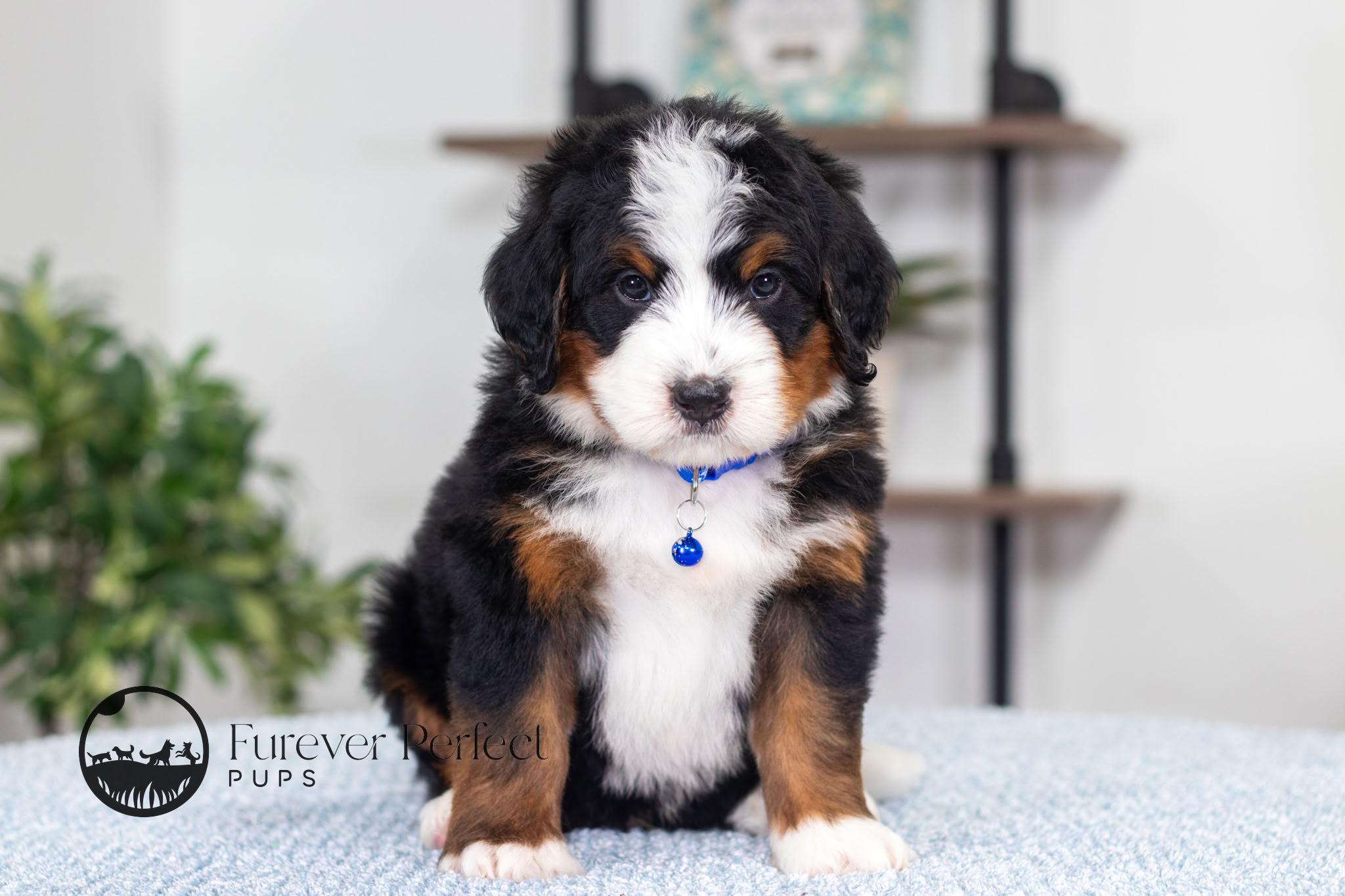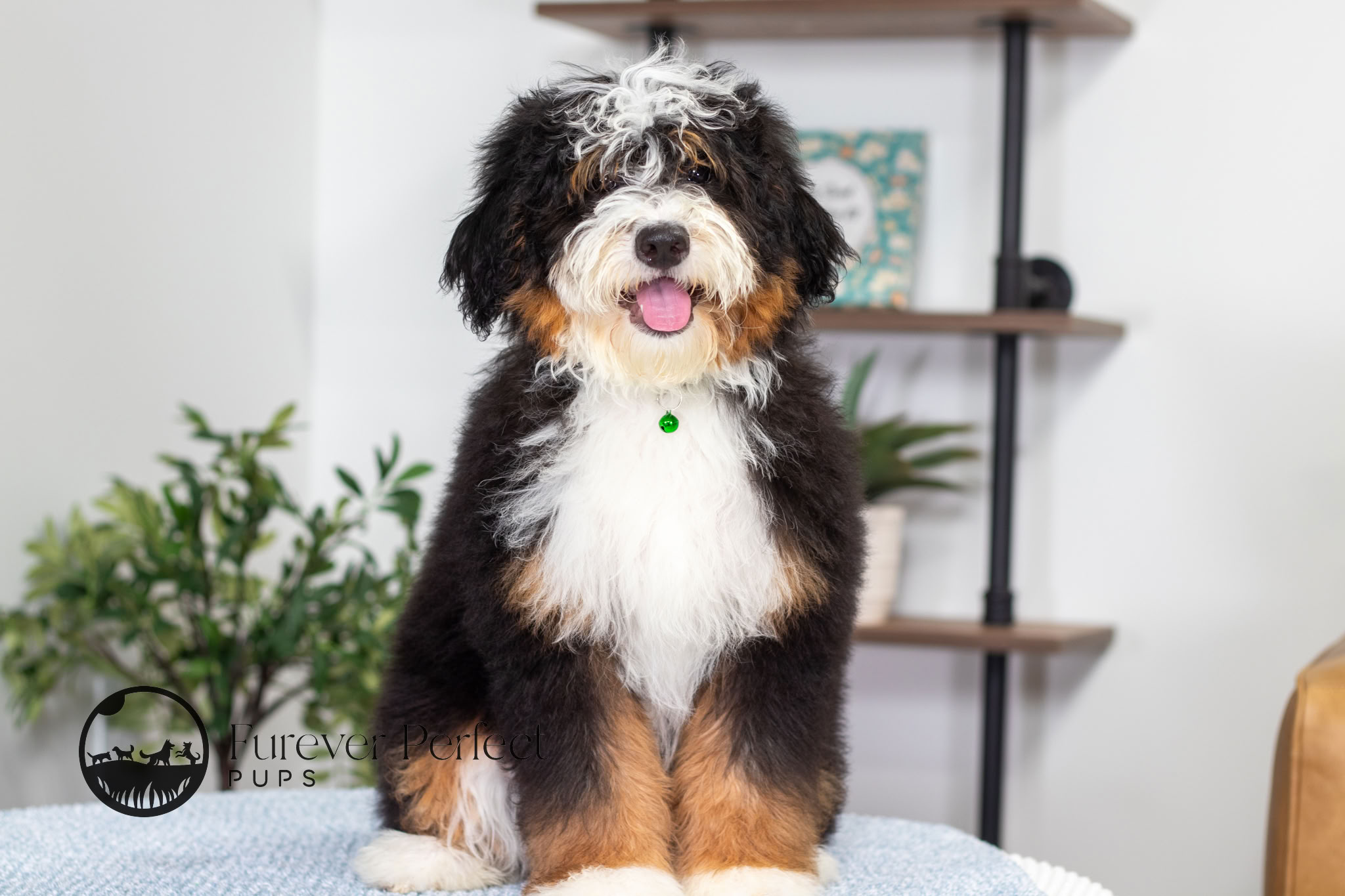
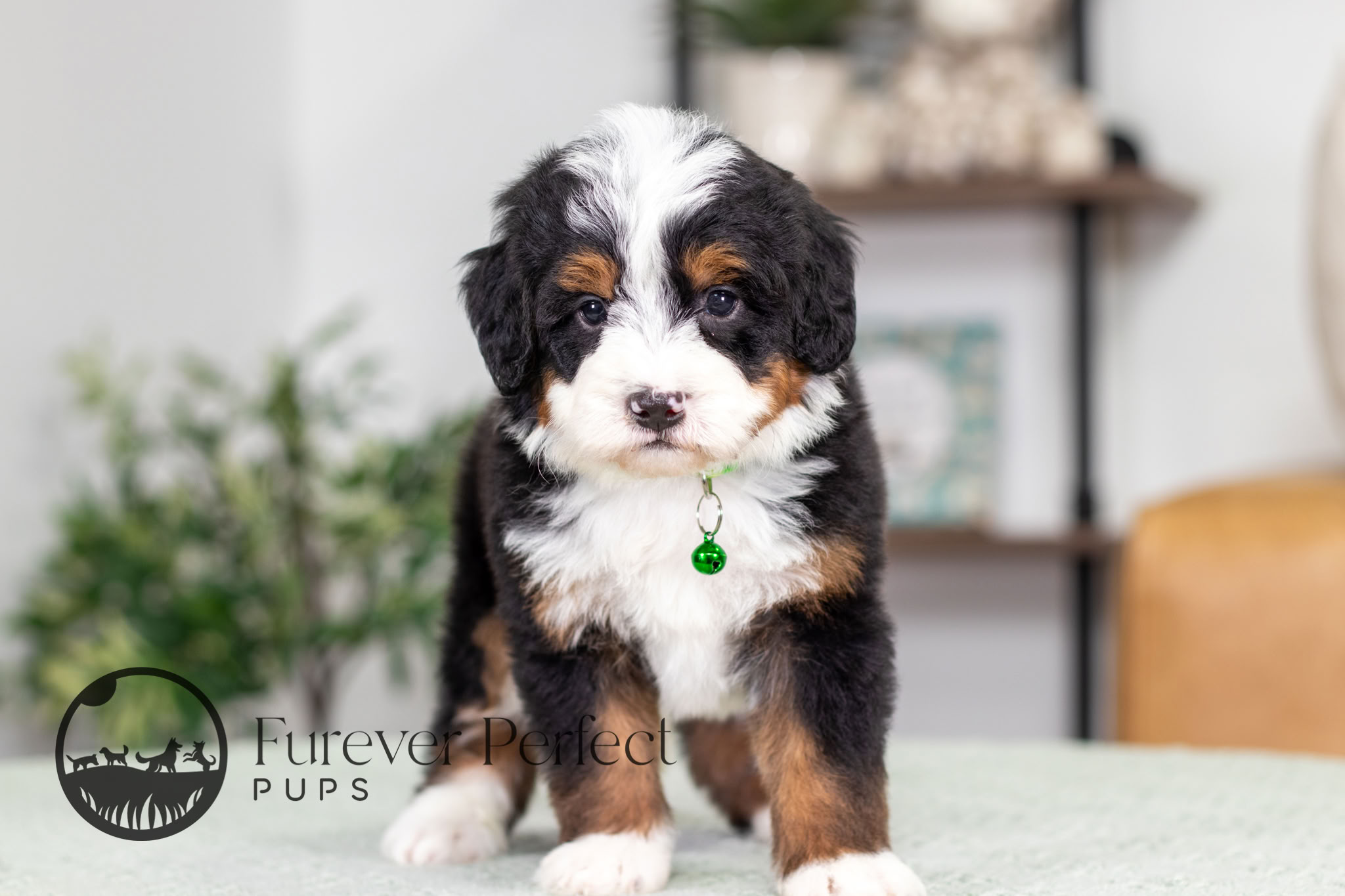
The single most important fact about traveling with a Bernedoodle is one most travel guides ignore entirely: there is no such thing as a typical Bernedoodle, and the difference between sizes changes everything about how the dog travels. A Tiny Bernedoodle at the bottom of the range can weigh as little as 10 pounds and slide under an airline seat in a soft carrier. A Standard Bernedoodle at the top of the range can reach 100 pounds, which puts it outside almost every commercial airline’s cabin allowance and, as of 2026, outside the cargo programs of most major U.S. carriers as well. Two dogs of the same breed, two completely different travel realities. Any advice that does not start with your dog’s actual adult size is advice that does not apply to you.
That size spread is a direct consequence of how the cross is built. The Poodle variety used in the pairing determines size more than the Bernese parent does, which is why our program produces dogs ranging from Tiny and Mini through Medium up to Standard. Before you book anything, you need to know which category your dog falls into, because it dictates your restraint options in the car, your eligibility for cabin travel on a plane, and even which hotel rooms will accept you given that many properties impose weight limits.
The second fact worth stating up front is temperament. Bernedoodles tend to inherit the Bernese Mountain Dog’s deep sensitivity to their handler’s mood and the surrounding atmosphere, layered over the Poodle’s quick, alert intelligence. In our experience, this combination produces a dog that reads travel stress off you faster than retriever-based crosses do, and one that learns to associate the car or the carrier with either safety or dread depending almost entirely on how the early experiences are handled. Individual variation, early socialization, and the practices of the breeder who raised the puppy all shape how any given dog responds, and the best predictor of a puppy’s adult temperament is the temperament of its parents. But as a group, this is a breed combination that rewards patient preparation and punishes the rushed, white-knuckle approach more visibly than most.
This post covers the three travel situations you are most likely to face, in the order most families encounter them: the car, the airplane, and the hotel room. It also covers motion sickness and the question of medication honestly, including the parts that complicate the appealing idea that you can simply give your dog a pill and make the problem go away. The goal is not to talk you into traveling with your Bernedoodle or out of it. It is to make sure that whatever you decide, you decide it knowing what the trip actually requires.
Every form of travel shares the same foundation, and skipping it is the most common reason trips go badly. The work below is not glamorous, but it is what separates a smooth trip from a stressful one, and most of it has to happen days or weeks before departure rather than the morning of.
Start with identification, because a lost dog in an unfamiliar place is the worst-case scenario every other precaution exists to prevent. The Center for Pet Safety lists a microchip as a core travel precaution precisely because dogs are at their highest risk of escaping and getting lost during the chaos of entering or exiting a vehicle, a carrier, or a new room. A microchip is permanent, but it only works if the registry information is current, so verify that your contact details are up to date rather than assuming they are. Pair the chip with a physical collar tag that carries your cell phone number, since a stranger who finds your dog can read a tag immediately but cannot scan a chip.
- Update the microchip registration: A chip implanted at eight weeks does nothing if it still points to a phone number you changed three years ago, so log in to the registry and confirm before you leave.
- Carry vaccination records: The AKC notes that proof of rabies vaccination should travel with you, and some hotels and most airlines will ask for it; a photo on your phone plus a paper copy covers you either way.
- Get a health certificate if flying: Many airlines require a certificate issued by your veterinarian within ten days of travel, and the CDC recommends the same window for any significant trip.
- Locate the nearest emergency vet at your destination: The AKC recommends programming the number of the closest 24-hour veterinary hospital into your phone before you leave, alongside your regular vet’s number.
- Pack from home, not the store: Bring your dog’s regular food, since an abrupt diet change on top of travel stress is a reliable way to produce digestive upset, and consider bringing water from home or bottled water to avoid the stomach reaction some dogs have to unfamiliar tap water.
The second piece of the foundation is conditioning, and this is where the Bernese sensitivity in the cross matters most. A Bernedoodle that has only ever been in a car twice, both times to the veterinary clinic, has learned that the car means something unpleasant happens at the end. VCA Animal Hospitals notes that dogs who travel only once or twice a year often associate the ride itself with the stressful destination, which produces anxiety, and sometimes vomiting, before the car has even moved. The fix is to build a history of short, pleasant, low-stakes trips that end somewhere good, so the car stops predicting the clinic and starts predicting a walk in a new park.
The car is where most Bernedoodle adventures happen, and it is also where the biggest gap exists between what feels safe and what is actually safe. An unrestrained dog in a moving car is a danger to itself and to everyone in the vehicle. The ASPCA recommends securing dogs of all sizes in travel-rated crates or carriers, both to protect the dog and to prevent the driver distraction that an unrestrained dog inevitably creates. A loose dog that catches an interesting scent and jumps into the front seat is not a charming quirk; it is a crash waiting to happen.
Here is the part that surprises many owners: an unrestrained dog of any size becomes a projectile in a sudden stop or collision. A small Tiny Bernedoodle curled in your lap is not safer for being small. As Hill’s Pet veterinarian Dr. Jessica Seid puts it, holding a small dog in your lap while driving is no safer than holding a child there. Restraint is not negotiable based on size; it is required regardless of size. What changes with size is which type of restraint fits.
Choosing the right restraint for your dog’s size
There are three realistic restraint categories, and your dog’s weight determines which one applies. The critical point that most product marketing obscures is that “crash tested” and “passed the crash test” are not the same claim. The Center for Pet Safety is the independent nonprofit that crash-tests pet restraints in the United States, and many products advertise that they were tested without disclosing that they failed. CPS publishes a directory of products that actually passed, and that directory is the list worth trusting.
For a soft-sided carrier rated as a car restraint, the practical ceiling is roughly 15 pounds, which covers many Tiny Bernedoodles but few others. For harnesses, the landscape is genuinely limited at the top of the size range: as of 2026, the Sleepypod Clickit line is among the very few harnesses CPS-certified for dogs up to around 110 pounds, which makes it one of the only crash-tested options that actually covers a Standard Bernedoodle. For a hard-sided travel crate anchored in a cargo area, the Gunner G1 earned top CPS ratings and accommodates larger dogs. One more detail worth knowing: CPS specifically advises against extension tethers and zipline-style add-ons, because attaching an untested accessory to a tested harness negates the protection you paid for.
- Tiny and small Bernedoodles (roughly 10 to 25 lbs): A crash-tested soft carrier or a certified harness both work, with the carrier doubling as a familiar den at your destination.
- Medium Bernedoodles (roughly 45 to 70 lbs): A CPS-certified harness clipped into the seat belt is usually the most practical choice, since a crate large enough for this dog may not fit your vehicle’s back seat.
- Standard Bernedoodles (roughly 70 to 100 lbs): A certified harness rated to the dog’s weight or a hard-sided crate anchored in an SUV cargo area, recognizing that very large dogs are more likely to contact the seat ahead of them in a crash simply because of their size.
- Every size, every time: The back seat or cargo area, never the front, because front-seat airbags deploy with force that can injure or kill a dog.
The mechanics of a long drive
Once the restraint is sorted, the rest of car travel is logistics, and the logistics are straightforward if you respect a few rules. STEP 1 Feed your dog three to four hours before departure rather than right before, which the CDC and AKC both recommend to reduce the risk of motion sickness and vomiting. STEP 2 Plan to stop roughly every two hours so your dog can stretch, drink, and relieve itself, and use those stops to reset rather than rushing through them. STEP 3 Before opening any door at a rest stop, secure the leash first, because the moment of exit is when escapes happen. STEP 4 Keep the vehicle well ventilated, and if your dog is crated, make sure air actually reaches the crate.
One Bernese-inherited trait worth anticipating: this side of the cross tends to bond deeply to specific people rather than being broadly social, and that depth can show up as distress when the bonded person walks away from the car. Building calm-with-handler associations early, which is part of the pre-training foundation we start before placement, makes these moments easier, but it is still worth planning your stops so the dog is not left watching you disappear.
Air travel is where the Bernedoodle size range stops being a convenience question and becomes a yes-or-no question. For a small dog, flying in the cabin is widely considered the safest and least stressful option available. For a large dog, the honest answer is that commercial air travel has become difficult to the point of impractical, and pretending otherwise sets families up for an expensive disappointment at the gate.
Cabin travel: the small-dog path
To fly in the cabin, your dog and its carrier must fit comfortably under the seat in front of you, with the dog able to stand, turn around, and lie down inside. The long-cited 20-pound rule of thumb is no longer applied uniformly; most airlines now care more about whether the carrier fits the under-seat space than about a precise weight number. Carrier dimensions vary by airline, generally falling in a range around 17 to 18 inches long, so the carrier that fits a Delta aircraft may not fit a regional jet on a connecting leg. This realistically covers Tiny and many Mini Bernedoodles, and almost no one larger.
Cargo travel: a shrinking option
For a Bernedoodle too large for the cabin, the picture has changed sharply in recent years, and the change matters. As of 2026, among major U.S. carriers, only Alaska Airlines and Hawaiian Airlines still offer general-public cargo pet transport; American and United have restricted their cargo pet programs to active-duty military with relocation orders and State Department Foreign Service personnel. For a typical family with a Standard Bernedoodle, this means the commercial cargo door that existed a few years ago is largely closed. Where it remains available, Alaska allows pets up to 150 pounds including the kennel in climate-controlled compartments, which is one of the last mainstream paths for a large dog.
Cargo also carries genuine added stress and risk that should not be minimized to make the option more appealing. The cargo hold subjects a dog to temperature swings, pressure changes, reduced oxygen, and handling by people it does not know, none of which it experiences in the cabin at your feet. Federal regulations prohibit shipping animals when temperatures along the route fall below 45°F or rise above 85°F for more than four hours, which is why summer and winter cargo bookings are frequently refused outright. For a large Bernedoodle, the realistic options are often a specialized ground transport service, a dog-dedicated charter at a price measured in thousands of dollars, or simply choosing a destination you can reach by car.
The sedation question
Many owners assume the humane way to fly an anxious dog is to sedate it. The American Veterinary Medical Association advises against sedation for air travel, and the reasoning is specific rather than precautionary. Sedatives and tranquilizers raise the risk of cardiovascular and respiratory problems at altitude, where pressure changes and reduced oxygen can amplify a drug’s effects unpredictably. A sedated dog may be unable to brace or adjust its position during turbulence, and a dog in distress under sedation is harder for staff to recognize. American Airlines, following the AVMA recommendation, will not knowingly accept a dog that appears sedated, and many airlines require owners to sign a declaration that a cargo pet has not been sedated. The recommended alternative is acclimating the dog to its carrier well in advance so that the carrier itself becomes a source of calm.
Hotels are the travel situation where your dog’s behavior affects other people most directly, and where a single badly behaved dog can cost the property’s entire pet program. Pet-friendly hotels exist on the goodwill of guests who follow the rules, and the families who treat that goodwill carelessly are the reason some hotels stop accepting dogs. The Bernedoodle’s size range matters here too, because many properties impose weight limits that a Standard will exceed, so the policy you need to confirm is not just “do you allow dogs” but “do you allow a dog this large.”
Before you book
Call the hotel directly rather than trusting a third-party booking site, which may carry outdated policy information. Ask the specific questions: Is there a weight or breed limit? What is the nightly or per-stay pet fee? Are dogs permitted in common areas? Is there green space nearby for walks? A property that technically allows dogs but charges steep fees, confines them to a few room types, and sits in a concrete lot with nowhere to walk is not meaningfully dog-friendly. Requesting a ground-floor room near an exit makes the inevitable late-night potty trips far easier.
The crate is the centerpiece
The single most useful thing you can bring to a hotel is a crate your dog already loves at home. Many pet-friendly hotels require that a dog be crated whenever it is left alone in the room, and some prohibit leaving dogs unattended entirely. A crate prevents your dog from damaging the room, stops it from bolting if a housekeeper opens the door, and gives a Bernese-sensitive dog a familiar den in an unfamiliar place. Bringing the actual crate the dog uses at home, rather than buying a new one for the trip, means you are bringing a known safe space rather than introducing one more novelty.
The Bernese side of the Bernedoodle’s heritage makes separation harder for some of these dogs than for a more independent breed, so this is worth assessing honestly rather than optimistically. Exercise the dog well before you leave it, keep the first solo absence short, under an hour, and extend only if the dog handled it calmly. Leaving a piece of clothing that carries your scent and turning on the television for background noise both help, but neither substitutes for a dog that is genuinely ready to be alone.
Common-area etiquette
- Leash everywhere outside your room: The lobby, hallways, elevators, and grounds all require a leash, because not every guest at a dog-friendly hotel is comfortable around dogs, and a dog that approaches uninvited creates a problem you cannot undo.
- Ask before any greeting: If your dog wants to meet another guest, ask the person first, and approach slowly and on leash only if they say yes; a reliable polite sit for greetings is one of the most valuable hotel skills you can teach.
- Pick up every single time: Carry waste bags on your person so you are never caught without one, and clean up immediately, because the guest who skips this is the reason a hotel reconsiders its pet policy.
- Manage housekeeping deliberately: Either be present with your dog when housekeeping comes or crate the dog and hang the “do not disturb” sign, since a stranger entering the room is a significant trigger for most dogs.
- Protect the room: Bring a sheet or blanket from home to cover any furniture your dog will be on, wipe muddy paws before entering, and report any accident or damage to the front desk honestly.
Motion sickness and travel anxiety are related but distinct problems, and confusing them leads to the wrong solution. An estimated 15% of dogs suffer from true motion sickness, which is a physical problem originating in the vestibular apparatus of the inner ear. A separate and larger group of dogs vomit not from motion but from fear, having learned to associate the car with something unpleasant. The two require different approaches, and a medication that targets one does nothing for the other.
True motion sickness is more common in puppies, because the vestibular system is still maturing, and many dogs outgrow it by one to two years of age. This is genuinely good news for new Bernedoodle owners: a puppy that gets carsick is not necessarily a dog that will be carsick for life. But the anticipatory cycle is real, and worth interrupting early. A dog that feels nauseous every time it rides can begin to vomit from the anticipation alone, before the car even moves, which is why the conditioning work described earlier matters as much as any medication.
What the medications actually do
If you are considering medication, understand what each category targets, and have the conversation with your veterinarian rather than reaching for something in the cabinet. The distinctions below come from veterinary sources, but the dosing and the decision belong to your vet, who knows your individual dog.
Antihistamines such as dimenhydrinate (Dramamine) and meclizine can prevent motion-sickness vomiting too, but they commonly cause sedation as a side effect and are generally considered less effective than maropitant. For dogs whose problem is genuinely anxiety rather than motion, veterinarians sometimes prescribe anti-anxiety medications such as trazodone or alprazolam, some of which need to be started days or weeks ahead to reach full effect. The key honest point is that no medication substitutes for the patient desensitization work, and several of these drugs carry side effects, including the possibility of paradoxical excitation, where a dog becomes more agitated rather than calmer.
One final point on over-the-counter shortcuts: antihistamines like Benadryl are formulated for allergies, not anxiety, and giving any human medication without veterinary guidance risks the wrong dose and unwanted side effects. The veterinarian who knows your dog is the right person to decide whether any medication is appropriate, which one, and at what dose.
At a Glance: Bernedoodle Travel by Size
| Size Variant | Typical Weight | Car Restraint | Cabin Air Travel | Hotel Consideration |
|---|---|---|---|---|
| Tiny / Mini | 10 to 45 lbs | Crash-tested carrier (small) or certified harness | Possible for the smallest, if carrier fits under the seat | Within most weight limits |
| Medium | 45 to 70 lbs | CPS-certified harness, seat belt anchored | Generally too large for the cabin | May exceed some weight limits; confirm first |
| Standard | 70 to 100 lbs | Certified harness rated to weight, or anchored hard crate | No; cargo largely unavailable on major U.S. carriers in 2026 | Exceeds many limits; call ahead every time |
Frequently Asked Questions
Can my Standard Bernedoodle fly on a commercial airline at all?
Realistically, not in the cabin, and as of 2026 most likely not in cargo either on a major U.S. carrier. The cabin requires that the dog fit under the seat in a carrier, which a 70-to-100-pound dog cannot do. On the cargo side, American and United have restricted their pet cargo programs to military and State Department personnel, leaving Alaska Airlines and Hawaiian Airlines as the main general-public options among major carriers, and Alaska accepts pets up to 150 pounds including the kennel where the service is available. For most families with a Standard Bernedoodle, the practical paths are a specialized ground transport service, a dog-dedicated charter that costs thousands of dollars, or choosing destinations reachable by car. This is one of the trade-offs of choosing the larger end of the breed, and it is worth understanding before you fall in love with a Standard puppy if frequent flying is part of your life.
Is it safe to give my dog Benadryl or Dramamine before a trip?
Talk to your veterinarian before giving any medication, including over-the-counter ones. Dramamine (dimenhydrinate) can prevent motion-sickness vomiting in some dogs but commonly causes drowsiness and is generally less effective than the prescription option, maropitant. Benadryl is formulated for allergies rather than anxiety, and while it can make a dog drowsy, it does not reliably address either motion sickness or fear and carries its own side effects. The bigger issue is that the right answer depends on whether your dog’s problem is physical motion sickness or fear-based anxiety, which are different problems with different solutions. Your veterinarian can tell the two apart and choose the appropriate medication and dose for your individual dog, which is something no general guide can do for you.
Do I really need a crash-tested restraint, or is any harness fine?
A regular walking harness is not designed to withstand crash forces and will not protect your dog in a collision. The distinction that matters is between products that were crash-tested and passed versus products that simply claim to be “crash tested” without disclosing the result. The Center for Pet Safety is the independent nonprofit that tests these products in the United States and publishes a directory of the ones that actually passed. The certified list is short, which tells you something about how many marketed products would not survive the test. For a Bernedoodle, the additional wrinkle is size: certified harnesses for dogs approaching 100 pounds are rare, so a Standard owner has fewer options and should verify weight ratings carefully rather than assuming a harness rated for a 40-pound dog will protect an 85-pound one.
My Bernedoodle gets carsick. Will it grow out of it?
It might. True motion sickness, which originates in the inner ear’s vestibular system, is more common in puppies because that system is still developing, and many dogs outgrow it by one to two years of age. The complication is the learned component: a dog that repeatedly feels nauseous in the car can start to vomit from anticipation alone, even after the physical motion sickness fades, simply because it has learned to expect to feel sick. This is why building a history of short, pleasant car trips early matters so much, and why pushing a nauseous or frightened dog through long drives can entrench the problem rather than resolve it. If your dog regularly vomits, drools heavily, or shows real distress in the car, it is worth a conversation with your veterinarian about whether the cause is motion, anxiety, or both, because the answer changes the plan.
How do I keep my dog from disturbing other guests at a hotel?
Honest self-assessment comes first: a dog that barks when left alone, has separation anxiety, or is not crate-trained should not be left alone in a hotel room, because the noise disturbs other guests and can get your dog deemed disruptive and even removed. If your dog is genuinely comfortable alone and crate-trained, leave it crated with a chew or stuffed Kong, keep absences short to start, and exercise it well beforehand. Beyond that, the etiquette is straightforward: leash in all common areas, ask before letting your dog greet anyone, pick up after it every single time, and manage housekeeping by being present or crating the dog with the “do not disturb” sign up. The Bernese side of this cross often bonds deeply and can find separation harder than a more independent breed, so assess your particular dog honestly rather than assuming it will be fine because the breed is described as easygoing.
What does Furever Perfect Pups do to prepare puppies before they go home?
A puppy that travels well is usually a puppy that was set up to handle novelty calmly from the start, and that is much of what our program is built around. From days three through sixteen, every litter goes through Early Neurological Stimulation, a set of brief daily exercises that build stress tolerance and help puppies meet new experiences with curiosity rather than panic, which is exactly the disposition that makes car rides and crates easier later. We pair that with Early Scent Introduction, exposing puppies to new scents during the neonatal period to develop confidence and engagement. Both parents are health-tested through the OFA, including hip, elbow, eye, and breed-specific genetic screening, with results in the public OFA database, because the temperament and soundness that make a dog a good traveler start with the parents. Before placement, each puppy begins our pre-training foundation, including leash desensitization, the marker concept, and the calm-with-handler associations that make separation and confinement less stressful on the road. And because the questions that come up at nine months in adolescence are different from those at twelve weeks, our post-placement support stays available as your dog grows into the traveler you are hoping for. None of this guarantees a dog that loves the car, since individual variation always plays a role, but it means your dog starts ahead rather than from scratch.
Final Thoughts
Traveling with a Bernedoodle is entirely doable, but the right plan depends almost completely on a fact you control at the start: your dog’s size. A Tiny Bernedoodle can ride in the cabin of a plane and curl into a soft carrier that doubles as a hotel den. A Standard Bernedoodle cannot fly commercially in most cases and needs a crash-tested restraint rated to a weight that few products reach. Same breed, two different sets of rules, and the families who get blindsided are the ones who assumed “Bernedoodle” was a single travel category.
Underneath the logistics runs the temperament thread. This cross tends to carry the Bernese Mountain Dog’s sensitivity, which means it reads your stress, bonds to its people, and learns its travel associations early and durably. As a group, these dogs reward the owner who conditions patiently and end up at ease in the car and the crate, and they struggle more visibly than stoic breeds when rushed or pushed through fear. Individual dogs vary, early experiences shape the outcome, and the parents’ temperament remains the best predictor, but the pattern is consistent enough to plan around.
The honest summary is this: invest the preparation before you need it. Update the microchip, build the history of short pleasant trips, buy the restraint that actually passed its test, confirm the hotel’s real policy rather than its listing, and have the medication conversation with your veterinarian rather than the internet. Do that work, and travel becomes one more thing you and your Bernedoodle do together rather than something you survive. That is the kind of outcome our program aims to set up from the first sixteen days of a puppy’s life, and it is the kind of outcome that makes the years of traveling together worth the early effort.