

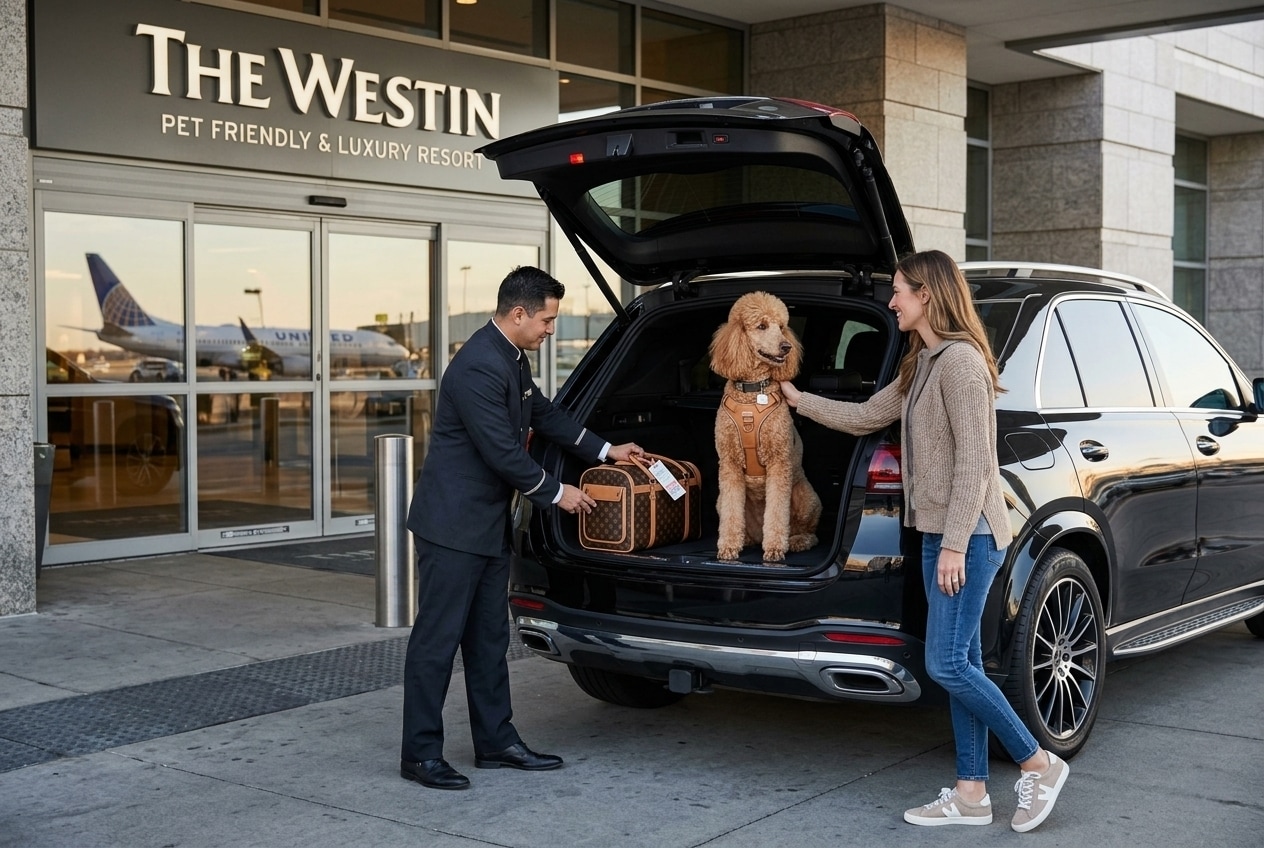
Traveling with a Poodle: Car, Plane, and Hotel Tips
Poodles are people dogs in the most literal sense. They were bred to work alongside humans in close partnership, and that orientation toward human company does not switch off when you leave the house. Many Poodle owners find that their dogs travel well precisely because being near their people is, in itself, settling. A Poodle in a car with its family is often calmer than the same dog left home with a sitter, even if the car trip is long and the destination unfamiliar.
That said, traveling well does not happen automatically. Poodles that have never been in a car beyond the occasional vet trip, never had a carrier introduced before the day they had to fly, and never practiced being alone in a strange room will not have an easy time of any of those situations regardless of how adaptable the breed tends to be. The difference between a Poodle that travels gracefully and one that arrives at the destination rattled and exhausted is almost always preparation, not temperament.
This guide covers all three primary travel modes in genuine depth: car travel, air travel, and hotel stays. Each section addresses the safety and logistics components, the Poodle-specific behavioral considerations, and the practical steps that actually make a difference. Where there is guidance from veterinary or regulatory sources, it is cited specifically so you can follow up directly. Airline policies and documentation requirements in particular change, so you will find direction to verify current information at the authoritative sources rather than details that may no longer apply by the time you travel.
The most common travel mistake is treating preparation as something that begins the day before departure. For a dog traveling by air, or crossing into a destination with specific animal entry requirements, or staying somewhere that requires a current health certificate, the preparation timeline is measured in weeks. For some international destinations, it is measured in months. Getting this piece right is not complicated, but it requires starting early enough that you are not managing last-minute problems at the airport or border.
Health Certificates and Veterinary Documentation
A Certificate of Veterinary Inspection – commonly called a health certificate – is a document issued by a licensed veterinarian confirming your dog has been examined and appears healthy for travel. For domestic air travel, most major U.S. airlines require a health certificate issued within 10 days of departure. For travel to Hawaii and for international destinations, requirements are stricter and the timeline is tighter because of endorsement requirements from the USDA Animal and Plant Health Inspection Service (APHIS).
The USDA APHIS Travel With a Pet website at aphis.usda.gov/pet-travel is the authoritative source for current documentation requirements for both domestic interstate travel and international travel. These requirements change, and relying on secondhand summaries – including anything written more than a few months ago – is a real risk. The APHIS site allows you to look up requirements by destination country directly, and a USDA-accredited veterinarian can guide you through what needs to happen in what order and on what timeline. For international travel, start this conversation at least four to six weeks before your trip. For countries with more stringent requirements like Australia, Japan, or the United Kingdom, three to six months is not excessive.
For dogs returning to the United States after any international travel, the U.S. Centers for Disease Control and Prevention sets import requirements for all dogs regardless of citizenship. Dogs arriving from countries with elevated risk for dog rabies have additional documentation requirements. The CDC’s dog import page at cdc.gov/DogTravel is the authoritative source for current U.S. entry requirements.
Microchipping
If your Poodle is not yet microchipped, travel is one of the strongest practical arguments for doing it before you go. A dog that slips its collar or leash in an unfamiliar location is a dog whose identification depends entirely on what is attached to it. Microchips provide a permanent identification layer that survives collar loss. The ISO 15-digit chip is the standard accepted in the United States and internationally. Most countries that have pet entry requirements list microchipping as a prerequisite, and several U.S. airlines require it for international travel regardless of the destination’s own rules. If your dog was microchipped some time ago, verify that the registration is current and that the contact information on file is accurate before any trip.
Crate and Carrier Introduction: The Most Skipped Step
The single most effective preparation for any form of travel with a Poodle is introducing the travel crate or carrier as a comfortable, familiar space well before the trip. A dog that has been resting in its carrier for two weeks before a flight has a fundamentally different experience than a dog placed in a carrier for the first time on travel day. The carrier smells like home, is associated with rest rather than the unknown, and is not one more novel element piled on top of an already novel situation.
The AKC’s travel guidance emphasizes letting dogs spend time sleeping in their carrier before travel and making entry enjoyable through treats and positive associations. The AVMA similarly recommends acclimating pets to whatever restraint will be used before the trip, because adding an unfamiliar restraint to an already stressful travel situation compounds the stress needlessly. Both organizations are consistent on this point: the carrier is a comfortable space built through gradual introduction, not something the dog encounters for the first time at departure.
For a Poodle that has never been crate-trained, this process takes anywhere from a few days to a few weeks depending on the individual dog. Begin with the carrier open in a room the dog uses frequently. Feed meals near it, then inside it with the door open, then briefly closed. Build duration gradually. By the time travel arrives, the dog should settle in the carrier voluntarily – that is the marker that preparation is complete.
Car travel tends to be the mode Poodles adapt to most readily, particularly for dogs introduced to it from an early age. The presence of their owners in the same vehicle, familiar smells, and the relatively predictable environment all work in the breed’s favor. The practical challenges that arise are almost always about safety restraint choices, heat management, and scheduling rather than any inherent dislike of the car itself.
Restraint: The Non-Negotiable Starting Point
The AVMA’s policy on pets in motor vehicles is direct: it is unsafe for pets to be loose inside moving vehicles. An unrestrained 60-pound Standard Poodle in a 35 mph collision can generate forces exceeding 2,700 pounds – a number that makes the danger to every occupant concrete rather than abstract. Beyond collision risk, the AVMA notes that a small dog in the footwell can interfere with brake or accelerator use, and a large dog across the driver’s lap obstructs road visibility. Unrestrained dogs in vehicles are also a distracted driving risk, which contributes to accidents independent of any collision physics.
Restraint options fall into two practical categories. The first is a crash-tested safety harness designed for vehicle use – these are different from the walking harness you use on leash, and the AVMA specifically recommends looking for harnesses that work with your vehicle’s seat belt and keep the dog upright rather than prone. The Center for Pet Safety at centerforpetsafety.org conducts actual crash testing on dog travel products and publishes its results; their tested harness database is the most reliable way to identify products that perform as advertised in a collision rather than simply meeting marketing claims. The second option is a secured crate positioned as near to the center of the vehicle as possible, with enough space for the dog to stand, turn around, and lie down, secured in place to prevent movement during stops and turns.
Pickup truck beds are a specific case worth addressing directly. Allowing a dog to ride unrestrained in an open truck bed is dangerous and is illegal in a number of U.S. states. If a truck bed is the only option, the AVMA recommends a properly ventilated kennel secured to the bed – not a leash tether, which creates strangulation risk if the dog goes over the side.
Motion Sickness
Some Poodles experience motion sickness, particularly younger ones. Puppies are more prone because the vestibular system – the inner ear mechanism that processes motion – is still maturing. Many dogs grow out of car sickness as they age and accumulate positive car travel experience. For dogs that remain prone to it, the AVMA recommends consulting your veterinarian about medications that can make travel more comfortable. The FDA has approved maropitant citrate (Cerenia) specifically for preventing vomiting from motion sickness in dogs, and your veterinarian can assess whether it is appropriate for your dog. Practical management in the interim includes withholding food for two to three hours before travel, keeping the car cool and well-ventilated, and building positive associations through short trips to enjoyable destinations before attempting longer drives.
Scheduling and Stops
The AVMA recommends stopping every two to three hours when traveling with a dog for bathroom opportunities, water, and brief movement. For a Poodle – particularly a Standard Poodle with meaningful exercise needs – these breaks do more than manage elimination logistics. A 10-minute walk at a rest stop gives the dog a chance to sniff, move its body, burn some of the accumulated physical energy from riding, and process some of the mild stress that even comfortable travel produces. A Poodle that arrives at the destination having had several structured breaks is in a substantially better state for settling into an unfamiliar environment than one that has been confined for many hours.
Keep water available at every stop and offer it proactively. Travel is dehydrating, and a Poodle that is also anxious or warm loses fluid faster than one resting at home. Bringing water from home is worth doing for trips that take the dog into an unfamiliar water supply – some dogs are reluctant to drink water that smells or tastes different from what they know, and staying hydrated throughout the trip is much easier than managing dehydration at the destination.
Car Travel by Poodle Size
| Variety | Best Restraint Options | Stop Frequency | Notes |
|---|---|---|---|
| Toy Poodle | Secured crate or crash-tested booster seat with harness tether in back seat | Every 2 to 3 hours | Small size does not mean lower risk when loose; footwell and airbag risks apply at any size |
| Miniature Poodle | Crash-tested harness with seat belt attachment, or secured rear crate | Every 2 to 3 hours | Often the most manageable size for road travel; tends to settle well once positively introduced to the car |
| Standard Poodle | Secured crate in cargo area, or crash-tested harness for large breeds | Every 2 hours; athletic dogs benefit from slightly longer breaks with actual walking | Measure the crate against your vehicle’s cargo dimensions before purchasing; a Standard needs real space to be comfortable for long drives |
Air travel with a Poodle is where the gap between what owners expect and what the actual logistics require tends to be widest. The practical picture depends heavily on your dog’s size, which determines whether cabin travel is even available as an option, and on your specific airline, because policies differ meaningfully between carriers and can change with minimal notice. Getting current information directly from your airline before booking, rather than from general summaries, is genuinely important here.
In-Cabin vs. Cargo: The Size Reality
Cabin travel for dogs is limited to dogs small enough to fit in a carrier that slides under the seat in front of you. Across major U.S. airlines, carriers generally cannot exceed roughly 18 inches in their longest dimension, and the combined weight of dog plus carrier is typically capped at around 20 pounds, with some variation between airlines. Toy Poodles and some smaller Miniature Poodles may qualify for cabin travel. Most Miniature Poodles and all Standard Poodles will not.
It is worth being clear-eyed about what in-cabin travel actually involves. The dog rides in the closed carrier under the seat for the duration of the flight. It cannot come out. It cannot sit on your lap. The carrier counts as your carry-on item on most airlines. For a short flight with a calm, carrier-acclimated Toy Poodle, this is entirely workable. For a longer flight, or a dog that has not been genuinely prepared for confinement in a carrier, it requires real preparation to go well.
For Standard Poodles and most Miniature Poodles, the cargo hold is the only airline option, and it is worth understanding what that actually means. Modern airline cargo holds are pressurized and temperature-controlled – conditions are not the same as an unregulated storage area. Airlines that transport pets in cargo are subject to the Animal Welfare Act and have handling protocols for animals. Real risks in cargo travel do exist: the dog is out of your sight for the entire flight, transfers introduce additional handling events, and extreme weather can trigger embargoes that prevent or delay cargo pet travel on certain routes and during certain seasons. Choosing nonstop flights and traveling during moderate weather months substantially reduces these risks.
Sedation: What the AVMA Actually Says
The impulse to sedate a dog for air travel is understandable – it comes from wanting to spare the dog discomfort. But the AVMA’s guidance is direct: sedation and tranquilization are generally not recommended for air travel because these medications can increase the risk of respiratory and cardiovascular complications at altitude. American Airlines’ pet policy specifically cites the AVMA recommendation and states that the airline does not accept pets that have been sedated or tranquilized. Several airlines require a signed statement confirming the pet has not been sedated prior to flight.
If your Poodle has genuine anxiety around travel, the right conversation is with your veterinarian well in advance of the trip. There are anxiety-management options that are safer than sedation for air travel, and your veterinarian can assess your individual dog’s situation and make an appropriate recommendation. What is not appropriate is administering a sedative at home based on what worked for a different dog or in a non-flight context.
Day-of Flight Checklist
- Exercise your dog meaningfully before reaching the airport. A long walk or active play session an hour or two before departure burns physical energy and reduces restlessness during the flight. The AVMA recommends arriving early enough for the dog to relieve itself and move around before going through security.
- Withhold a full meal for two to three hours before the flight, but do not withhold water. A dog with a full stomach is more prone to nausea during travel. An empty stomach with adequate hydration is the better starting point.
- At TSA security, you will remove the dog from the carrier. The empty carrier goes through the X-ray machine; you carry the dog through the metal detector. Your dog should be comfortable being held by you while on leash in a loud, busy, unfamiliar environment. Practice this scenario before travel day if it would be new for your dog.
- Once on board, the dog stays in the closed carrier under the seat for the full flight. Do not open the carrier. A familiar toy or worn piece of your clothing inside provides comfort without requiring you to interact with the dog in ways that disturb other passengers or risk the dog escaping in the cabin.
- For cargo travel, book nonstop whenever your route allows. Every connection is an additional handling event, and nonstop travel minimizes both the total duration of the experience and the number of points where things can go wrong.
A Note on RetrievAir
A charter flight service called RetrievAir launched in mid-2025 specifically to address the cabin size restrictions that leave owners of larger dogs without in-cabin options on conventional airlines. RetrievAir operates between select major U.S. cities including Los Angeles, New York, Chicago, Dallas-Fort Worth, Denver, and Fort Lauderdale, with additional routes planned. Dogs of any size can fly in the cabin on RetrievAir flights, with seat or legroom options depending on the dog’s size. This is not a substitute for a major airline if your route or schedule does not align, but for Standard Poodle owners who specifically want in-cabin travel, it is worth knowing the service exists. Verify current routes and policies directly at retrievair.com.
International Air Travel
International air travel adds a documentation layer that requires planning well in advance. For most international destinations, you will need a USDA-endorsed health certificate – the APHIS Form 7001 – completed by a USDA-accredited veterinarian and endorsed through the USDA’s Veterinary Export Health Certification System (VEHCS) within a specific window before departure. Some countries still require physical ink-stamped documentation rather than digital endorsement. The USDA APHIS country requirements pages at aphis.usda.gov are the authoritative source for current destination-specific requirements, which change periodically and must be verified for every trip.
The hotel market for pet travel has expanded significantly in recent years. According to the American Hotel and Lodging Association, roughly 75 percent of mid-scale, economy, and luxury hotels now allow pets. The American Pet Products Association reported that 88 percent of dog owners traveled with their pets in 2024, and that demand has driven rapid growth in pet-accommodation options across price points. The practical picture for a Poodle owner, however, is more nuanced than “most hotels allow dogs” suggests, because the variation in what pet-friendly actually means between properties is enormous.
Finding and Booking the Right Property
The most important rule of hotel booking with a Poodle: call the specific property directly before finalizing your reservation, even if you have already confirmed pet-friendliness through the hotel’s website or a third-party booking platform. Hotel pet policies are set at the property level, not the brand level. A Marriott in one city may welcome pets with no size restrictions and no fee; a Marriott in the next city may have a 40-pound weight cap and a substantial nightly surcharge. Booking through a third-party site may also surface pet policies the property has since updated without notifying the aggregator. That phone call takes three minutes and prevents the considerably larger problem of arriving with a 65-pound Standard Poodle at a property that caps dogs at 25 pounds.
Questions worth asking: Is there a pet fee, and is it per night or a flat fee for the stay? Is there a weight or breed restriction? Are there designated pet-relief areas on or near the property? Are specific pet-friendly rooms set aside, and are they still available for your dates? Is it permissible to leave a pet unattended in the room? That last question matters significantly if any part of your trip involves being away from the room without your dog.
Arrival and Room Setup
Before bringing your dog into the room, photograph its existing condition – any stains, scuffs, or wear visible in the space. This documentation protects you against being charged for damage that predated your stay. It takes two minutes and has saved many pet-traveling owners from disputes at checkout.
Once inside, give your dog a thorough sniff exploration of the room before expecting it to settle. Poodles are scent-oriented, and allowing systematic investigation of the new space reduces the ongoing environmental alertness that produces restless or vigilant behavior in unfamiliar rooms. Place familiar items – the dog’s own blanket or bed, a familiar toy, a worn piece of your clothing – in the space as quickly as possible. These scent anchors establish the room as territory within the unfamiliar environment and consistently produce faster settling than the same dog placed in a completely novel space with no familiar markers.
If your Poodle is crate-trained, travel with its crate and set it up in the room. The crate is a portable den – it is the dog’s familiar space regardless of where it is located. This single preparation step makes hotel stays measurably more manageable for dogs that experience any anxiety in new environments, and provides a safe containment option if you need to step out briefly.
Being a Good Hotel Guest
- Declare your pet at check-in regardless of whether you called ahead. Most properties require formal check-in declaration and have specific pet rooms set aside. Arriving with an undeclared dog and hoping no one notices is a policy violation that can result in additional fees or being asked to leave.
- Keep your Poodle leashed in all hotel common areas including hallways, lobbies, and elevators. Even a well-trained dog can create a difficult situation in a confined space with another dog that is less predictable.
- Clean up completely and immediately in all areas your dog uses, including any indoor accidents and outdoor pet relief areas. Hotels that withdraw pet policies typically do so because of chronic failures in this area, which affects every future traveling dog owner who wants to use that property.
- Inform housekeeping that you have a pet so that staff are not surprised when entering and so that appropriate cleaning protocols are used during and after your stay.
- Do not allow your dog on the furniture unless the property specifically permits it. Assume it is not permitted unless told otherwise. Bringing your dog’s own travel bed gives it a comfortable alternative and one less point of potential friction.
- Tip appropriately at checkout. Housekeeping staff in pet rooms deal with fur, dander, and occasional accidents that owners do not always notice before leaving. A reasonable tip at the end of a stay acknowledges that reality and supports the continued availability of pet-friendly rooms at that property.
Finding Ground-Floor Rooms and Pet Relief Areas
Before settling in on your first night, ask the front desk where the designated pet relief area is and what the nearest green space is to the property. Ground-floor rooms are worth requesting specifically when traveling with a Poodle – particularly with a puppy or senior dog – because they eliminate the urgency management problem of being four floors up when your dog signals an immediate need. Some properties do not have true ground-level access from their first-floor rooms; clarifying this when making the request saves a frustrating discovery at 2 AM.
Traveling with a Poodle puppy introduces considerations that do not apply to adult travel, and they are worth addressing directly rather than treating puppy travel as simply a smaller-scale version of the same thing.
Vaccination Status and Public Exposure
Puppies that have not completed their vaccination series are vulnerable to pathogens in public environments – rest stops, airport pet relief areas, hotel grass, and any surface other dogs have used. Canine parvovirus in particular can persist in soil and on contaminated surfaces for months and is not reliably eliminated by routine cleaning. Before traveling with a puppy under 16 weeks, discuss with your veterinarian which environments are appropriate given the puppy’s current vaccination status. This does not mean a puppy cannot travel – it means planning travel stops and destination environments with immune status in mind, and being selective about high-traffic pet areas until vaccination is complete.
Most airlines require dogs to be at least 8 weeks old for domestic air travel, and at least 6 months old when traveling to the United States from another country.
Potty Frequency Is Different
A puppy’s bladder capacity is limited – approximately one hour of holding ability per month of age as a general rule, and less when excited or stressed. Travel is stimulating, and stimulation accelerates elimination urgency. Plan car trip stops more frequently than the two-to-three-hour adult guideline, and factor immediate outdoor access into every hotel booking. A puppy that needs to go out every 60 to 90 minutes while awake needs rapid outdoor access from its room – not a fourth-floor room at the end of a long corridor.
Early Travel Experience Has Lasting Effects
Well-handled early travel experiences build the nervous system resilience that makes a dog adaptable throughout its life. Poorly handled ones – too much stimulation at once, insufficient rest, environments that overwhelm rather than challenge – can produce anxiety patterns that require significant work to address later. Travel with a puppy should be manageable in scope, generous with rest periods, and include more familiar comfort items than you think are strictly necessary. A puppy that arrives at a destination having slept adequately, eaten on schedule, and been accompanied by a calm handler is in a completely different state than one that has been overstimulated for hours and arrives dysregulated.
| Category | What to Bring | Why It Matters for Poodles |
|---|---|---|
| Documents | Vaccination records, health certificate if required, microchip number in writing, vet contact info, current photo on your phone | Required for many travel modes and destinations; essential for identification if the dog is lost in an unfamiliar location |
| Food and Water | Enough of the dog’s regular food for the trip plus two extra days, collapsible travel bowls, water from home for the first day or two | Diet changes during travel cause GI upset; familiar water avoids reluctance to drink; dehydration is a real travel risk especially for active breeds |
| Containment and Restraint | Crash-tested vehicle harness or secured crate for car travel, airline-compliant carrier if flying in cabin, backup collar with current ID tags and contact information | Unrestrained dogs in vehicles and airports create real safety risks; lost dogs without current ID are much harder to reunite with their owners |
| Sleep and Comfort | Dog’s own bed or familiar blanket, worn piece of owner clothing to place in carrier or crate, one or two familiar toys | Poodles are highly attuned to environmental and scent cues; familiar smells significantly reduce anxiety in unfamiliar spaces |
| Grooming Basics | Slicker brush, ear cleaning supplies, travel-size dog shampoo or dry shampoo for longer trips | Poodle coats mat with extended confinement and exposure to moisture; brief brushing at rest stops prevents tangles from becoming a grooming problem at the destination |
| Health and Cleanup | Any medications the dog takes regularly, enzymatic cleaner in a small spray bottle, poop bags, paper towels | Enzymatic cleaner breaks down accident odors completely and is essential for hotel stays where incomplete cleanup can result in damage charges |
| Mental Enrichment | Frozen Kong prepared before departure, an appropriate chew item, one travel puzzle feeder | Poodles manage confinement better when mentally occupied; these items work during car rides, flights, and hotel rest periods to reduce restlessness that owners often mistake for needing more physical exercise |
Frequently Asked Questions
My Standard Poodle is too large to fly in cabin. Is cargo travel actually safe?
Cargo holds on modern commercial aircraft are pressurized and temperature-controlled, and airlines that transport pets in cargo are regulated under the Animal Welfare Act with handling protocols in place for animals. That said, cargo travel involves real considerations that deserve honest assessment: your dog is out of your direct care for the duration of the flight, transfers create additional handling events, and extreme weather can trigger embargoes that delay or reroute cargo pets. To reduce risk: choose nonstop flights whenever your route allows, travel during moderate weather months, use an IATA-compliant crate that provides your dog enough space to stand up and turn around comfortably, and have your dog fully comfortable in the crate before travel day rather than introducing it at the airport. Discuss with your veterinarian whether your individual dog is a good candidate, particularly if the dog has known cardiovascular, respiratory, or anxiety issues.
How do I manage my Poodle’s coat on a longer trip?
For trips of more than a few days, the practical minimum is a slicker brush used daily or every other day to prevent the mat formation that confinement and occasional moisture accelerate in a Poodle coat. Waterless or dry dog shampoo can extend the time between full baths on multi-week trips. If your trip is longer than two to three weeks, identify a groomer near your destination before you leave – finding one when you urgently need it in an unfamiliar city is considerably harder than making a call in advance. For Standard Poodle owners specifically: call ahead and confirm the groomer has experience with Poodle-specific trims. Continental and other traditional Poodle cuts require skill that not every generalist groomer has, and a bad scissor job on a Poodle coat is a slow problem to grow out.
Can I give my Poodle Benadryl or melatonin to calm it before a flight?
This question belongs with your veterinarian, not a blog post, and we say that without hedging. The answer depends on your dog’s weight, health history, any current medications, and your veterinarian’s assessment of whether the specific situation warrants intervention at all. What we can tell you is that the AVMA’s general guidance discourages sedation for air travel because of altitude-related cardiovascular and respiratory risks, and that multiple major airlines will not accept sedated pets. Diphenhydramine – the active ingredient in Benadryl – produces the opposite of the intended effect in some dogs, causing excitability rather than sedation. If your veterinarian does recommend any calming aid, request a test dose administered before travel day so you know how your individual dog responds before you are at the airport.
My Poodle barks when left alone in a hotel room. What can I do?
This is one of the most common and consequential challenges of hotel travel with Poodles, and it has two components. The first is immediate management: do not leave a dog you know will bark in a hotel room without a plan. If you need to be away from the room for any length of time, arrange a pet sitter through Rover.com or ask the hotel whether it can recommend local dog-sitting options. The second component is preparation before the trip – a Poodle that has practiced being alone in unfamiliar environments, has been crate-trained so it has a familiar anchor point in the room, and has a frozen Kong or familiar chew item as a reliable settling tool will manage hotel alone time dramatically better than one without those foundations. If separation anxiety is significant rather than situational, this is worth addressing with a veterinary behaviorist or certified professional dog trainer before making hotel travel a regular part of your life with the dog.
Do I need any documentation to drive my Poodle across state lines domestically?
USDA APHIS does not regulate the routine interstate movement of pets, but individual states may have their own requirements, and Hawaii has particularly stringent requirements for any dog entering the state. Most of the continental United States does not require documentation for routine road travel with a pet, but if you are traveling to a destination with specific animal entry requirements or through an area with an active disease situation, check with USDA APHIS and your destination state’s department of agriculture. Carrying current vaccination records and your veterinarian’s contact information is good practice regardless of whether it is technically required. National parks, campgrounds, and specific destination facilities may also have their own rules for visiting dogs – confirm those for any specific venue before arriving.
What travel preparation do your puppies receive before leaving your care?
Every puppy from our program has been through Early Neurological Stimulation and Early Scent Introduction from the first weeks of life – both of which build the neurological resilience and sensory confidence that make novel experiences, including travel, less disruptive than they would be for a puppy without that foundation. Before puppies leave us, they have experienced car travel in a crate accompanied by a calm person, been handled in multiple environments by different people, and had a range of surfaces and sounds introduced during the developmental window when those exposures have the most lasting impact. We send every puppy home with documentation of their vaccination history and the specific food they have been eating, and we ask that families maintain that food for at least two weeks before transitioning. We are available to families post-placement for guidance on travel questions as they come up – it is one of the more common topics we hear about in the weeks after puppies go home, and we are genuinely glad to help think through individual situations.
Final Thoughts: The Dog Reads You
Poodles are unusually good at reading the emotional state of the people they are with. A handler who is anxious about the trip, rushing through the airport, or projecting stress about how the dog will behave communicates all of that to the dog – and the dog’s behavior reflects it back. The inverse is equally true. A calm, prepared owner who moves through the logistics without drama treats the travel as an ordinary extension of ordinary life and gives the dog the information it needs to be calm as well.
This is not a suggestion to perform false confidence. It is a practical observation about how these dogs process information. The most effective preparation for Poodle travel is the kind that gets done weeks ahead of time – the carrier familiarization, the practice car rides, the veterinary visit, the documentation – so that by the time travel day arrives, you are genuinely calm because you are genuinely ready. The dog notices the difference. It almost always does.