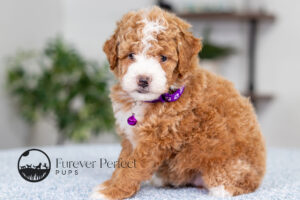

Maltipoo 101: What New Owners Should Know Before Bringing One Home
A Maltipoo is a toy dog first and a doodle second. That one fact explains most of what surprises new owners. The coat, the teddy-bear face, and the low shedding are what draw families in, but the daily realities of living with a Maltipoo come from its size: a puppy that may weigh under three pounds when it comes home, a mouth too small for all the teeth it is trying to hold, knees that carry a toy breed’s inherited risks, and a body with very little reserve when a meal gets skipped.
We raise F1 Maltipoos here in Millersburg, Ohio, alongside our Poodles and mini Bernedoodles. That means one purebred Maltese parent and one purebred Poodle parent, and it means we spend a lot of time with very small puppies. We weigh them, hand them to different people, trim their nails, and watch which ones nap in a pile and which ones go exploring. Much of what follows comes from that daily work and from the questions families call us with in the first few months.
This post covers where the Maltipoo comes from and why that matters, what size really means for a cross between two small breeds, the health issues a toy dog owner should know before the puppy comes home, what coat care looks like week to week, and how to set up the first weeks so a tiny puppy stays safe while it learns your household. We will be direct about the parts that complicate the picture, because a family that hears them now makes a better owner later.
Maltipoos tend to be affectionate, people-focused little dogs, and many families find them a wonderful fit. They are also a real commitment in grooming, supervision, and dental care, and they are not the right dog for every home. Both of those things can be true at once.
The Maltese is one of the oldest toy breeds, kept as a companion for well over two thousand years. The AKC breed standard describes a dog under 7 pounds, with 4 to 6 pounds preferred, and calls the breed gentle-mannered and affectionate while also eager and sprightly in action. In our experience that description holds up: Maltese parents tend to be people-oriented and content to stay close, with more spark than their size suggests.
The Poodle side brings the brain. Poodles placed second among all breeds in Stanley Coren’s research on working and obedience intelligence, and that trait shows up clearly in our Maltipoo litters. A Poodle-influenced puppy picks up routines fast, notices patterns in your day, and learns what works for it, which includes learning things you did not mean to teach. The AKC standard puts the Toy Poodle at 10 inches or under at the shoulder, and the Poodle Club of America describes the Miniature as 10 to 15 inches. Which Poodle variety sits behind a Maltipoo has a lot to do with how big that Maltipoo gets.
Put those together and you get a dog that, as a group, tends to want to be where you are. Families often describe their Maltipoo as a Velcro dog, and we use the phrase too. It is a lovely trait in a home where someone is around much of the day. It is a harder trait in a home where the dog is alone for nine hours, and it is worth thinking about honestly before you commit.
Why F1 Matters
An F1 Maltipoo is a first-generation cross: Maltese parent, Poodle parent, 50 percent of each. Later generations (F1B, F2, multi-generation) are bred from Maltipoos themselves and can be more uniform or less so depending on the program. We raise F1s. The tradeoff is that an F1 litter can show a real spread in coat type and size, because each puppy inherits a different mix from two different breeds. We tell families that up front and show them the parents so they can see the range that pairing is likely to produce.
Size is the question we hear most, and it is the one where marketing language does families the least good. Most of our Maltipoo litters are expected to land around 5 to 10 pounds as adults. A few pairings are planned a little larger, around 10 to 16 pounds, for families who want a dog that can handle longer walks and some hiking. Each litter listing on our Maltipoo puppies page shows the expected adult range for that specific pairing.
Those are estimates. Size in a cross depends on both parents and on which genes each puppy happens to inherit, so two puppies from the same litter can finish a few pounds apart. Anyone who guarantees an exact adult weight for a Maltipoo puppy is guessing with confidence, and we would rather give you an honest range.
The Truth About “Teacup”
You will see “teacup” used for the smallest Maltipoos and Poodles, and we use the word ourselves for our tiniest puppies. It is not an official size category. It is a description, and it should always come with an expected adult weight. A dog expected to finish at 4 or 5 pounds needs more careful handling, more frequent meals as a puppy, and more protection from falls and bigger dogs than a 12 pound Maltipoo does. Families should choose a very small dog because they are ready for that care, not because the word sounds appealing.
A common belief is that crossing two breeds cancels out their health problems. The research does not support that as a blanket rule. A large study by Thomas Bellumori and colleagues at UC Davis, published in the Journal of the American Veterinary Medical Association in 2013, compared more than 27,000 purebred and mixed-breed dogs and found no difference between the two groups in the rate of several inherited conditions, including patellar luxation and hip dysplasia. Mixing breeds can lower the odds of a recessive disease when the two parent breeds do not share it. It does nothing for a condition both breeds carry, and the Maltese and the Toy Poodle share several of the same toy-breed problems.
That is the real argument for health testing the parents. Here are the conditions we want every Maltipoo family to know about before their puppy comes home.
Luxating Patella
The kneecap slips out of its groove, which can show up as a skip or a few hopping steps before the dog goes back to normal. The American Maltese Association names luxating patella as one of the most common health problems in Maltese and many other toy breeds and describes it as primarily inherited. The Poodle Club of America includes a patellar evaluation, at a minimum age of one year, in its recommended screening for Toy and Miniature Poodles. Mild cases may never need treatment; severe cases can need surgery. Keeping your Maltipoo lean and limiting jumps off furniture are two things you control.
Dental Disease
Small mouths crowd teeth together, and crowded teeth trap plaque. A 2021 Royal Veterinary College study by Dan O’Neill and colleagues, using records from more than 22,000 dogs in UK veterinary practices, found that Toy Poodles had the highest odds of periodontal disease of any breed studied, close to four times the odds of crossbred dogs, and that the risk dropped as adult body weight went up. For a Maltipoo, that means tooth brushing is not optional. Start while the puppy is young, keep sessions short, and ask your vet to check the teeth at every visit.
Low Blood Sugar in Young Puppies
Very small puppies store little energy, so a missed meal, a chilly car ride, stress, or a long play session can drop their blood sugar quickly. The AKC notes that toy puppies are most vulnerable between about 6 and 12 weeks of age, with risk lasting up to around 7 months, and recommends feeding toy puppies four to five times a day until they are about four months old. Signs include weakness, wobbliness, trembling, and unusual sleepiness. Because our Maltipoos go home at 9 weeks, the first weeks in your home fall right inside that window.
Liver Shunt (Portosystemic Shunt)
A shunt is an abnormal blood vessel that lets blood bypass the liver. A review of 2,400 cases by Karen Tobias and Barton Rohrbach, published in JAVMA in 2003, identified the Maltese among the breeds at increased risk, and later research in Maltese has looked at how the condition is inherited. A puppy with a shunt may grow poorly, seem dull or wobbly after meals, or recover slowly from anesthesia. It is uncommon, but it is the reason we mention it: if anything about your puppy’s growth or behavior after eating seems off, your vet has simple blood tests to check for it.
Inherited Eye Disease
Progressive retinal atrophy, prcd form, is an inherited disease that slowly destroys the retina and leads to blindness. It is recessive, so a puppy can only be affected if both parents carry it. The Poodle Club of America’s December 2024 health statement calls for a PRA-prcd DNA test and an annual exam by a board-certified veterinary ophthalmologist, starting at one year, for Toy Poodles. A DNA test on the parents is how a breeder makes sure an affected puppy is never produced.
What Health Testing Covers, and What It Does Not
Our Maltese and Poodle parents are DNA tested through Embark or Animal Genetics for conditions including PRA-prcd, vWD1, and DM, and OFA tested once they are old enough. Each parent’s results are on their profile page, and our health testing page explains how it works. Testing lowers the odds of the conditions it screens for. It cannot rule out every problem, and it does not make a dog immune to ordinary illness, injury, or aging. Our written health guarantee spells out exactly what is covered, and we encourage every family to read it before reserving.
Neither the Maltese nor the Poodle has the seasonal undercoat that makes a Labrador shed in drifts, so Maltipoos tend to shed very little. That coat comes with a cost: hair that does not fall out keeps growing, and hair that keeps growing tangles. A Maltipoo coat ranges from soft and wavy to a looser curl, and almost all of them mat behind the ears, under the collar, and in the armpits if they are not brushed.
Many families come to us because someone in the home has allergies, and they have heard Maltipoos are hypoallergenic. No dog is truly hypoallergenic. Every dog produces the main dog allergen, a protein called Can f 1, in its skin, saliva, and dander. A 2012 study by Dorine Vredegoor and colleagues in the Journal of Allergy and Clinical Immunology measured Can f 1 in the coats and homes of so-called hypoallergenic breeds, including Poodles, and found no evidence that they produced less allergen in the home than other dogs. The authors concluded that no breed should be called hypoallergenic. A low-shedding coat can mean less hair spread around the house, which some mildly sensitive people notice. It does not protect someone with serious dog allergies.
A Realistic Grooming Routine
DAILY A quick brush-through with a slicker brush, then a metal comb to find any tangles the brush missed. Five minutes a day is far easier than an hour of dematting on Saturday. Wipe around the eyes, since light-colored Maltipoos often show tear staining.
DAILY Brush the teeth. Given the dental research above, this belongs on the daily list right next to the coat.
EVERY 4 TO 6 WEEKS Trim the nails. Our puppies have their nails trimmed from early on, so most go home already relaxed about it. Keep it up and it stays easy.
EVERY 8 TO 12 WEEKS A professional groom: bath, haircut, sanitary trim, and a tidy around the eyes and feet. A shorter “puppy cut” stretches the time between grooms and makes daily brushing faster.
The first weeks with a Maltipoo are mostly about structure. A tiny puppy does best with predictable meals, a quiet place to sleep, short training sessions, and supervision that keeps it out of trouble it is too small to survive. The good news is that a Poodle-influenced brain picks up a routine quickly once it has one.
- Feed small meals, often: Stay on the food the puppy came home on, and follow the AKC’s guidance of four to five small meals a day for toy puppies under four months. Do not let a young puppy skip a meal because it was busy playing.
- Keep the puppy warm on the trip home: Cold and stress both burn energy fast. A covered carrier, a soft blanket, and a short stop to offer food on longer drives all help.
- Block the drops: Couches, beds, and stairs are real fall hazards for a puppy this size. Use gates and a play pen, and teach children to sit on the floor to hold the puppy.
- Use a harness for walks: A small dog pulling against a collar puts all the pressure on its neck. A well-fitted harness spreads it out and is easier on a toy-sized body.
- Watch around bigger dogs: Even a friendly 60 pound dog can injure a 3 pound puppy with one paw. Supervise every interaction and give the puppy a space the bigger dog cannot reach.
Potty Training a Toy Dog
Small dogs have small bladders, and a Maltipoo puppy can go from fine to accident in minutes. That is the main reason toy breeds get a reputation for being hard to house-train. They are usually not harder to teach; they just give you less warning. Crate training, taking the puppy out first thing in the morning and about every two hours at first, and ringing a potty bell on each trip out all work well for Maltipoos. Our guides to crate training and housebreaking a Poodle apply almost word for word.
Socialization and Training
The American Veterinary Society of Animal Behavior (AVSAB) recommends that puppies begin socialization before their vaccine series is complete, as long as they have had at least their first vaccines and deworming and avoid places like dog parks where the vaccination status of other dogs is unknown. Their reasoning is that behavior problems, not infectious disease, are the leading cause of death in dogs under three years old. For a Maltipoo, good socialization means calm, positive exposure to new people, sounds, and surfaces, carried in your arms at first if needed.
AVSAB’s 2021 position statement recommends reward-based training only, and the evidence behind it is strong. A 2020 study of 92 companion dogs by Ana Catarina Vieira de Castro and colleagues found that dogs trained with aversive methods showed more stress behaviors and higher cortisol than dogs trained with rewards. In our experience, small sensitive dogs show this even more plainly. A Maltipoo that is scolded or jerked on a leash tends to get worried and clingy, not better behaved. Short sessions, small treats, and a marker word will get you much further.
At a Glance: Is a Maltipoo Right for Your Home?
| Factor | What Tends to Be True | What to Plan For |
|---|---|---|
| Adult size | Most of our litters are expected around 5 to 10 lb; some pairings 10 to 16 lb. | An estimate based on the parents, never a guarantee. |
| Temperament | Affectionate and people-focused; many are Velcro dogs. | Long hours alone are hard on a dog that wants company. |
| Shedding and allergies | Very low shedding coat. | No dog is hypoallergenic; all dogs produce Can f 1. |
| Grooming | Coat keeps growing and tangles easily. | Daily brushing; professional groom every 8 to 12 weeks. |
| Health watch list | Knees, teeth, puppy blood sugar, liver shunt, eyes. | Tested parents, daily tooth brushing, regular vet checks. |
| Young children | Can do well with gentle, supervised kids. | Smaller Maltipoos are easily hurt by falls and rough play. |
| Travel | Small enough to fly in the cabin on many airlines. | Airline rules vary; check carrier size and age limits. |
Frequently Asked Questions
Do Maltipoos bark a lot?
They can. Both parent breeds are alert little dogs, and the AKC notes that Poodles are more likely to bark than many breeds. In our experience, a Maltipoo that barks constantly is usually bored, under-socialized, or has learned that barking gets attention. Plenty of exercise for the brain as well as the body, rewarding quiet, and not letting a puppy perch at a front window all day go a long way. Expect a Maltipoo to tell you when someone is at the door; expect a well-raised one to stop when you ask.
Can a Maltipoo be left alone while we work?
Most adult Maltipoos can learn to handle a few hours alone, but this is a breed mix that tends to want its people close, and a full workday alone every day is hard on many of them. If your household is empty for long stretches, plan on a midday visit, a dog walker, or daycare, and teach alone time gradually from the first week rather than all at once on your first day back at work. Young puppies also need to eat and go out far more often than an eight-hour absence allows.
How long do Maltipoos live?
Small dogs tend to live longer than large ones. The AKC lists a life expectancy of 12 to 15 years for the Maltese and 10 to 18 years for the Poodle. A Maltipoo from health-tested parents, kept lean, with good dental care and regular vet visits, has a good chance of a long life. No one can promise a specific lifespan for any dog, and we will not, but the choices you make about weight, teeth, and vet care add up over those years.
Can my Maltipoo fly in the cabin with me?
Many Maltipoos are small enough to fly in an under-seat carrier, which is one reason families who travel choose them. Each airline sets its own rules on carrier size, pet weight, minimum age, and how many pets are allowed per flight, so check with your airline before you book. If you live far from Ohio, our flight nanny service brings your puppy home in the cabin, never in cargo, with one person caring for it the whole way. The details are on our puppy transportation page.
Are Maltipoos good with kids?
They can be very good with gentle, supervised children, and many of our Maltipoos go to families with kids. The bigger risk usually runs the other way: a toddler can hurt a 5 pound puppy by squeezing, dropping, or falling on it, and a puppy that gets hurt can learn to be afraid of children. Have kids sit on the floor to hold the puppy, teach them to let it walk away, and supervise every interaction. If your children are very young, a pairing on the larger end of our range may be the better fit.
What does Furever Perfect Pups do to prepare puppies before they go home?
It starts with the parents. Our Maltese and Poodle parents are DNA tested and OFA tested once they are old enough, and their results are posted on their profile pages. From day 3 through day 16, every puppy goes through Early Neurological Stimulation, short daily handling exercises meant to help puppies handle stress and new experiences, along with Early Scent Introduction, a new scent each day from a scent tin. After their eyes and ears open we add household sounds, new textures, the crate, and the leash, and we handle them constantly so they are relaxed for nail trims, the groomer, and the vet. That is all part of our ENS pre-training program, which gives families a puppy that already knows the basics of being handled and crated. At six weeks an independent professional trainer evaluates every litter and writes each puppy’s description. Our Maltipoos go home at 9 weeks, and the conversation does not end there. Families call us at twelve weeks with potty questions and at nine months with teenage-dog questions, and we are glad to take both, because buying a puppy from us means gaining a lifelong resource.
Final Thoughts
A Maltipoo can be one of the easiest dogs to love and one of the most rewarding to live with. There is a lot of personality packed into a very small dog. But the size that makes a Maltipoo so portable is also what makes the first months more delicate, the teeth more work, and the knees worth watching.
If you go in knowing that, the rest is manageable. Choose a puppy from parents whose health testing you can see, plan for daily brushing of both coat and teeth, feed a young puppy often, and train with patience and rewards. Then you are set up for the long, close companionship that brings most people to this little dog in the first place.
When you are ready to look at upcoming litters, our Maltipoo page shows each pairing with its expected size, and we are always happy to talk through which one fits your home.